
Albany Navy veteran recalls World War II service in the Pacific
Staff Photo: Tom Seegmueller
By Tom Seegmueller
[email protected]
ALBANY – On June 9, 1944, Bill Abell’s mother had to sign for him to join the United States Navy at the age of 17, joining the more than 16 million Americans who would serve during World War II.
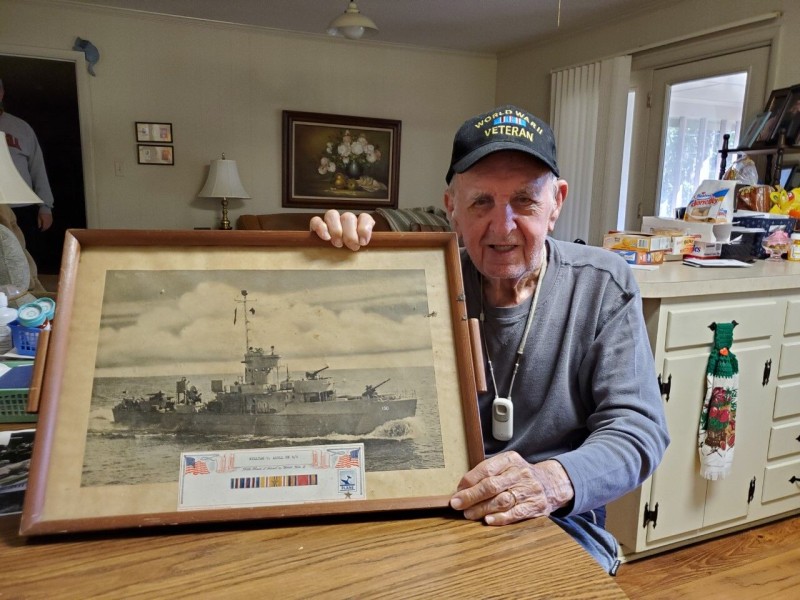
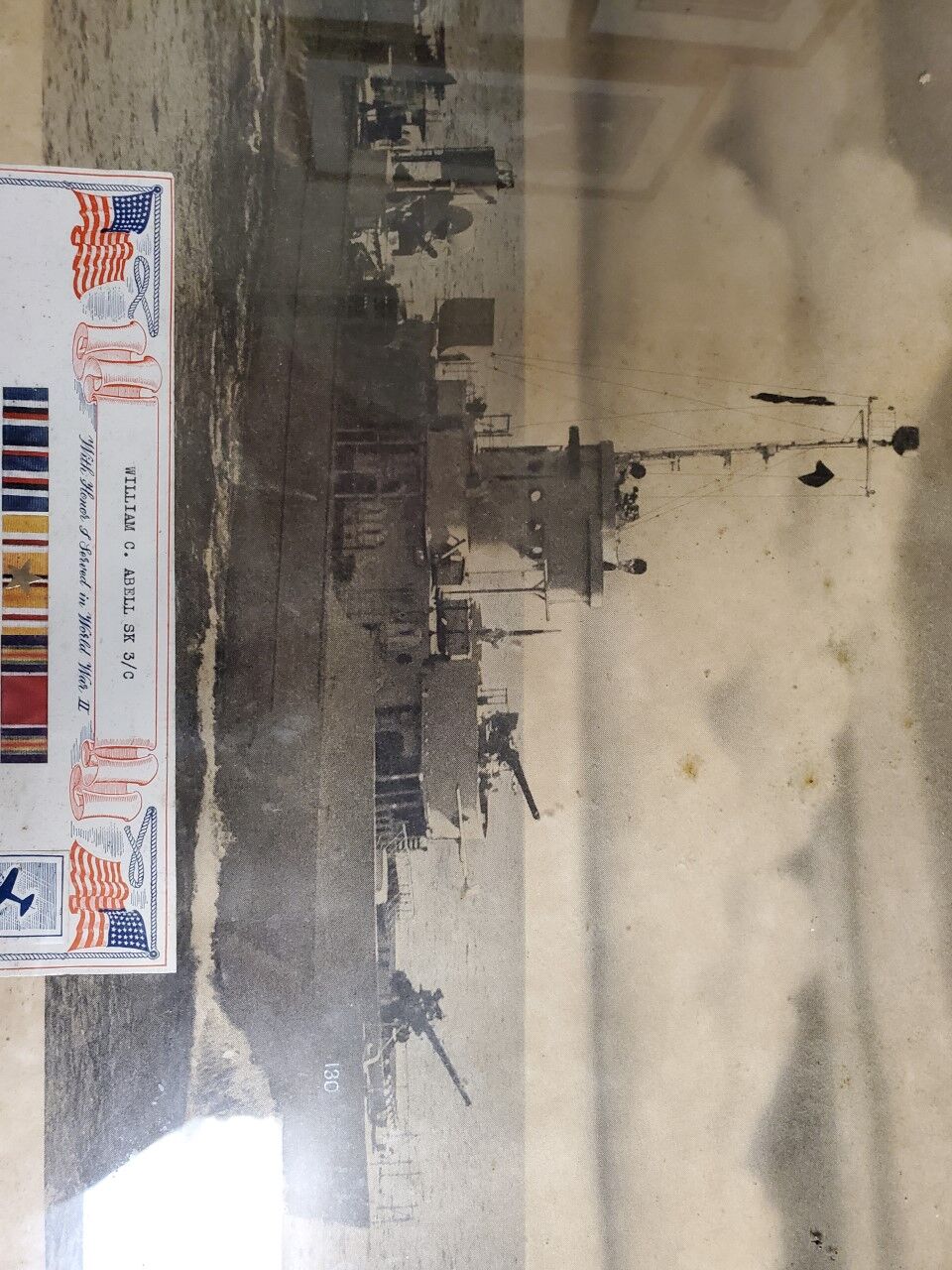
“I got in the Navy just before I turned 18 years old; there’s the ship I served on,” Abell said, pointing to a picture on the table beside him in his Albany home. “That’s an LCSL It was converted from an LCI, which was a Landing Craft Infantry with ramps on the side. They made gunships out of them.”
Three shipyards would produce 130 of the ships that would retain the flat bottom and shallow draft of the original ship, allowing it to safely beach, a feature that would prove to be significant for Abell.
It is also notable that an entire ship could be built in 10 days, with final fitting and stocking taking a few weeks longer. The ships could be armed in a variety of configurations.
“This ship had three twin 40s and four 20 mm (guns),” said Abell, who served onboard officially as gunner’s mate third class. As such, Abell’s ability to type saw him fulfilling the roles of yeomen (a navy petty officer performing clerical duties) and quartermaster. “I went through boot camp at Camp Perry, Virginia, then went to Fort Pierce, Florida, for gunnery school, then back to Little Creek, Virginia, for another school,” the World War II veteran said as he talked about his service. “From there, we went to Boston, Massachusetts, where the ship’s company was formed. We picked up our ship and came down through the (Panama) Canal Zone, then to Pearl Harbor. We stopped at Eniwetok in the Marshall Islands to refuel.
“We did plane guard duty for the USS Antietam and carriers there. They didn’t have helicopters back then, so when the guys went into the drink when they tried to land, we were there to get them. In March, we formed around Guam to make the invasion of Okinawa. Early in April we started landing invasions on Okinawa. We were on the south side of the island. In addition to the gun mounts, we had what they called 5-inch rockets. We would go in about a thousand yards from the beach and fire the rockets onto the beach to explode any type of undetonated stuff.”
Following the support duty during the amphibious landing on Okinawa, the LCSLs were deployed to provide anti-aircraft cover against kamikaze attacks, to create smoke screens to hide the fleet when it was at anchor, and to perform “skunk patrols” for Japanese suicide boats.
A transcript of an article in the New York Times describes action on the picket line:
The Navy threw a ‘picket line’ across ‘Bogey Highway’ to keep Japanese ship breakers out of the Okinawa transport area. These picket ships fought the longest and hardest battle of naval warfare. They suffered the greatest losses in men and ships ever sustained by the U.S. Navy. But they fulfilled their mission in keeping the bulk of enemy aircraft out of the transport area where vital supplies for soldiers and Marines were being unloaded. It is no exaggeration to say that these little ships, which seldom have the chance for glory given to aircraft carriers and battleships, performed a major role in Okinawa, This thrilling story, which can be told for the first time now that the Okinawa Campaign is won constitutes an epic that will live forever in the annals of naval history.
The article goes on to detail how the gunnery skills of the crews on the picket line played a pivotal role in the battle’s success. During an 82-day period, the ships on the line were at general quarters more than 150 times. These alerts lasted for minutes or hours, with as many as 200 Japanese aircraft attacking at one time.
The picket line comprised destroyers, destroyer escorts and LCSLs.
“While we were out there on the picket lines, a destroyer was sinking and we went in to pick up survivors,” Abell said. “Oil was across the water. Our ship rammed the rear end of the destroyer and put about a 6-foot rip in our bow. We picked up 30-something survivors, and we took them to a hospital ship the next day.
“When those boys were in the water, the Navy had one-cell lights and whistles on the life vests, and you could see those lights and hear those whistles across the water. We had a small boat called a ‘wherry.’ and it would pick them up and bring them to our boat because we didn’t have high sides. We shot down two kamikazes but were only credited with one.”
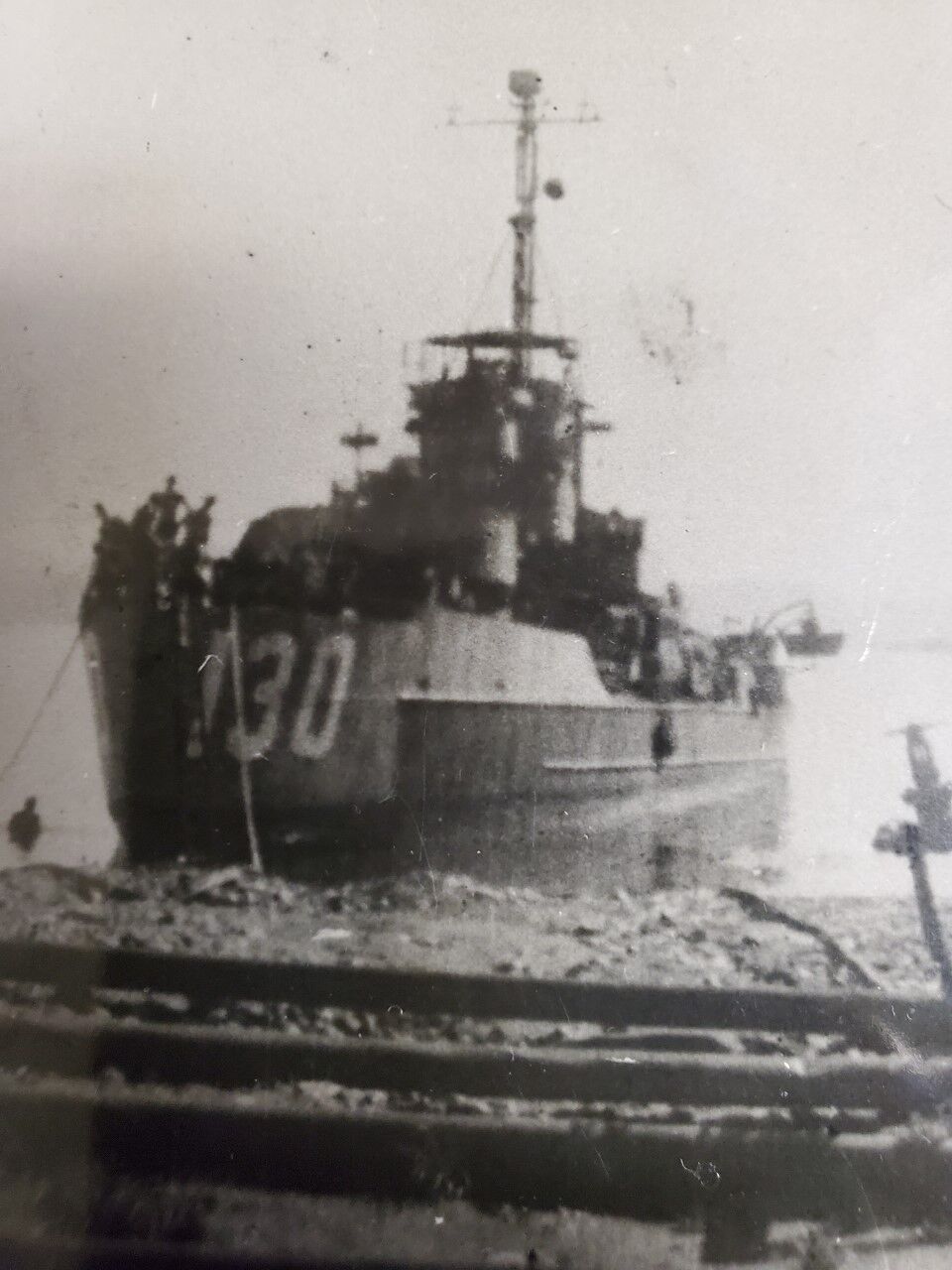
Abell explained how his ship’s flat bottom proved to be a saving grace as they were able to beach it on Okinawa at high tide and make repairs when the tide went out.
“We were back on the picket line after we got fixed up,” he recalled. “We were on the picket line when they dropped the atomic bombs. The Japanese didn’t know they had surrendered. It was about a month later that we got orders to go to Leyte Gulf in the Philippines for recreation and repairs for about three weeks.”
While he was on leave there, Abell got word that Chase Riddle, a friend from Jordan High School in Columbus, was also on a ship there. The two friends, who played on the school’s 1943 state basketball championship team, were able to reunite for a brief period before being redeployed.
“We got orders to go to Hiro Bay in Japan,” Abell said. “Minesweepers were cutting mines loose in the bay, and we would take our guns and bust them. We were there for about two weeks, then we came back down to Subic Bay for R&R. I understand it’s got to be quite a place.”
Abell would return to the States and make his way by train form San Diego to Eufaula, Ala., which was the closest station to Columbus. He was discharged in March 1946 and would join a group of high school friends playing college sports while seeking his degree. In 1950, he married Freda Bailey, going on to raise a family with her and chart a successful business career.
While serving in the Navy Reserve, Abell was recalled to active duty during the Korean War. The Navy wanted him in the Pacific, but he had had all the Pacific he cared for. Instead, he got a transfer to the beach at San Diego Naval Station.
Author

Related Articles
From cotton to cloud: In the data center debate, is rural Georgia once again being asked to carry the cost?
Across much of rural Georgia, the abandoned cotton warehouses and shrinking tax bases remain — enduring reminders that industries built to serve distant markets do not necessarily stay rooted in the communities that first sustained them.
My Grandpa Was Killed in World War II. I Met Him Through His Letters Home
Gina Wolf’s grandfather died before she was born. His letters sent to her grandmother from Europe during World War II made it possible to know what kind of man he was.
‘Sounds Like a Mutiny.’ Secret Recording Exposes Claims of Toxic Leadership After a Marine’s Suicide
This week’s War Horse story follows the systemic failures before and after the death of Cpl. Drew Mobley who was the third in two years at Marine Corps Base Quantico to die by suicide.
