
On Flag Day, a history of the red, white and blue
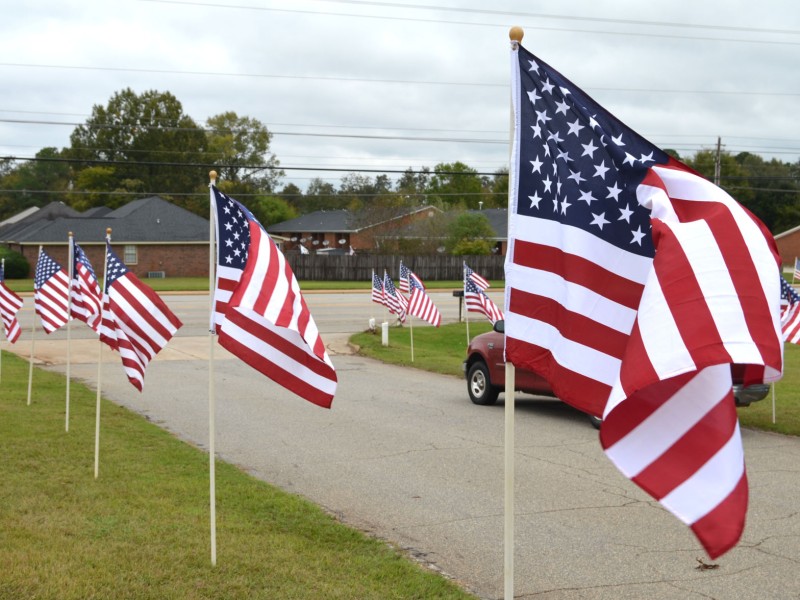
File Photo:Alan Mauldin
By Tom Seegmueller
tom.seegmueller
@albanyherald.com
“We take the stars from heaven, the red from our mother country, separating it by white stripes, thus showing that we have separated from her, and the white stripes shall go down to posterity, representing our liberty.” — George Washington, attributed
ALBANY — By definition, a flag is “a piece of cloth of distinctive sizes, color and design, used as a symbol, standard signal or emblem.” But flags are far more than a piece of cloth. They have been symbols of national identity since antiquity.
Their origin is unknown but generally accepted to be related to early military standards and field signs like those used by the Roman legion. Their roots can also be traced back more than 3,000 years to the Chinese Zhou dynasty, during which flags were considered sacred.
Flags are simple in their construction, consisting of four main parts: the canton, which is the upper inner section of the flag; the field, which is the entire flag minus the canton; the hoist, which is the edge of the flag used to attach the flag, and the fly, which is the edge furthest from the hoist.
However, there is no denying that flags are far more than mere pieces of fabric representing a national identity. The mere sight of the flag can stir our souls and express our beliefs and resolve … such as the emotions we experience when we see images of the raising of the American Flag by the United States Marines on Mt. Suribachi during the Battle of Iwo Jima on Feb. 23, 1945 … the image of the flag hanging from a steel beam at the World Trade Center immediately following 9/11 … or the image of the flag draped over Dave Christian’s shoulders as we celebrated the “Miracle on Ice” at the 1980 Winter Olympics.
Today the flag of the United States of America consists of a banner with a field of thirteen horizontal stripes – seven red stripes alternating with six white stripes. A canton designed as a blue rectangle in the upper left corner contains 50 five-pointed stars.
This banner can trace its roots back to 1737, when the colors were adopted from the British Union Jack to symbolize colonial unity. However, many earlier flags were used as colonists began to openly express their feelings toward rebellion. In the Southern colonies, a coiled Rattlesnake with 13 rattles frequently represented these feelings of unrest. Benjamin Franklin added further symbolism to this design by having the rattlesnake cut into pieces bearing the motto “Unite or Die.”
In 1775, the Continental Congress appointed a committee of revolutionary leaders to meet with Washington to design a universal emblem symbolic of their cause. On Jan. 1, 1776, he raised these “continental colors” on a hill outside Boston. At this time, most colonial leaders believed that there would be an eventual reconciliation with the crown. This flag displayed two prevalent political ideas of that day: the 13 stripes represented colonial unity against oppression and the Blue canton containing the British Union Jack expressing a continued union with Britain.
As the realities of the rebellion set in and a real understanding of the consequences of their actions against the crown became even more apparent, Congress again addressed the issue of a standardized flag. On June 14, 1777, Congress resolved, “The flag of the United States shall be 13 stripes, alternate red and white, with a union of 13 stars of white on a blue field.” Congress made no rule on the arrangement of stars; therefore, initially there were a variety of designs being flown.
In 1780, Francis Hopkins, a patriot, lawyer, Congressman from New Jersey and signer of the Declaration of Independence, asserted in a letter to Congress that he had designed among other seals and ornaments “the flag of the United States of America.”
Hopkins’ design called for the stars to be arranged in a pattern similar to the now unpopular outline of the Union Jack. This feature was not adopted and was replaced by the circular pattern that we know today. Tradition holds that Betsy Ross was commissioned by a secret committee that included George Washington to make what we recognize today as the “first” American flag.
As new states were created, they demanded representation on the flag’s canton. In 1795 Congress voted to increase the number of stars and stripes to 15 representing Kentucky and Vermont.
In 1818, five more states joined the Union, and Congress re-established the number of stripes to be 13 and “on the admission of every new state to the Union, one star be added to the union of the flag.”
When the War Between the States broke out, the flag contained 34 stars, including those of the seceding states.
The symbolic importance of the flag during this conflict is evidenced by the fact that when Congress created the “Medal of Honor” for recognition of distinguished gallantry in action, many of the recipients of the medals were awarded to Union soldiers who protected the flag or captured a Confederate banner.
In 1942, Congress established a uniform code addressing the proper display and handling of the flag, including that the flag be flown from sunrise to sunset when in the open. Today, flags may fly 24 hours a day if lighted between sunset and sunrise. The flag should be raised briskly and lowered slowly. It should be displayed daily, weather permitting. During a time of mourning, the president may announce that flags be flown at half-mast after first being raised to the pole’s peak, then lowered.
Ironically, a debate has followed the flag of the United States almost from the time it was adopted. Since the flag is a representation of the liberties and freedoms each citizen is entitled and afforded, should it be a punishable crime to desecrate this banner?
The first federal flag desecration act was passed by Congress in 1968 in response to protestors of the Vietnam War burning the flag. Over time, 48 of the 50 states passed some form of flag protection laws. All were overturned by the United States Supreme Court.
“We do not consecrate the flag by punishing its desecration, for in doing so we dilute the freedom that this cherished emblem represents,” Justice William J. Brennan wrote for the majority of the U.S. Supreme Court after its decision on July 3, 1989
Recent events will certainly revive these debates. Hopefully, those on both sides of the debate will take a moment to reflect and understand in the words of Sir Edward B. Hamley: “ A moth-eaten rag on a worm-eaten pole, It does not look likely to stir a man’s soul, ‘tis the deeds that were done ‘neath the moth-eaten rag, When the pole was a staff, and the rag was a flag.”
Author

Related Articles

From cotton to cloud: In the data center debate, is rural Georgia once again being asked to carry the cost?
Across much of rural Georgia, the abandoned cotton warehouses and shrinking tax bases remain — enduring reminders that industries built to serve distant markets do not necessarily stay rooted in the communities that first sustained them.

My Grandpa Was Killed in World War II. I Met Him Through His Letters Home
Gina Wolf’s grandfather died before she was born. His letters sent to her grandmother from Europe during World War II made it possible to know what kind of man he was.

‘Sounds Like a Mutiny.’ Secret Recording Exposes Claims of Toxic Leadership After a Marine’s Suicide
This week’s War Horse story follows the systemic failures before and after the death of Cpl. Drew Mobley who was the third in two years at Marine Corps Base Quantico to die by suicide.
