
As Georgia weighs ag education funding, Miller County students show what’s at stake for the region
As Georgia lawmakers and state leaders reconsider how parts of agricultural education and FFA should be funded, Miller County students had a message for the people making those decisions: In rural Georgia, separating agriculture education from the programs surrounding it is not as simple as separating a classroom from an extracurricular activity.

COLQUITT — As Georgia lawmakers and state leaders reconsider how parts of agricultural education and FFA should be funded, Miller County students had a message for the people making those decisions: In rural Georgia, separating agriculture education from the programs surrounding it is not as simple as separating a classroom from an extracurricular activity.
The students did not deliver that message through a policy presentation. They told their own stories.
That was the intent behind the Miller County FFA chapter’s Blue and Gold Social on Monday at Cotton Hall, according to Amanda Little Long, a middle school agricultural education teacher and FFA adviser who organized the event.
“It’s important that our regional and state representatives understand that in communities like Miller County and across southwest Georgia, FFA is not simply about preserving a school tradition,” Long said. “It’s about preserving part of the pipeline that prepares young people to sustain the region’s agricultural economy and the communities built around it.”
Middle and high school students spoke about livestock and tractors, agricultural mechanics and family farms. But they also spoke about grandparents and friendships, overcoming fears, learning to speak publicly and discovering careers they had never considered.
“FFA teaches us more than just agriculture,” MCHS FFA President Mason Horace said. “It teaches us leadership, responsibility, teamwork and the importance of giving back to our community.”
Those experiences carry particular weight as Georgia leaders reconsider how agricultural education is funded.
The state’s agricultural education budget has been the subject of an unusual back-and-forth between Gov. Brian Kemp and the General Assembly over where taxpayer support for agricultural education ends and private funding for FFA begins.
Last year, lawmakers included $268,157 in the Fiscal Year 2026 budget for camp-affiliated staff within agricultural education. Kemp directed the Georgia Department of Education not to spend it, arguing the money would pay expenses for existing administrative staff within the private Georgia FFA Foundation rather than expand services for students.
The governor’s FY ’27 budget proposal then called for eliminating that $268,157 altogether. Lawmakers responded during the 2026 session with a substantially broader investment.
The final budget passed by the General Assembly included $498,206 for support staff with language specifying that doing so would allow private funds to be prioritized for direct student services. Lawmakers also included $706,885 connected to extended-day and extended-year agricultural education programs, $591,965 for storm repairs at FFA camps and $325,051 for annual major repairs and rehabilitation at youth camps.
The final FY ’27 agricultural education appropriation totaled about $18.1 million in state funds.
Kemp signed the FY ’27 budget May 12 while directing state agencies to withhold more than $300 million in proposed new spending governmentwide because of declining revenue projections. He emphasized that those actions involved proposed new spending rather than reductions to existing programs.
The disagreement in no way undermines the state’s support for agricultural education or FFA. But it does raise a broader question at a time when rural school systems, farmers and families across Georgia are all facing increasing financial pressure: Where does state-funded agricultural education end and privately supported FFA begin?
In southwest Georgia, where the classroom, FFA chapter and agricultural community often function as one system, that line can be difficult to draw.
FFA may be described as a student organization, but Georgia’s agricultural education model extends beyond the classroom. The state’s Extended Day Grant Program funds agriculture teachers for work outside normal school hours, including supervising projects, preparing students for competitions, working with chapter officers, and providing FFA leadership and career-development opportunities.
For a student growing up in metro Atlanta, agricultural education may introduce an industry he or she has never encountered, but in much of southwest Georgia, students already live inside it.
Their parents grow peanuts and cotton, raise cattle or work for agricultural businesses. Their grandparents farmed. Their neighbors operate equipment dealerships, processing facilities, feed stores and agricultural service businesses.
That was evident as Miller County students took to the microphone Monday.
“Our community is built on agriculture and continues to be mostly agriculture to this day,” Jacob Smith told the audience.
Smith described learning to drive a tractor at about 4 years old, working with his father and showing livestock through FFA and 4-H. He said he hopes to continue studying agriculture and is considering becoming an agricultural attorney.
Neftali Caro said hearing her father’s stories about FFA convinced her to join. She said the organization gave her some of her closest friends while helping her develop public-speaking and environmental-resource skills.
Brantley Barefield told the audience he joined FFA partly to follow in the path of an uncle who had participated in the organization before his death.
Taken together, the students’ stories illustrated a cultural role that is difficult to capture on a state budget spreadsheet. In small agricultural communities, FFA can serve at once as career preparation, leadership training, community service, a social network and a bridge between generations.
The organization’s roots run deep in Georgia. From its founding in 1928, during the expansion of vocational agricultural education across the United States, Georgia established its FFA association the following year. Its infrastructure has also long involved both public and private responsibilities.
A 2025 state audit noted that the state and Georgia Association of Future Farmers of America have partnered in operating FFA camps since 1948. The audit found unresolved questions about whether the camps should be considered state entities and therefore subject to state financial-management requirements — another example of the sometimes complicated boundary between the public agricultural education system and the organizations supporting it.
But the distinction can look very different from a school agriculture shop or livestock barn than it does from the Capitol.
Millie Odom, a Miller County junior, described entering FFA without knowing what to expect. Participation in an agricultural career development event led her toward agricultural mechanics and eventually to an interest in engineering.
That progression — from classroom instruction to competition, hands-on experience, leadership development and eventually a possible career — illustrates why agricultural educators such as Long resist treating those pieces as separate programs.
“Agricultural education is made up of a three-ring model: FFA, classroom and lab instruction, and supervised agricultural experience,” Long said. “All of those parts carry equal weight. It makes FFA an intracurricular part of the learning process. One part can’t be done without the others. Just like in a community or ecosystem, all parts work and thrive together for the good.”
The General Assembly’s FY ’27 decision to put another $706,885 toward extended-day and extended-year agricultural education underscores that lawmakers have not abandoned that model. Instead, the emerging debate is about which pieces taxpayers should fund and which should be supported through private dollars.
For communities heavily dependent on agriculture, that distinction deserves attention because seemingly administrative funding decisions can ultimately determine who is available to organize, supervise and support the experiences students receive beyond regular classroom hours.
That may also explain why Miller County FFA leaders wanted elected officials and policymakers in the room Monday.
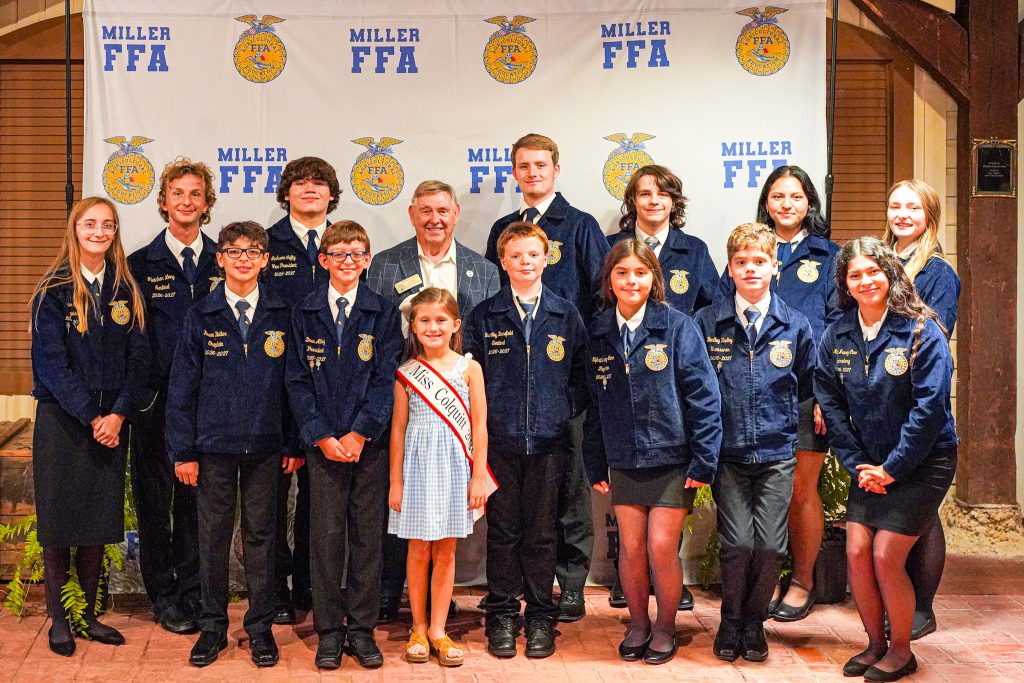
Gov. Brian Kemp and first lady Marty Kemp sent a prerecorded message to the Blue and Gold Social recognizing the chapter and FFA’s role in encouraging students to pursue careers in agriculture. Kemp also noted Georgia’s standing among the nation’s largest FFA organizations and credited schools, teachers and communities that recognize agriculture’s importance.
State Rep. Gerald Greene, congressional candidate Matt Day and Frank Griffin, vice chair of the Georgia State Board of Education and the board’s 2nd Congressional District representative, were among those who attended alongside local government, school and agricultural education officials.
The gathering served a purpose beyond celebrating the chapter. It gave students a chance to show the people who make or influence education policy what FFA looks like in practice.
Related Articles
PHOTOS: Albany State Freshman Leadership Academy
Click the arrow to scroll through the photos.

The 2026 Georgia ballot will include a lengthy list of statewide and local races
Having so many elections for some of the top jobs without an incumbent in the mix is a rarity
Dawson finance director resigns as city reworks troubled FY ’27 financial plan
Dawson Finance Director Dawn Williford resigned Friday as city officials work to revise the financial report presented to the City Council earlier this month and prepare a final fiscal year 2027 budget for public review. A high-ranking city official confirmed Williford’s resignation Friday. Additional details about the circumstances of her departure were not immediately available.
