
The making of a Nation: Independence Day celebration II
Special Photo
By Tom Seegmueller
[email protected]
ALBANY — Although the American war for independence had been won against the most powerful empire in the world, the fledgling nation now faced the challenge of creating a viable government and economy.
The country’s first national holiday, the 4th of July, found most Americans bursting with patriotic pride. A retelling of the achievements and tribulations was immediately forming a national identity. During the war, George Washington was often considered an ineffective commander and was accused frequently of failing to be aggressive. Afterward, he was cast as a hero and military genius.
Bells rang in every major city across the colonies except in Charleston, where the British had stolen them and melted them down for cannon fodder. Ships in every harbor raised their flags high and fired salutes, except those sailing under the Union Jack.
By the 1780s, there was no question that the colonies were independent. However, it was becoming apparent that the loose confederacy of 13 states was not an effective way to govern the new nation. As the states began to squabble over boundaries, fishing rights, and other issues related to state sovereignty the confederation was powerless to offer resolution.
A convention of states was convened to improve on the Articles of Confederation. The representatives would meet in Philadelphia for four months. Rhode Island refused to participate in the process. Fifty-five men worked to create a document that would both protect liberty and create domestic harmony. Although they did not succeed in drafting a perfect document, they did come up with one that created a more perfect union as well as a more refined standard of justice.
By 1787, some of the luster of independence had worn off, and it was not guaranteed that enough votes were available to adopt a drafted Constitution. Only 39 of the 55 delegates were initially willing to put their names on the document. A major point of contention for many was the idea of having a strong central government with the power to tax the states. Many felt that is exactly what they had fought to oppose just 10 years earlier. Others opposed it because the form of governance they favored was not included in the document. The New York delegation, with the exception of Alexander Hamilton, withdrew from the process.
On the final day of the convention, Benjamin Franklin rose and addressed the delegates.
“The older I grow, the more I am apt to question my own judgement,” he said, speaking for many of the delegates.
Having spent the majority of his adult life in Europe, Franklin knew that Britain was just waiting to hear that although the Americans had won the war, they could not govern their new country.
The process required nine states ratify the document. Slowly states began to sign on. Delaware signed first, recognizing the benefit of two Senate seats, regardless of size. Pennsylvania followed before strong opposition could be organized. Georgia and New Jersey were next. Connecticut, one of the states with a large population, followed. Maryland and Massachusetts ratified the Constitution with the proposition that a Bill of Rights be added. South Carolina ratified on May 23, and New Hampshire put things over the top on June 21, 1788.
Although the ratification process was complete, realists of the day knew that the Republic could not stand without the support of Virginia. There a heated debate continued over ratification with Patrick Henry leading the opposition. However, Virginia would ratify on June 26. New York would ratify the document on July 26. It would take a year or two for North Carolina and Rhode Island to come on board, in the case of Rhode Island, when the federal government threatened to cut off trade with the renegade state.
When word of Virginia’s ratification went out, Philadelphia and other cities began planning grand celebrations. South Carolina and Georgia did not learn of the ultimate ratification until after the Fourth. In Gorton, Mass., nine pillars were raised on the town square for the fourth of July and nine volleys were fired. They did not have news of Virginia’s ratification but celebrated anyway. In Albany, N.Y., where news of Virginia’s ratification arrived on July 3, officials agreed to a celebration with 13 cannon volleys.
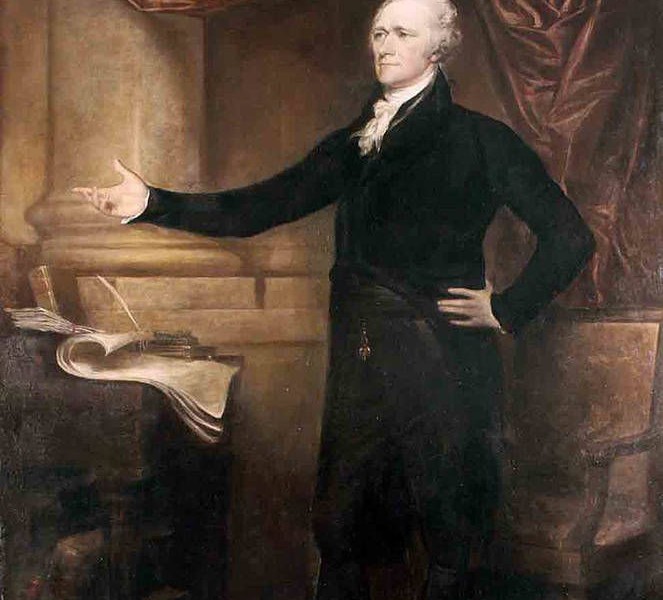
The political atmosphere of the early 1800s might mirror todays contention. Two parties formed around the personalities of two candidates: Jefferson and Hamilton. Jefferson, founder of the Democratic-Republican Party, was the aristocratic Virginian with visions of an agrarian democracy. Hamilton, the Federalist, was the illegitimate son of West Indian parents and had served with valor under Washington during the revolution. He was a financial genius when such skills were rare and served as Washington’s Secretary of the Treasury.
Ironically, it was Hamilton who feared the rule of a revolutionary mob, believing the young democracy could only survive under the direction of a governing elite and that the young nation should become a nation of manufacturers and merchants.
The ensuing campaign was a bloodbath, both literally and figuratively. Epithets of “French agent, tyrant, monarchist, and atheist” were cast about. The contention led to the infamous duel between Arron Burr, who was insulted when Hamilton called him a dangerous man. When the two met on the “field of honor,” Hamilton’s death ended the career of two leading political figures of the day.
Contention was so heated that in many towns members of opposing political parties would not sit together for dinner and the ensuing celebrations.
There was no standardized celebration. Some towns arranged for church bells to ring in synchronization for an agreed-upon period of time. If cannons were available, they were fired. If a military post was located nearby, the troops might parade in formation. Many churches organized celebrations for their congregants and parishioners.
The need to have patriotic orations at organized dinners became more prevalent as political parties realized the benefits of tagging their message into these patriotic celebrations.
Immediately following the ratification of the Constitution, most 4th of July celebrations favored the Federalist Party, which triumphed during the ratification process. Americans with anti-Federalist views organized their own dinners and celebrations in an effort to ensure the national holiday did not become a Federalist holiday.
Fireworks became a more common component of these celebrations as a result of improving economies across the nation. Boston had its first fireworks celebration in 1805.
Going into the early 19th century, political division continued to grow. The rights of American sailors were being violated by both the British and French navies, while the two nations were at war against each other.
Federalist New Englanders wanted to settle these differences with England at the bargaining table so trade would not be hurt. The Southern and Western states wanted a war that would give them access to Florida, Canada, and the Northwestern Territories. In frontier settlements, where any Federalist intervention was likely to be far away, celebrations of American nationalism were more common.
Americans living precariously outside the established borders of the country were certainly in favor of expansion, hoping their settlements and property would become part of the United States.
In 1826 grand celebrations were planned to celebrate 50 years of independence. A half a century of overall stable governance and growth of the fledgling nation flew in the face of European skepticism expressed when the nation was born. The 13 colonies had grown to 24 states and a number of western territories and were still expanding.
Author

Related Articles
Albany Herald – July 18, 2026
Georgia Trust for Local News partners with… Adult leadership group spreads concept to… Lee County homeowners have until Aug. 1 to claim…

Classifieds – July 18, 2026
Classifieds; Legals;

Albany police make arrests in murder, robbery cases
Officials with the Albany Police Department have announced a number of arrests in cases that involved a homicide and a pair of thefts.
