
Albany Utility Board says no to city manager utility approval proposal
Carlton Fletcher
ALBANY — The Albany Utility Board threw a symbolic monkey wrench into City Manager Sharon Subadan’s proposal to allow her to sign off on certain utility projects without Utility Board or Albany City Commission authorization at a special called meeting Monday afternoon.
The request to allow for city manager authorization, under state contract, of utilities projects up to $100,000 without consent of the two governing bodies surprisingly died for lack of a second. Board member Bob Hutchinson made a motion to accept the proposal, but neither Judith Corbett nor the Rev. Gary Sanders offered a second to that motion.
Board member Jay Sharpe had an emergency and was unable to attend the meeting.
Mayor Dorothy Hubbard, who serves as chairwoman of the board, waited for a matter of minutes while staff explained specifics of the proposal, but neither Corbett nor Sanders budged.
“It happens,” Subadan said after the meeting. “This item is still on the commission’s agenda, so it will be brought up tomorrow.”
Asked if she had any idea why neither Corbett nor Sanders offered a second to the motion, Subadan shrugged her shoulders and said, “You’ll have to ask them.”
Corbett, who had expressed concern that “we still don’t know what our role is” during discussion of the matter, said after the meeting she’s still seeking clarity.
“From my perspective, I want to engage in this process, but I need to understand what my input means,” Corbett said. “This (proposal) makes a certain amount of sense, but this is adding a level of bureaucracy for someone who already has all those balls in the air.”
Sanders, who replaced Ward IV City Commission candidate Chad Warbington on the Utility Board when Warbington stepped down to focus on his political campaign, was attending only his third meeting. But he was adamant in his refusal to support Subadan’s proposal.
“It’s not so much that I am opposed to this, it’s more a matter of needing more clarity on where this board stands,” Sanders said.
Corbett had asked Subadan during discussion if she would come to the Utility Board before any projects were approved under the proposal, but the city manager told her Utility Board members would be notified after the fact usually.
“If we publicly air our plans, we lose any competitive advantage we might have,” Subadan said.
Asked by Corbett what the Utility Board’s role might be if it had no say in approval of such projects, Subadan said, “I see this board’s roll as an advisory one. We will rely on you to advise us on what kinds of projects we might need to focus on, whether we need to put more emphasis on gas or telecommunications. And I would update this board periodically once these (utility) projects are in progress.
“If we keep our plans quiet until we’ve signed a contract, no private industry can come in and stroke a check and take a project away from us.”
Hubbard told board members she was sold on the proposal because it falls under state contract.
“The state’s not going to allow anything to move forward that is not done properly,” she said. “That solidifies it for me.”
Assistant City Manager Phil Roberson said Albany State University, the Georgia National Guard and the Georgia Department of Transportation use a similar program in approving contracts.
Since the Utility Board is a recommending body only, the Albany City Commission will have final say on Subadan’s proposal. City commissioners will address the issue at a special called meeting Tuesday.
Related Articles
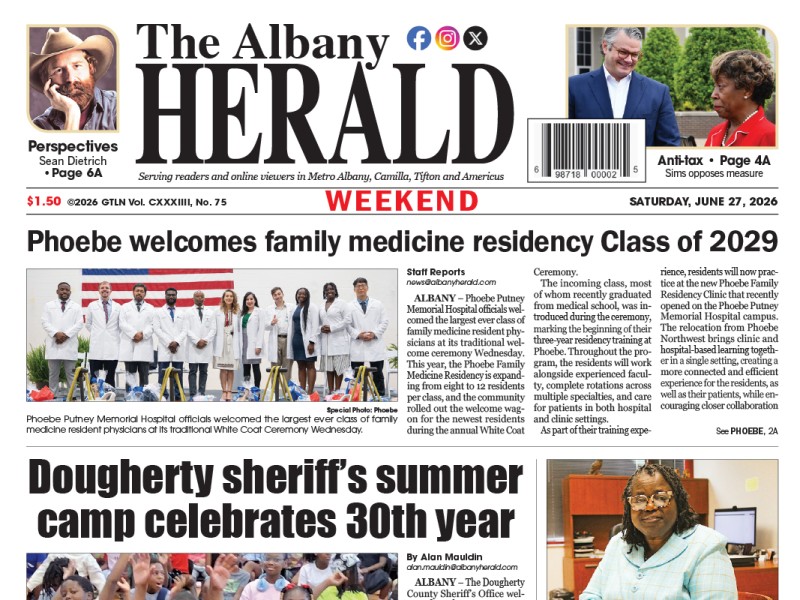
Albany Herald – June 27, 2026
Phoebe welcomes family medicine… Dougherty sherrif’s summer camp celebrates… For Community Care Department head Debra Wiley…

Special Sections – June 27, 2026
Interesting facts related to Independence Day,,, Fire up true American flavor on the grill… The nicknames of all 50 states… 9 facts about the Declaration of Independence…

Classifieds – June 27, 2026
Full Time Job: Women’s Recovery & Substance Use Services Director… Real Estate for Sale: 230 Frost St…
