
Behavior analyst says need for autism services great in area
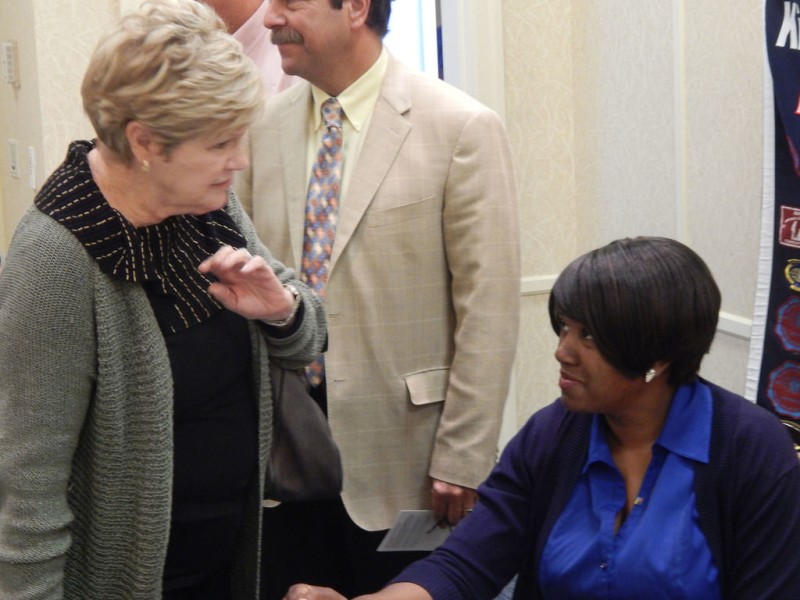
Katrina Beckham shares autism data with Kiwanis club members
By David Shivers
ALBANY — Autism is a behavioral disorder that can isolate children, but there is hope if intervention can be accessed, the Kiwanis Club of Dougherty heard recently.
Behavior analyst Katrina Beckham, a mother of four ranging in age from 8 to 24, says she has worked in the field of developmental disabilities for 17 years and described working with the autistic as her “true passion.” She owns Beckham Behavior Consulting and provides services to school districts, private and public agencies, and families in Southwest Georgia and North Florida.
In the United States alone, Beckham said, autism “affects one in 58 children, and it affects boys five times more than girls.”
She said, “There is still no resource that has identified what actually causes autism. There are some theories associated with (potential genetic causes) and various environmental factors that may contribute. There are many families currently dealing with the challenge of getting services for their children with autism, especially here in Southwest Georgia.”
She added, “There’s just not a lot of specialized services when it pertains to behavior in children with autism. There are also a lot of federal mandates in limiting funding for services as they pertain to insurance. There have been some federal mandates that have come into play to try to get insurance companies to pay for services.”
After eight years of lobbying the Georgia Legislature on the issue, some result was finally achieved, but Beckham said “it wasn’t what we really wanted. We ended up (with service consumers) having to pay something, which is better than having nothing.”
Beckham emphasized that “there are some families who are able to access services, but there are many families who are still not able to access the services that would potentially be life-changing for their children.”
Beckham said, “Many children with autism have limited social skills. They can’t have a conversation like you and I. There’s not the back and forth reciprocity that we would typically see, so that limits their ability to make friends. It can limit their ability to have normal relationships. Also, sometimes they engage in peculiar behavior. If you come into contact with a child with autism, you can’t always look at them and know (they are autistic); they look just like you and I and our children. However, if you interact with them you will notice that they have some limitations that pertain to social interaction.”
The result many times is “they tend to live a life that can be isolated, unless their family can access services so that we can give them proper training (to) reach their full potential,’ which is why intervention is important.
“There continues to be a need for awareness,” Beckham said, as well as “a need for understanding and support for these families.”
Related Articles

James Rubino installed in new role at Marine Corps Logistics Command in Albany
James L. Rubino recently assumed the role as executive deputy of Marine Corps Logistics Command in Albany. In his new role he will oversee integrated logistics support.

Rain depresses voter turnout in Dougherty County
“A lot of people don’t vote when it’s raining. People don’t do a lot of things when it’s raining.”
City of Albany faces shortfall for police, fire salaries
“We can’t tell staff to hire more police officers and then complain at what it costs.”
