
Organ donation offers second chance at life
Education efforts on organ donation ongoing in Southwest Georgia
By Jennifer Parks
ALBANY — When someone talks about giving the gift of life, the mind is often drawn to blood donations. But there is another method of giving such a gift for which there is still a dire need to raise awareness.
LifeLink Foundation has the monumental task of getting the word out on the importance of organ donation, addressing myths about the process and recruiting potential donors who might be destined to have a part of themselves live on in another person.
Carla Hawkins, education specialist for LifeLink, is among those tasked with educating the public on the importance of organ donation. The organization facilitates organ donations so that when an organ donor passes away and they are a match to a recipient, the recipient gets the organ he or she needs.
Hawkins has the duty of educating the multicultural Southwest Georgia community through donor drives, workshops and presentations at various venues. The group’s current focus is on minorities, who are less likely to consent to donation, Hawkins said.
“We make sure the general public understands it’s about giving someone a second chance in life,” she said.
The donation process involves a hospital identifying a potential organ donor and contacting LifeLink, which meets with the donor family to discuss and confirm donation plans. A donor’s medical and social history is thoroughly reviewed, matches are found, and organ and tissue recovery begins. Donor organs are matched on a waiting list, and the search for transplant recipients begins.
Hawkins said a general shortage of organs exists, as many who wish to donate turn out to be ineligible due to illness or a history of smoking and drinking, further prompting the need for education on healthy living.
In the African-American community, there exists a high prevalence of blood pressure problems and diabetes, leading to a potential need for dialysis and a kidney transplant. For tissue matching purposes, a donor is needed from the same ethnic background, Hawkins said.
“African-Americans are not as educated,” she said. “There is a critical shortage of kidneys, and they end up on dialysis longer. Eighteen people pass away daily waiting.
“(A recipient) can live longer through others. It helps others in the grieving process to know that.”
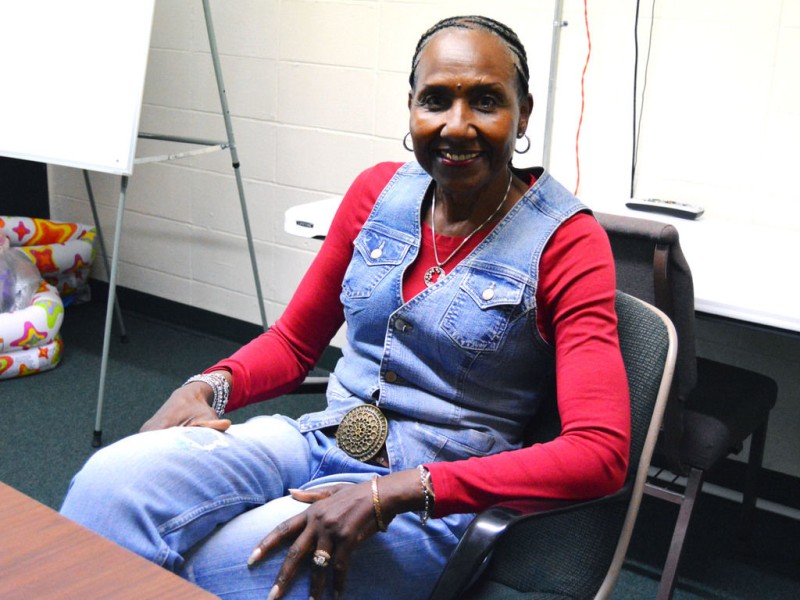
Peggy Lyons was one such individual. In 1968, after her son was born, her liver enzymes elevated. At first, that was determined to be a normal postpartum side effect. The enzymes remained the same until 1996, and after a surgery the same year, the enzyme level increased again.
Bloodwork was sent everywhere. Even the team at Emory Healthcare could not figure it out. In 1998, Lyons was diagnosed with idiopathic liver disease, meaning she had a diseased liver with no known cause.
“Whatever was going on (with my liver), if we didn’t find an answer it would be (like) a freight train going downhill with no way to stop it,” Lyons said.
Ultimately, her condition lead to cirrhosis. The only way to fix the problem was with a transplant. In May 2000, the congregation at Greater Second Mount Olive Baptist Church was called on to participate in a 30-day fast while an answer was sought for Lyons’ plight.
In the weeks that followed, she found it difficult to go to church because of her pain. Shortly before midnight on the last day of the fast, a phone call from a stranger who had heard about Lyons’ condition directed Lyons to the Mayo Clinic in Jacksonville, Fla.
Lyons decided to give it a try. Emory told her she could not take advantage of more than one transplant list, so Lyons cut her ties with Emory and placed her trust in the Mayo Clinic.
In October 2000, Lyons had her first appointment at the Jacksonville facility and started the process of waiting. She finally got a letter the following December saying to come in on Jan. 15, 2001.
By then, there was a strong sense of urgency.
“When we got there (for the appointment), my liver stopped working,” she said.
The doctor at the Mayo Clinic saw Lyons’ numbers and determined she needed to be moved to the top of the waiting list. She was sent back to Albany with a beeper. Her husband, who was unaware her liver was not functioning, had to go into work the next day.
They got back home and she was about to break the news about her liver to her spouse when she drifted off to sleep. At 2 a.m. on Jan. 16, the Lyonses got a call saying they had a donor liver, and they immediately headed to Jacksonville. They managed to get there with just a few minutes to spare. The medical staff immediately got her on a gurney and removed her clothes.
“I was fearful because I did not know what to expect,” she said.
More than six hours later, Lyons woke up and learned the surgery had gone perfectly. She went home on Valentine’s Day, almost a month later.
“It has been an absolutely wonderful journey, (although) I certainly would not have chosen that journey,” she said.
Since that time, Lyons has dedicated a lot of her time to education of others on the cause of organ donation. In her efforts, she has heard a number of misconceptions about the process: Some still think it is experimental, and others think registering as an organ donor means a doctor will be less motivated to save a life.
“This is a viable way for people to live,” Lyons said. “Too many of us are missing an opportunity because too few are willing to donate. Even in our dying, we can help others to live.
“It is a way to help loved ones to live longer, and not just longer, but a better quality of life. I have two grandchildren I would not have seen. God has used me in ways I’d never imagined.”
During the extended life she has been given, Lyons has also worked in ministry, has worked as a radio personality, done fitness instruction and assisted with children’s summer camps.
The message she offers is that nobody knows whose family organ donation is going to impact until it happens. The family of her donor, who turned out to be a 4-year-old boy, learned that, and Lyons later had the opportunity to meet the boy’s mother in Atlanta and make a connection.
That mother had the difficult decision to make on whether to share what her son had left to give. Looking at Lyons now, no one would know what she went through because she has come a long way from the days when she was suffering from cramps and hemorrhaging.
If that mother had not made the decision she did, Lyons would not be here now.
“You never know if you would be willing to do the same thing unless you are faced with it. I hope I could make the same (decision),” Lyons said.
She has also been fortunate to not have problems with rejection, further adding to the improved quality of life.
“I’m saying to please consider it because it really does make a difference in the the life of the person receiving it,” Lyons said.
She has tried to spread the word by visiting schools and workshops emphasizing that it is a viable medical procedure for helping someone and spreading the mindset that donation is a good thing to do. Someone in a trauma will not get substandard care if they are registered as an organ donor, she said.
“It does change the quality of life for so many,” Lyons said. “There are so many waiting, and so few willing to give. I’m going to continue to talk and teach, because it is a viable answer. (The community has) to get on board with it.”
Hawkins said that donor drives are often held in venues such as the Albany Government Center, Albany State University and movie theaters in the community. Donors can sign up on the spot, and the individual’s information is uploaded to the donor registry.
Lyons said a faith-based film called “The Wish” is shown at some events to ingrain the message of organ donation.
A “Walk for Life” is held every April at Darton State College that typically draws up to 500 people.
The Association for Multicultural Affairs in Transplantation and Donate Life America joined forces last year to develop Donate Life ECHO (Every Community Has Opportunity) that will be celebrated July 10-23 as a nationwide observance designed to reach multicultural communities.
Hawkins said that on July 16, while that observance is ongoing, a community day at the Walgreen’s at 2351 Dawson Road is set to help get the message out on ECHO.
“The need is great,” Hawkins said. “The need for transplants is constantly increasing. We are hoping one day it balances out if the numbers of donors steadily increase.
“We are always looking for volunteers, or opportunities to get the word out.”
Officials from LifeLink said there were 574 organ donors in 2014-15 in Florida, Georgia and Puerto Rico, and during the same timeframe, 1,700 organs were transplanted. In 2015, there were 59,506 lives improved through transplantation of LifeLink Tissue Bank tissue grafts.
LifeLink says there are currently about 121,000 waiting for organs.
Hawkins said more people are needed to get involved to let the community know about LifeLink and the cause. To get connected to the Southwest Georgia effort, contact Hawkins at (229) 291-7457 or [email protected].
For more information on organ donation, visit lifelinkfoundation.org or donatelife.net.
Related Articles

Albany teen, 16, makes bodybuilding debut at Atlanta OCB Pro/Am
Crockett, an Albany resident and student at Albany Technical College Academy, placed second in the teen bikini division this weekend at the OCB Immortal Muscle Pro/Am Bodybuilding Competition in Atlanta, becoming the youngest competitor across all categories at the event.
Phoebe opens new urgent care clinic in Camilla
Phoebe Putney Health System has expanded its network of urgent care clinics by opening a new location in Camilla.
Colquitt Regional introduces new heart failure treatment
Colquitt Regional Medical Center recently announced a major advancement in its cardiac care services with the introduction of the biventricular implantable cardiac device (ICD)
