
Lee commissioners hold Oxford to original repaving contract
Oakland Road repaving moves forward, no new money spent
By Brad McEwen
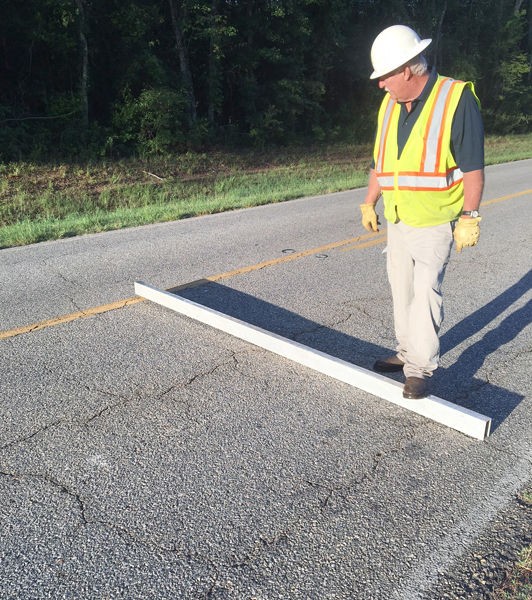
LEESBURG — After asking the Lee County Commission for additional funding to complete the repaving of Oakland Road last week, Oxford Construction was informed Thursday morning that the board is holding the company to its original bid contract and will not approve additional change orders for completion of the project.
Commissioners voted unanimously at a special called meeting to follow the recommendation of staff and not approve a change order that would have given Oxford an additional $155,000, on top of the $440,204.38 the company originally bid, to repave the major county artery. In doing so, the commission also informed the company of its expectation that the work be completed to Georgia Department of Transportation standards for the amount of money agreed upon in the original contract.
Interim County Co-Manager Mike Sistrunk explained to Oxford Project Manager Jay Griffith that, after conferring with County Attorney Jimmy Skipper, he felt that Oxford had enough time prior to submitting a bid, and after the bid was awarded, to determine that the road needed additional leveling work and that more asphalt would be needed to complete the project.
“The only concern I have is that all this should have been considered when the bid was put out,” said Sistrunk. “When the bid was put out, everybody had the opportunity to go look at these roads to work up a number to do this with. And all we’re asking is to go back to the original contract.
“That road has been there since you bid on it back in January and we got a call from y’all five, six hours before a commission meeting Tuesday night that said there’s a change order for $175,000. You had six months to find any issues.”
Griffith did not dispute the time frame the company had to inspect the road, but did remind Sistrunk and the board that Oxford’s bid was based on the quantity of materials the county had estimated it would take to repave the road, and that the additional money is needed to purchase additional materials beyond what was estimated.
“It’s a unit price contract,” said Griffith. “This has nothing to do with price, this is quantity. If I went out and confirmed the (quantities) on every contract I bid, I wouldn’t have time to do anything else. That’s not our responsibility. I would say it’s your responsibility to do your due diligence and make sure your design’s correct.”
Sistrunk then explained that the county had not done any design work on the road prior to issuing the bid requests, which subsequently helped clear up some confusion stemming from last week’s county commission work session. Due to a clerical error, some of the documents in the original bid package said EMC Engineering had done engineering and design work for the county in regard to the repaving request for proposal, when in fact the company had not been involved.
After that work session, former Lee County Engineer Matthew Inman, who had been in that role when the repaving RFP was prepared, informed the county that he had used a standard document he had always used during his time with EMC when preparing the RFP, and that the document had not been changed to properly reflect that the RFP specs had been done by his office.
Inman also stated that when preparing that RFP, and previous RFPs, his office used the standard process of preparing the bid specs based on prior road work that had been done in the county. He said that was standard for most municipalities, and he also stated that it was not uncommon for project specs to be altered as contractors went through the bidding process. But typically not so long after the contract had been awarded.
Ultimately, it was Sistrunk’s contention that because there was ample time for Oxford, and the other companies that bid on the Oakland Road work, including Reeves Construction and Jim Boyd Construction, to have discovered issues with the road that the company needed to stand by it’s original bid.
In fact, Sistrunk referenced a similar situation in which Jim Boyd Construction won the contract to build the Marlow Lane extension elsewhere in the county, and the county had to deny a change order based on a mistake or misunderstanding on the part of the contractor.
“We held them to the same standard,” said Sistrunk.
When the four commissioners present Thursday morning — Rick Muggridge, Dennis Roland, Luke Singletary and Billy Mathis — all agreed with Sistrunk, Griffith said that it would “be almost impossible” to complete the road for the amount of money in the contract and that Oxford “could not guarantee” there would not be issues like water standing in the road because the proper leveling was not done.
Sistrunk, along with Muggridge, then reminded Griffith that the contract between the county and Oxford stipulated that the work had to be done to the standards set forth by the Department of Transportation since the bulk of the money for the project was coming from GDOT’s Local Maintenance and Improvement Grant (LMIG).
“The county will not accept any work for Oakland Road from Oxford that’s not consistent with the GDOT standards,” said Sistrunk. “It isn’t like (Oxford) can go over there and say, ‘Well, we didn’t have enough asphalt that’s why that spot is bare.’ They’ve still got to abide by GDOT standards. I’m not trying to be the bad guy. I’m just saying that when you put out a contract, it’s your diligence to make sure that when you stick a number out there you be able to support that number.”
In the end the commission agreed with Sistrunk and voted to deny the additional funding and to move forward with the original contract. They also agreed to hold off on widening Oakland until the resurfacing is complete.
In other matters the commission voted:
— to approve the purchase of four panels for the E911 Center from Motorola;
— to approve acceptance of a $194,485 grant from the State Road and Tollway Authority;
— to approve a technology service agreement with Crown Networking;
— approve the purchase of four 2016 Dodge Chargers for the Lee County Sheriff’s Office, using a total of $134,983 of SPLOST VI funding.
Related Articles

From Ledo to Coston, Lee County’s summer road projects are underway
Updates provided during recent meetings of the Lee County Board of Commissioners show projects are underway or scheduled to begin on several county roads, while additional transportation improvements funded through the Local Maintenance and Improvement Grant (LMIG) program and Transportation Special Purpose Local Option Sales Tax (T-SPLOST) are expected to begin shortly after the July Fourth holiday.

PSC candidate Peter Hubbard makes case for election to full term
The reason why voters should pick me is I’m a rare breed in that I read everything that comes across my desk. I’m asking hard questions at the meetings. I want to get to the bottom of are data centers paying their fair share, are residential customers getting their fair share.

Dougherty Schools prepare for bell-to-bell student cell phone ban
As Georgia prepares to expand its statewide ban on personal electronic devices in public schools, Dougherty County School System leaders say they are working to balance compliance with the new law while giving individual schools flexibility in how they implement the policy.
