
Albany native remembers friend D.J. Vinson as ‘everyday hero’
Jasmyne-Nicole Walker writes piece on friend’s passing as a form of closure
By Jennifer Parks
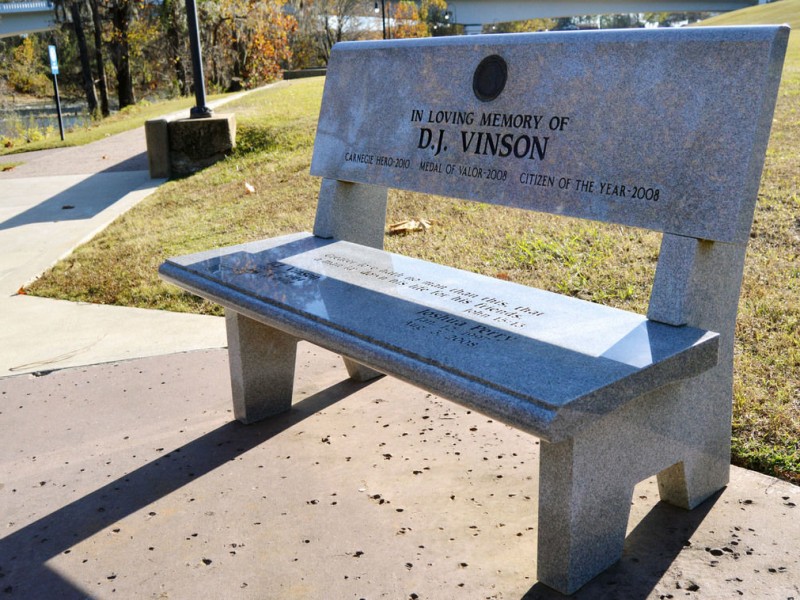
ALBANY — People who find themselves at the riverwalk in downtown Albany may see a bench honoring the memory of D.J. Vinson, a 23-year-old man who died attempting to save the lives of Joshua Perry, 11, and his brother Matthew Perry from the Flint River’s currents before Vinson and Joshua both succumbed to the water on Aug. 3, 2008.
Even though the incident made headlines, and Vinson was later named a Carnegie Medal recipient, not many people know about the Albany High School graduate who perished that day. Jasmyne-Nicole Walker, a friend of Vinson’s and a graduate student at the Savannah College of Art and Design’s Atlanta campus, recently reflected on his character.
Walker participated in the GENERATE challenge, a competition hosted by SCAD annually to challenge students to create completed works of art in a 24-hour period. Her piece, titled “Hindsight,” was an opportunity to give herself closure while also demonstrating to others what might be learned from Vinson’s life.
Vinson and Walker grew up together through high school. While Vinson was nearby with friends on that fatal day, Walker was at Sarah Lawrence College. After hearing about Vinson’s death, she had trouble coming to peace with it in the years that followed.
She decided that GENERATE, which she took part in around the time of Vinson’s birthday in October, would be a chance to use the gift he encouraged her to use to commemorate him and express the loss she suffered.
“If you knew then what I know now, maybe you wouldn’t have tried to save those two little boys,” the piece starts. “Maybe you would have hesitated just long enough that they (would have) simply slipped beneath the muddy brown waters, their slick ebony skin camouflaging them from rescue. But you didn’t do that.”
Walker has spoken of her feelings on the incident by admitting she was angry, which she said she has felt guilty about, because of why Vinson died. It is something Walker said her friend would likely do again tomorrow, even knowing the consequences.
“In the back of my mind, I know he would,” she told The Albany Herald. “That is why I am so proud to call him my friend.”
Walker’s piece gives a recollection of the incident that started when someone was able to capture Vinson’s attention after the brothers got caught in the river. A human chain formed, and Vinson ended up waist-deep in the water. The group was successful in bringing one boy to safety, but after the other slipped from his grasp, Vinson decided not to listen to his friends and he went in after him.
In her piece, Walker expresses what Vinson must have felt while trying to get to Joshua while the boy was drifting farther away and staying underwater more than he was staying up.
“The seconds ticking by feel like an eternity,” she wrote. “You know there is no time to form another human chain and wade out again. He will be gone. You look over your shoulder at your friends for a moment, then turn and dive into the river toward the other boy.”
Vinson got to Joshua, but the combination of a frightened boy and the conditions of the Flint overpowered the strong swimmer. Joshua’s body was found that night, while Vinson’s remains were recovered the next day, a few yards away from where he had gone in.
Walker goes on to write that she only heard about the response at his funeral, as she could not bring herself to attend. The decision not to go to the service is something she says she now regrets because of the lost opportunity to express the value of a friendship between a black girl and a white boy during a time of ongoing racial and social tension.
Vinson, who was white, jumped in that day to help save two black boys, Walker points out. Near the end of her piece, Walker cites Eula Biss’ “Relations” in which Biss shares law professor Randall Kennedy’s theory that a “well-ordered multiracial society ought to allow its members free entry into and exit from racial categories.”
The master of Fine Arts student disagreed with this point of view.
“In my ideal racial society, there is no need to flow from one racial group to another, because there is but one race: humanity,” Walker wrote. “And when we see each other in need, we help, with no regard for the amount of pigment in a person’s skin or regional variation in their features, because we are in tune with our humanity.”
Eight years later, in times when there is still racial and social upheaval, Walker recalls the ability Vinson had to put that conflict out of his mind and focus on what was important.
“He did something so selfless that put race and class out the window,” she said. “It reminds me every day to do the same thing. That’s why we were best friends.”
While speaking of their childhood together, Walker said, “To know D.J. was to love D.J.” The circumstances of his passing, in a city that had a significant role in the Civil Rights Movement, was almost like divine intervention to her.
“It gave me hope for my hometown,” she told The Herald. “I feel what D.J. did brought a lot of people together. I operate on the mindset that there is no race. We let that define us (as) being different.
“We all want families and want loved ones to be with us. (That crosses) ethnic background.”
The piece, which has been published in The Ivy Hall Review, got top honors with GENERATE. The recognition, to a degree, felt like validation to Walker.
“I feel like God used me,” she said. “That is the whole reason why I write. I didn’t do anything in my mind, I just wrote it.
“It is almost like the gift that keeps on giving. Anytime you put positively out in the world, it just keeps coming back. Paying it forward is always going to have a payback.”
Apart from breaking down racial barriers, Walker’s hope is that those in Albany will go to that spot on the Flint to visit the bench and be reminded of their convictions. Even for those unable to make that trip to downtown Albany, she encouraged the same thing.
“We need to hold a mirror to ourselves and think about what we would live and die for,” she said.
People have become used to reading about tragic incidents in the newspaper or seeing the impacts of them on TV news, but it always influences them differently when it happens to someone they know personally, she said. Now, Walker is left with the memories of Vinson’s supportive nature and his willingness to do anything to make someone’s day.
“He really was an everyday hero,” she said. “For sure, he is my hero. Whenever I am ready to snap, I think about him (and) what he was willing to give up.
“He threw himself in the midst of that. He didn’t have to do that. I would not have expected anything less of him.”
When word got out that Vinson would posthumously receive the Carnegie Medal, a number of Albany and Dougherty County officials spoke highly of Vinson’s sacrifice. Also speaking out was Vinson’s mother, Beth Vinson, who expressed a sentiment similar to Walker’s.
“All his life, he wanted everyone to love one another,” she said in 2010. “If they did put (a memorial sign) down (at Riverfront Park), it would really touch me.
“I know he’s my son, but he was a sweet young man. I never heard anyone say anything bad about him. He was a one-of- a-kind son is all I can say.”
To read Walker’s piece, visit ivyhallreview.org/?page_id=956.
Related Articles
New commander takes helm as Marine Corps logistics adapts to evolving battlefield
Brig. Gen. Kevin G. Collins assumed command of Marine Corps Logistics Command during a change of command ceremony at Marine Corps Logistics Base Albany, succeeding Maj. Gen. Keith D. Reventlow after four years leading the organization responsible for sustaining Marine forces around the globe.
DOT says delay in Oglethorpe Bridge opening should be brief
“We know it’s not going to be July 22. We don’t think it’s going to be much later than that.”

City of Albany has big July 4 celebration planned for Saturday
“It’s going to be a lot of moving and shooting them off in a short time. It’s going to be a big show.”
