
Albany speed camers bring in $6.5 million in fines
Alan Mauldin
[email protected]
ALBANY – Chances are that frequent Youtube viewers in the Albany area have seen some of the recruitment pitches for the Albany Police Department pop up on screen between videos.
There is also a chance that more than a few have helped pay for those ad spots through speeding fines generated in the nine city school zones where license plate readers/speed detection devices are in operation.
Since the cameras were installed three and a half years ago, more than 187,000 citations have been issued. Of that total, 1,670 have been dismissed by Albany Municipal Court.
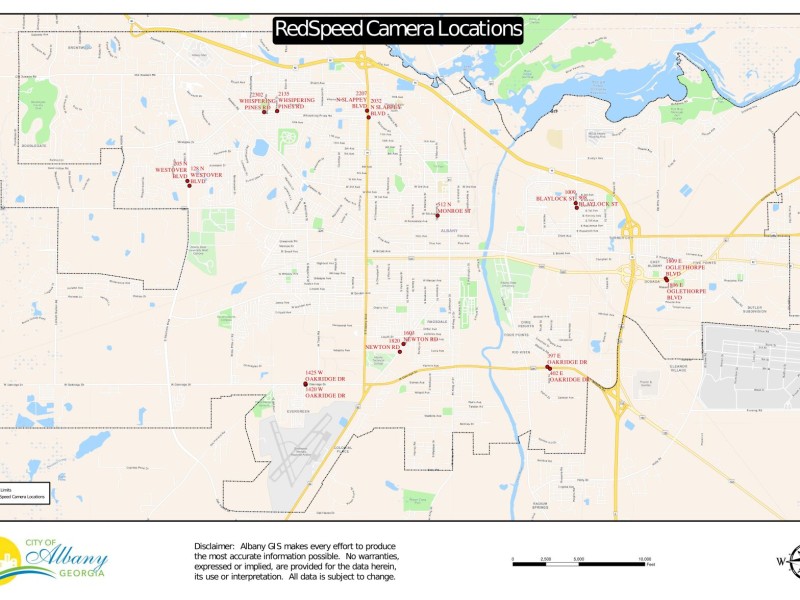
After starting the program during the 2020-2021 school year with seven cameras at four public school campuses, the city has expanded the number of cameras operated by RedSpeed Georgia to 17 cameras at nine schools.
Through early February the tickets had generated some $6.5 million in fines, according to the city. Funds raised through those fines cannot be steered into the city’s general fund coffers, but must be used for law enforcement purposes.
So far, the money has been spent on equipment, school zone signage and flashing lights as well as the Flock safety cameras that have been placed around the city, Albany Police Department Chief Michael Persley said. In addition, some of the funds have been used for the real time crime center and training for personnel.
The tickets, fines and benefits to the department are secondary to the actual purpose of the program, the chief said. Put simply, the police department is looking to change drivers’ habits and slow them down, especially while they are driving through areas where students are walking and traffic is heavy with parents and buses dropping off and picking up children during the school day.
“This is all about traffic safety,” he said. “It has changed driving behavior of people in the community to the point they are cognizant these cameras are operational and someone is monitoring their speed.
“One of the biggest (efforts) has been made to reduce speeding, particularly around school zones in Albany.”
Speed enforcement in school zones in the state is covered under the Georgia Code Section 40-14-18, which allows for use of the speed detection devices beginning one hour before classes begin for the day, through the school day and for one hour after classes have concluded. The law only allows for citing drivers traveling at more than 10 miles per hour over the speed limit.
Fines are set at $75 for a first violation and $125 for second and subsequent violations, and proceeds can only be used for law enforcement purposes. Tickets are mailed to the owner of the vehicle, and in cases where someone else was driving the registered owner can
In Albany, the speed limit is 25 miles per hour during the early morning and afternoon period at around the time school is convening or the conclusion of the school, so with the 10-mile cushion citations are only written for drivers traveling 36 miles per hour or more. For the remainder of the school day the speed limit reverts to the normal rate, so a driver traveling through a 45 miles per hour zone should only be ticketed for speeds of 56 miles per hour or greater.
After the first year of enforcement the police department paid to update signs alerting drivers to the presence of school zones, including the flashing lights that alert drivers that they are approaching a school zone during the times the speed limit is 25 miles per hour.
The only exception is Northside Elementary School on North Slappey Boulevard.
Because it is part of a state highway, the city must receive permission from the state for the flashing lights, Persley said. State law requires only signs in school zones, and although flashlng lights are not required the city is working to place them on North Slappey boulevard.
“There have always been signs,” he said. “We have been in lengthy discussions with the Georgia Department of Transportation. Once the Georgia Department of Transportation gives us permission, we will install the flashing lights.”
The locations chosen for the speed camera sites were based on traffic surveys conducted in all of the school zones located within the city, Persley said.
“They were the ones that had the highest traffic, the most vehicles,” he said. “This is where we had more violations, looking at the speed. They took everything into (account).”
For City Commissioner Jon Howard, the speed cameras account for the highest number of complaints he receives on issues, he said.
Albany Mayor Bo Dorough also hears those complaints.
“It’s very controversial,” he said. “But at the end of the day, when I’m going to work on Dawson Road by Merry Acres (Elementary) School, speeding is not a problem now. Four years ago it was an issue and we received complaints for speeding in school zones throughout the city.”
Drivers were not only speeding, but exceeding the speed limit through school zones by a significant amount, the mayor said.
There is evicence the cameras are working. The first year cameras were in place at Alice Coachman Elementary School for the 2020-2021 school year, the two cameras provided 16,803 working citations, and the two cameras at Sherwood Acres Elementary School produced 24,096.
For the 2022-2023 school year, those numbers had dropped to 6,299 at Alice Coachman and 9,537 at Sherwood Acres.
“The real issue is the speed cameras have achieved the objective and continue to do so,” Dorough said. “If you removed every speed camera in the city, who doesn’t think we wouldn’t have the same problems that we had four years ago?”
The fines levied also have allowed the police department to purchase technology that will help reduce crime and prosecute criminals, Dorough said, and are also helping to address the significant shortage of officers through paying for online advertising.
While the speed detection devices have brought in a lot of complaints, they are performing the intended function of changing the behavior of drivers, Persley said.
Citations bring a civil, not a criminal, penalty, he said, and are not time consuming like a traffic stop by an officer would be. In addition, a traffic stop is more intrusive and could result in the officer discovering the driver had additional infractions that could result not just in a speeding ticket but a trip to jail.
“I’ve heard a lot against them, but then I’ve heard just as much for,” the chief said. “This reminds you to always be aware of your surroundings when you are driving.
Asked about his take on the speed cameras while he was enjoying a cigar on a bench at Turtle Park in downtown Albany during his lunch break, Dr.. Greg Keiser said he thinks overall they are a good thing.
“It keeps people accountable,” the oral surgeon, who moved to Albany from New Jersey about three months ago, said, “Typically what I’ve noticed, they’re around schools and churches, where you should be minding your p’s and q’s anyway. I think in general it’s a good idea.”
Nearby in the park, Michael Jones expressed the same sentiment, although he said he thinks drivers should receive a warning for the initial infraction.
“A lot of kids walk home from school,” he said. “I think we need to keep kids safe. There used to be crossing guards at all of them. Maybe they should bring the crossing guards back, too.
“There are people who don’t care about (speeding. If they’re in a hurry, they’re just in a hurry.”
Speaking outside the Cornerstone Coffee+Co, Sheila Jackson said that the city should do a better job of educating the public about the hours the speed cameras are in operation in school zones.
“I don’t hate them,” said Jackson, who has not received a ticket through the system. “There is a little miscommunication with the public. I am aware that the cameras are on all day when school is in, but the lights aren’t flashing all day. It’s a miscommunication.”
And auto owners who for some reason do not know they have been ticketed or cannot afford several fines also can be surprised at the tag office when they are unable to renew their registration, she said.
“Now that leads to issues where people can’t drive their car,” she said. “It just creates a whole other issue.”
Author

Related Articles

New commander takes helm as Marine Corps logistics adapts to evolving battlefield
Brig. Gen. Kevin G. Collins assumed command of Marine Corps Logistics Command during a change of command ceremony at Marine Corps Logistics Base Albany, succeeding Maj. Gen. Keith D. Reventlow after four years leading the organization responsible for sustaining Marine forces around the globe.

Classifieds – July 2, 2026
Cemetery lots for sale: 5 burial plots in Riverside Cemetary… Health: Private Caregiver…Full-Time Job: Irrigation Tech needed…
Albany Herald – July 2, 2026
Dougherty schools prepare for bell-to-bell… From Ledo to Coston, Lee County’s summer road… Lee County moves another step closer to issuing…
