
Missing Punctuation: Loss of matriarch heightens right whales’ peril
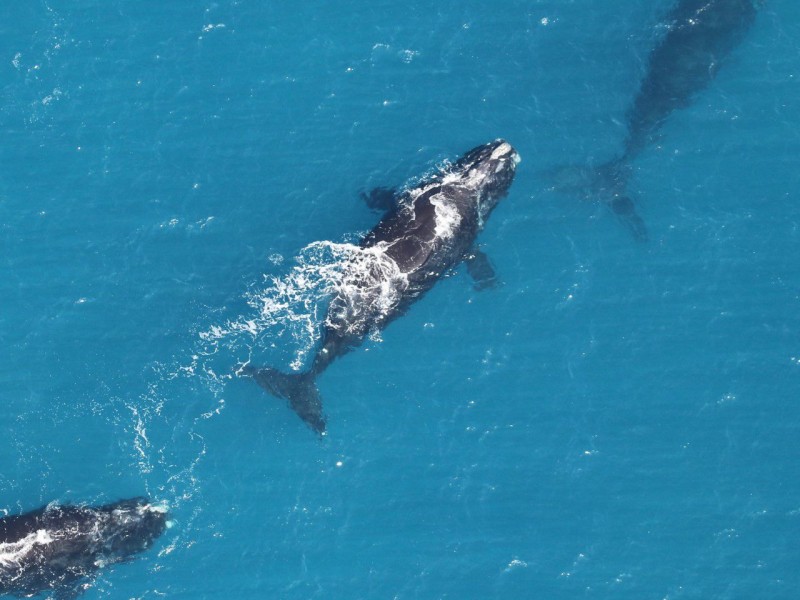
Special Photo: Georgia DNR
From staff reports
BRUNSWICK – The seasonal return of North Atlantic right whales to the Southeast has started like clockwork. At least seven adult females have been seen from North Carolina to north Florida since late November, and the season’s first calf was spotted off Sapelo Island.
The news is encouraging for a species considered among the world’s most endangered whales. But it is also tempered by the awareness that one well-known right whale will not return this winter.
Female No. 1281, nicknamed Punctuation for a unique pattern of white scars on her head, died last summer in Canada’s Gulf of St. Lawrence. She was hit by a vessel.
Over nearly four decades, Punctuation had been seen at least 250 times along the eastern seaboard. More importantly, she had been prolific, giving birth to eight calves. Yet even in death she stands out, a testament to the dangers right whales face and the growing fear they are heading toward extinction.
Clay George, a senior biologist with the Georgia Department of Natural Resources, said that at the rate right whales are dying, they could be “functionally extinct by the end of this century. We’ve got to stop killing them, and fast.”
North Atlantic right whales have been on the brink before. For eons, the bus-sized mammals migrated more than 1,000 miles along the Atlantic seaboard, from feeding grounds off Canada and New England to calving grounds off Georgia and Florida. Yet their proximity to shore and abundant oil and baleen made them the “right” whale to kill. By 1900, commercial whalers had hunted them nearly to extinction.
A ban on hunting and other protections helped the species recover slowly during the 20th century. Despite new human threats that emerged in the wake of whaling – primarily vessel collisions and entanglement in commercial fishing rope – the population grew. From 2001 to 2010, the number of right whales increased from some 330 to more than 480, boosted by an average of 24 calves a year.
Then, about 10 years ago, the recovery stalled.
According to National Oceanic and Atmospheric Administration estimates, more than 100 right whales were killed or seriously injured from 2010 to 2016. During that time, 110 calves were born. In the last three years, that downward trend has accelerated. Only 12 calves have been seen compared to 30 whales found dead, most from vessel strikes and entanglement in Canada and New England waters.
“It’s like we’ve traded harpoons for prop blades and fishing rope,” George said.
And births aren’t an even trade for the loss of adult whales, particularly females. Factoring in survival and gender rates, scientists say it takes about four calves to equal one breeding-age female. With deaths outpacing right whales reaching maturity, the population has dropped to about 412.
Punctuation both bucked and bore those trends.
She was a survivor and one of the era’s most successful right whale moms. Photographed in 1981 off Massachusetts’ coast, over the next 38 years she would shed entanglements in fishing rope five times, survive two minor vessel strikes and raise eight calves, young that can be 14 feet long at birth and nurse for almost a year. Punctuation also was a regular in Georgia, even seen here in 1986 with her first calf.
Her life, however, was shadowed by the pain and disaster common to right whales.
In addition to being run over by vessels and getting snagged in fishing rope, she outlived at least two of her young and two of theirs. One died from entanglement; another from a vessel strike. Two, including a whale seen with deep propeller wounds on its back, simply disappeared. (NOAA estimates that 62 percent of right whale carcasses go undetected.)
Punctuation last gave birth to a male calf. It was seen near St. Simons Island in January 2016. Five months later, the calf died off Massachusetts after being hit by a vessel.
None of the females Punctuation gave birth to is alive today.
The shortage of right whale females makes the species’ potential recovery more tenuous. It takes nine years on average for females to reach sexual maturity. There are now fewer than 100 breeding females alive. Compounding the issue, NOAA says the lifespan of females has shrunk from at least 70 years to about 45, while birthing rates have stretched from a calf every three years to one every six to 10.
For Barb Zoodsma, right whale biologist for NOAA Fisheries, the result of shorter lives and longer calving intervals is clear. “Right whales are producing fewer and fewer calves,” Zoodsma said. “If we don’t fix this, things could spiral out of control pretty quickly.”
In February 2018, a Clearwater Marine Aquarium team flying surveys for DNR photographed Punctuation in a social group with seven other whales.
They were about 30 miles east of Jekyll Island.
She was not seen with a calf that winter, so it’s unclear why she migrated to the Southeast. What is clear is that it was her final trip here.
Last summer, on June 5 and 6, Punctuation was swimming in Canada’s Gulf of St. Lawrence, more than 1,500 miles from Georgia. Two weeks later, her carcass was discovered sliced open and floating in the Gulf of St. Lawrence. A necropsy revealed that she died from a collision with a vessel.
Punctuation would not be the only casualty. That June and July, eight more right whales were found dead in the Gulf of St. Lawrence. Three were adult females. At least two died from ship strikes. A 10th whale seen entangled but alive in Canada turned up dead off New York in September.
Possibly because of shifting populations of copepods – the tiny crustaceans right whales eat in masses called blooms – many whales are bypassing traditional summer feeding grounds in the Gulf of Maine and swimming into Canadian waters, where vessel traffic is heavy and thick synthetic ropes are used to catch lobster and snow crab. Rope from lobster pots is also a serious threat in U.S. waters.
The plight of North Atlantic right whales has spurred calls for increased protections in both nations.
Meanwhile, researchers in the Southeast hope for a strong calving season. Many of the females seen have calved before and could be pregnant.
One of those is Slalom, right whale No. 1,245. Slalom is 38 years old and has had five calves.
She has yet to match Punctuation. But given time, maybe she can.
Related Articles

Albany Herald – July 18, 2026
Georgia Trust for Local News partners with… Adult leadership group spreads concept to… Lee County homeowners have until Aug. 1 to claim…

Classifieds – July 18, 2026
Classifieds; Legals;

Albany police make arrests in murder, robbery cases
Officials with the Albany Police Department have announced a number of arrests in cases that involved a homicide and a pair of thefts.
