
Record holiday spending forecast
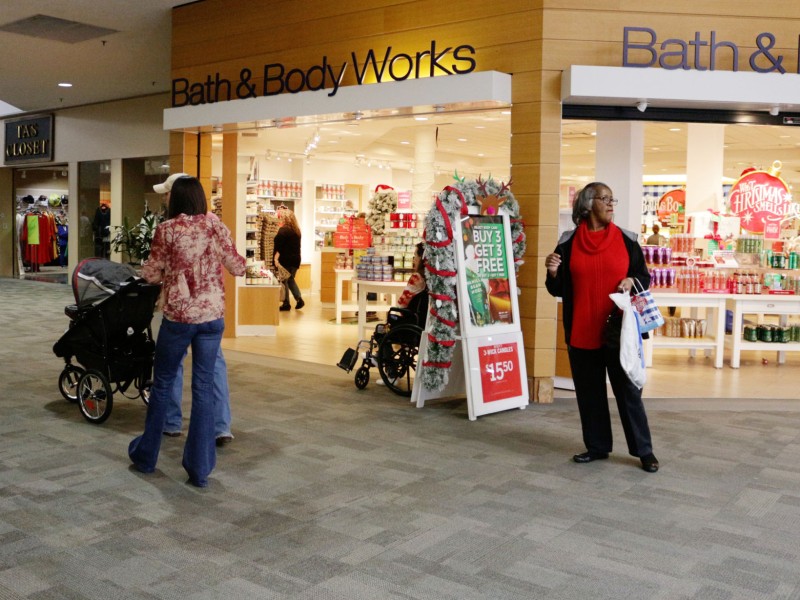
File Photo
From staff reports
ALBANY — Santa will be pulling gifts from his sack at a record level this year both in terms of total spending and average spending. That record overall spending, however, might be even higher if potential impacts from tariffs don’t cause consumers to feel a twinge of humbug.
Still, shoppers celebrating the winter holidays plan to spend an average of $1,047.83, up $40.59 or 4% from last year when the biggest spending period of the year broke the $1,000 mark for the first time in average spending as reckoned by the National Retail Federation.
Based on the survey conducted annually for the NRF by Prosper Insights & Analytics, the biggest spenders will be in the 35-44 age group at an average of $1,158.63.
“Consumers are in good financial shape and willing to spend a little more on gifts for the special people in their lives this holiday season,” NRF President and CEO Matthew Shay said. “Retailers are fully prepared to meet the needs of holiday shoppers looking for that perfect mix of sales, quality and selection.”
In a separate survey conducted in late September by Prosper Insights & Analytics, the NRF found that year-to-year spending in the months of November and December should be up 3.8%-4.2%. That would result in a record level that would fall between $727.9 billion and $730.7 billion.
“The U.S. economy is continuing to grow and consumer spending is still the primary engine behind that growth,” Shay said earlier in October. “Nonetheless, there has clearly been a slowdown brought on by considerable uncertainty around issues including trade, interest rates, global risk factors and political rhetoric.
“Consumers are in good financial shape and retailers expect a strong holiday season. However, confidence could be eroded by continued deterioration of these and other variables.”
The overall spending is expected to rise for an 11th straight year since dropping 4.7% from 2007 to 2008 in the midst of the Great Recession. With the government shutdown last year, 2018 spending, at $701.2 billion, was up 2.1% over 2017. Despite having no concrete idea of the tariffs’ impact, consumers are expected to go out and celebrate the holidays.
“There are probably very few precedents for this uncertain macroeconomic environment,” NRF Chief Economist Jack Kleinhenz said. “There are many moving parts and lots of distractions that make predictions difficult.
“There is significant economic unease, but current economic data and the recent momentum of the economy show that we can expect a much stronger holiday season than last year. Job growth and higher wages mean there’s more money in families’ pockets, so we see both the willingness and ability to spend this holiday season.”
That also means more work for Americans. During the year-end holidays, the NRF says, businesses are expected to add 530,000-590,000 temporary workers, compared to 558,000 who were added to 2018 payrolls.
The additional workers are needed because, despite the fact that online and non-store sales are expected to grow at a much higher rate year-to-year, the majority of sales still occur at brick-and-mortar retailers. The NRF expects online/non-store sales to jump 11%-14%, but that total spending will fall in the $162.6 billion-$166.9 billion range, up from $146.5 billion last year.
Meanwhile, businesses have worked to beat the tariffs that will affect imported consumer items, including popular electronics, in mid-December. Shay said retailers are expected to import near-record volumes of merchandise before tariffs hit a wide range of consumer goods from China on Dec. 15.
By then, quite a bit of the Christmas shopping season likely will be in the books. November is the most popular time for launching holiday shopping, with the NRF survey showing 43% plan to start during the year’s penultimate month. About one in five —19% — started in September or earlier, and another 20% joined in during October. Only 3% will procrastinate to the point of getting into the shopping spirit the last two weeks of the year.
About 91% of U.S. consumers will engage in winter holiday shopping, with nearly three-quarters — 73% — using their smartphone or tablet to research or facilitate purchases.
More than half — 56% — plan to shop online, with 92% of those taking advantage of free shipping and 17% using expedited shipping. Just under half — 48% — will make an online purchase that they’ll pick up at a store.
With the majority of purchases coming at brick-and-mortar stores, 53% of consumers will go to department stores and 51% will visit discount stores. About 44% will go to grocery stores, 34% to clothing stores, and electronic stores and local businesses each will attract 23% of shoppers.
From there, shoppers will frequent crafts stores (17%), drug stores (14%), specialty stores (13%), thrift stores (10%), outlet shops (9%), catalog facilities (7%) and others (4%).
When it comes to what’s on their letters to Santa, 59% included gift cards. Other items, in rank of popularity, were clothing and clothing accessories, 52%; books and other media, 35%; electronics, 29%; home décor, 24%; jewelry, 23%; personal care items, 21%; sporting goods, 18%; home improvement items, 17%, and that catch-all “other,” 7%.
As to whom consumers are spending on, gifts for family take up nearly half the $1,048 average with $501. Gifts for friends will be take $84, with $35 going toward co-worker gifts and $38 to others.
Regarding non-gift items, $110 will be spent on candy and food, $61 on decorations, $31 on greeting cards and postage, and $25 on flowers and potted plants. Non-gift purchases for self or family will average $162.
What’s the most important consideration for purchasers? Sales or price discounts was No. 1 for 70%. Quality of merchandise was important to 59%, and merchandise selection was big with 57%.
Free shipping was important to 46%; 44% cared about convenient locations; 39% like everyday low prices; 32% want a no-hassle return policy; 30% cited easy-to-use web or mobile sites; 28% are impressed by helpful and knowledgeable customer service, and 5% cited layaway services.
NRF retail sales figures exclude automobile dealers, gasoline stations and restaurants. It classifies the winter holidays as being the period of Nov. 1-Dec. 31 in determining holiday sales, which the NRF says comprises about 20% of retailers’ annual sales. Holidays during the winter holidays period include Thanksgiving, Christmas, Hanukkah and Kwanzaa.
The survey of average spending and spending intentions included 7,782 adult consumers, was conducted Oct. 1-10 and has a margin of error of plus or minus 1.2%. The holiday forecast survey was conducted in September.
Related Articles
From cotton to cloud: In the data center debate, is rural Georgia once again being asked to carry the cost?
Across much of rural Georgia, the abandoned cotton warehouses and shrinking tax bases remain — enduring reminders that industries built to serve distant markets do not necessarily stay rooted in the communities that first sustained them.
My Grandpa Was Killed in World War II. I Met Him Through His Letters Home
Gina Wolf’s grandfather died before she was born. His letters sent to her grandmother from Europe during World War II made it possible to know what kind of man he was.

‘Sounds Like a Mutiny.’ Secret Recording Exposes Claims of Toxic Leadership After a Marine’s Suicide
This week’s War Horse story follows the systemic failures before and after the death of Cpl. Drew Mobley who was the third in two years at Marine Corps Base Quantico to die by suicide.
