
DeSoto made way through southwest Georgia during exploration
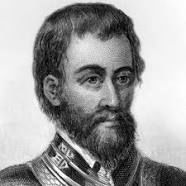
Special Photo
By Tom Seegmueller
Special to The Albany Herald
ALBANY – It is generally accepted that in early 1540, Don Hernando DeSoto “discovered” the Swamp of Toa on the outskirts of Albany.
The exact route of DeSoto’s trek through the Southeastern United States has been debated for almost a century. However, written journals from those on the expedition tend to collaborate DeSoto’s journey though southwest Georgia.
On April 20, 1537, DeSoto received a charter from King Charles V of Spain for the conquest and governance of La Florida. The charter required that he “conquer, pacify and settle 200 leagues (560 miles) of La Florida’s coast.” The charter was specific in the number of men and supplies he was to take as well as the time he had to establish three stone forts using his own funds.
In exchange for these accomplishments, he would receive “titles, land and a share of the colony’s profits.” He was given power over all the inhabitants of the land and the power to judge all officers of the province.
DeSoto was well-prepared for these duties. In 1520, he rose to the rank of captain serving in Panama under Vázquez de Coronado, the governor of New Spain in northwestern Mexico. He served with Ponce de Leon and Pizzaro in Panama and Nicaragua, leaving there a wealthy man in 1531. From there, he led a number of expeditions in Peru.
In the spring of 1540, DeSoto led his expeditionary force from Florida into what is now Georgia. Early in the journey, they came across a river, “so wide that our best thrower could not hurl a stone across.” It would take more than four days for his expedition to cross the Chattahoochee River near Bainbridge.
Journals recount that the next day they came upon the village of Capachequi in what is now Miller County. The village appeared to be recently deserted. However, “within the forests many Indians were walking about who came to spy on us. Five of them separated from the others and attacked our men.” One soldier was killed, and three others were wounded.
Journals indicate that the expedition entered a “desert.” Today historians believe this is actually referring to the vast longleaf pine and wiregrass region of southwest Georgia. The Army stopped near White Springs near Arlington, where their hunger forced them to slaughter some of the 300 pigs traveling with them.
The expeditionary force was in reality an invading army that consisted of 600 men. During its 4,000-mile journey through the Southeastern states it would confiscate the food stocks of the villages along the way. In one rapidly abandoned village, it is recorded that they found meat still grilling above the fires. This is considered to be the first documentation of barbecue in North America.
As the army approached the River of Toa, or Ichauwaynochaway, they noted a change in the style of housing. “Those behind were covered with hay, and those of Toa were covered with cane in the manner of tile … throughout these cold lands each of the Indians has his house for the winter plastered inside and out.”
DeSoto would continue from Toa on a path taking him through Dawson, Americus, Warner Robins and Augusta. He would travel though South and North Carolina and into Tennessee and would re-enter Georgia and travel near Etowah. He traveled west for another three years. Half of the Army would die in combat or from disease as DeSoto himself did on the banks of the Mississippi River on May 21, 1542. The remaining 300 conquistadors would flee la Florida by boat for Spanish settlements in Mexico.
Archaeological and historical information indicate that within a few years of DeSoto’s passage through the region most of the chiefdoms he came in contact with would disappear. The collapse of these cultures is believed to be not only a result of direct abuse but from exposure to European disease such as measles, for which the native population had no resistance. It is estimated that 95 percent of the precontact population was lost.
During his expedition, DeSoto found little in the way of the treasure such as gold, silver and gems. However, he did discover a region rich in natural resources opening the way for future Spanish settlements.
The Swamp of Toa is one such treasure. Sadly, its next historical reference is also a part of the swan song for the native inhabitants of the region. With westward expansion in the late 1700s and early 1800s in Southwest Georgia, conflict with the chiefdoms remaining in the region was inevitable.
Where DeSoto found no treasure, settlers later found great wealth in other forms. It is estimated that during the late 1700s, more than 1 million deer a year were harvested for the buckskin trade. With a hide selling for a dollar, the denomination became known as a buck.
As the natural resources and agricultural potential of the region became more evident, a concerted effort was made to remove the remaining native inhabitants. When a marauding band of Creeks burned the town of Roanoke in Stewart County, they attempted to flee the area and join with the Seminole tribes in Florida. Angry Georgians formed two companies of militia to try and intercept the fleeing Creeks.
On June 26, 1836, the militia were camped on a road leading from Albany to Blakely where it crossed the Chickasawhatchee Creek. During the night they heard gunfire, and when daylight broke, they marched to discover a burned-out homestead and nine dead settlers along with three survivors.
Riders set out to get reinforcements to take on the estimated 300 Creeks who were now known to be hiding in the swamp. Scouts were sent in to locate them. After wading four miles through chest-deep waters, they located them camped on an island in the swamp’s interior.
Without waiting for the main force to arrive, the scouts attacked, setting off a 20-minute battle. When the smoke from the black powder weapons cleared, the bodies of the chief and 13 more Creeks were found on the island. The remainder had slipped away and fled, to either be killed or captured as part of their final removal from the state. Ironically, the battle took place within a few miles of DeSoto’s initial encounter with the region’s native residents 300 years earlier.
The Creeks had used fire as a tool to enhance the pine forests in the region, and settlers took up the practice as well, burning large tracts so that their cattle could graze on the fresh sprout grasses that followed a burn. The piney woods cattle ranged without fences and were herded by riders using long whips to drive them as needed. As a result, the cattlemen of the region became known as Georgia Crackers. Their use of fires in the woodlands greatly benefited the stands of longleaf pine.
The woodlands themselves did not become a valued asset to a large degree until after the War Between the States. By the beginning of the 20th century, this region was producing 70 percent of the world’s “naval stores.” These products include tar, pitch, turpentine and resin, which were used to waterproof wooden ships.
During the latter part of the 1800s and early 1900s, Irish immigrants were sent into the swamps to dig drainage canals so the massive cypress trees growing there could be harvested.
The Red Cypress Lumber Company was formed in the early 1900s to cut the trees growing in the swamp of Toa or Chickasawhatchee, as it became to be known. It was believed that it would take at least half a century to harvest the wealth of the swamp. For 20 years, the logging towns of Pretoria and Doles flourished.
However, in less than 20 years, the great cypress stands were gone. A hundred years later, massive stumps and the remains of the tram rails used to remove the large logs still can be found there. A few giant cypress remain as reminders of grandeur of the primordial swamp DeSoto described.
In 1956, the St. Joe Paper Co. purchased a large portion of the swamp, and for the next half-century they managed it for the production of pulpwood. The Georgia Department of Natural Resources leased a portion of this property for use as a wildlife management area.
When St. Joe put the majority of their timber holdings on the market in 2000, a dedicated group of conservationists went to work with the state in an effort to purchase and protect the land.
Governor Roy Barnes and Lt. Gov. Mark Taylor partnered with the Robert Woodruff Foundation, the Doris Duke Foundation, and the U. S Fish and Wildlife Service to raise the $37 million needed to acquire 19,700 acres to be designated as a heritage preserve.
One day the swamp might appear as it did when DeSoto first trekked through it’s tannin-stained waters.

Related Articles

From cotton to cloud: In the data center debate, is rural Georgia once again being asked to carry the cost?
Across much of rural Georgia, the abandoned cotton warehouses and shrinking tax bases remain — enduring reminders that industries built to serve distant markets do not necessarily stay rooted in the communities that first sustained them.
My Grandpa Was Killed in World War II. I Met Him Through His Letters Home
Gina Wolf’s grandfather died before she was born. His letters sent to her grandmother from Europe during World War II made it possible to know what kind of man he was.

‘Sounds Like a Mutiny.’ Secret Recording Exposes Claims of Toxic Leadership After a Marine’s Suicide
This week’s War Horse story follows the systemic failures before and after the death of Cpl. Drew Mobley who was the third in two years at Marine Corps Base Quantico to die by suicide.
