
Diggory the greyhound: Canine royalty
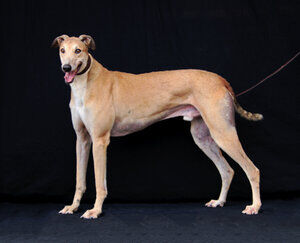
Special Photo: Doug Porter
By Doug Porter
Special to The Albany Herald
ALBANY — Have you ever been at some event or gathering when someone walked in and took over the room? Perhaps it was the host, or the guest of honor, or maybe a well-known celebrity. But the moment they walk in, the electricity changes. Conversations slow, eyes turn, the air seems to get sucked out of the room.
I have seen it with people on numerous occasions, but the day I met Diggory was the first time I’d seen such reaction to a dog.
This special dog came into my son’s living room from the basement apartment where my son lives with the dog’s owner, Will. His arrival was unexpected. The door to the basement opened and there he was, striding confidently — majestic and regal — into the room. Diggory is a fawn-colored, 75-pound, 3-foot-tall greyhound. I was nearest the door, sitting at the kitchen table, so he came to me first, gazed at me across the table, sniffed my arm, and moved on. He checked both humans and dogs as he circled the room, moving with the easy fluid grace of an elite athlete. He finally curled up on an impossibly small dog bed in the corner.
From the moment I saw Diggory, I could see why greyhounds are such special creatures. Diggory is the essence of the dog breeder’s credo: form follows function. From his sleek aerodynamic head to his broad chest that curves into a tightly tucked waist, his smooth hide is stretched over muscle and bone without an ounce of fat.
Greyhounds have been an object of fascination for artists, poets and kings for as long as human beings have been civilized. Legend has it that Cleopatra had coursing greyhounds, and they were the hunting hounds of ancient mythical gods and goddesses. Over the centuries, greyhounds have traveled with explorers and generals, adorned the suites of kings and queens, and appeared in fine art and literature.
According to the American Kennel Club, greyhounds belong in the Hound Group — a diverse lot that defies generalization. Hounds can be long low dachshunds or Irish wolfhounds, the AKC’s tallest breed. The group includes elkhounds, coonhounds, deerhounds, Afghans and beagles. Most hounds share the common ancestral trait of being used for hunting. Some use an acute sense of smell to follow a trail. Others demonstrate a phenomenal gift of stamina as they relentlessly run down quarry. And then there is the blinding speed of the greyhound.
Greyhounds were bred for hunting in the open, where their pursuit speed and keen eyesight were essential. The original use of greyhounds was in running down smaller animals for meat. Later, they became specialized in competition hare coursing. Some greyhounds are still used for coursing in artificial lure sports like dog racing. Before he retired, Diggory was a racer. He ran under the name Mega Diggory, and some of his races can still be seen on the internet.
My connection with greyhound racing is etched in vivid childhood memories. My dad was a plasterer who had a second job to help support our family. On weekends and Wednesday evenings he worked as an assistant starter at Derby Lane dog track in St. Petersburg, Fla.
Derby Lane, the St. Petersburg Kennel Club, claims to be the oldest continuously operating greyhound track in the world. It was carved out of palmetto scrubland on the edge of Tampa Bay in the 1920s. The club’s first race was held on the afternoon of Jan. 3, 1925. The final race was nearly a century later, in December 2020, just days before greyhound racing was banned in Florida. According to the Humane Society of the United States, greyhound racing is cruel and inhumane and is now illegal in more than 40 states.
I wasn’t allowed to attend the regular dog races because Derby Lane was a gambling establishment — no children allowed — but I did go to the schooling races on occasion. These were practice races, probably for young dogs, and I never observed anything cruel or inhumane.
The starting box, where my dad worked, consisted of a long, low unit with eight greyhound-sized stalls. The handlers walked the dogs to the box on a leash and my dad helped them remove the leash and stuff dogs in the box. Each dog wore a colorful vest with a number from 1 to 8 on it. Once the dogs were loaded, a mechanical arm was activated and a fuzzy, white artificial rabbit began its run around the track.
My recollection is that the starter held a button in his hand that was connected to the dog box by a cord. When the mechanical rabbit was in front of the box at a spot the starter was looking for, he pushed the button that caused the entire front of the box to burst up and expose all of the dogs to the rabbit at the same time. When they bolted out in their colorful vests with their front legs extended and their necks stretched out toward their quarry, it was the most exciting thing I had ever seen.
I assume that somewhere, someone was controlling the speed of that mechanical rabbit so the dogs were close behind, but they could never quite catch it. After they had crossed the finish line, the rabbit snapped into a box along the rail and the dogs gathered at the box where they could be retrieved by their handlers. The dogs were excited and winded after the chase, but they appeared happy to me as a young boy as they danced around with their tails wagging. Of course, I only saw the end result. I could not know how these majestic dogs came to be there.
According to the ASPCA, racing greyhounds routinely experience terrible injuries during training and when racing. And, while greyhounds may live a dozen or more years, they were usually retired from racing by 2 to 5 years of age because they were either deemed unfit to race after an injury or no longer fast enough to be profitable. Today, most of these retired dogs are sent to rescue groups. In the sordid past of this cruel sport, they were quietly euthanized. Today, there are hundreds of rescue organizations around the country that are ready to step in on their behalf — organizations like Second Chance Greyhounds out of Douglasville.
Second Chance describes itself as a dedicated group of volunteers working to place former racing greyhounds into adoptive homes. But Second Chance is unique. Their dogs are fostered and trained by inmates in the Georgia prison system. One of the programs is at the Jenkins County Correctional Facility in Millen — a program that provides an opportunity for inmates to give back to the community while alleviating boredom and tension in prison, resulting in a safer environment for both staff and inmates.
The goal of any training and socialization program is to increase retention of greyhounds in their new adoptive homes. Second Chance offers the added benefit of allowing prison residents to experience first-hand, the unconditional love of a pet — a novel experience to many inmates. One fascinating aspect of the program is the blog that provides an inmate report on the dog’s progress. Diggory’s inmate mentor named the dog Hector and here is a selection of his reports on Hector (Diggory):
3/8/2020 — Hi there from Hector the Handsome Hound. Hector’s trainer loves this guy already. He is so intelligent, loving and gentle.
3/29 — This week has been a great week for this sweet pooch. Hector is enjoying his time at Second Chance Greyhounds Academy. He loves being able to roam around freely and play with his toys, but nothing compares to the love he has for his bed. Relaxing during retirement couldn’t be sweeter for Hector.
5/10 — Well, we’ve reached the end of the 10-week training program. Hector’s inmate trainer says that he’s truly enjoyed working with this smart boy. You can’t help but smile when you’re around Hector. His inmate trainer says that he believes Hector is going to make a great addition to his new forever family.
Greyhounds are trained athletes that are bred for speed, endurance and an even temperament. They are handled a great deal during their early years by dog walkers, trainers, veterinarians and others, so they love being around people. But since they are raised in a monoculture of other greyhounds, they may be uncomfortable around cats and other breeds of dog — especially small dogs that might resemble the fluffy, white rabbits they were trained to chase at the track.
According to his profile, Diggory was not tolerant of either. In real life, however, he learned to get along with my son’s rambunctious golden retriever, Libby, and seemed to relish the company of a quiet, 7-year-old cocker named Alice.
The literature describes greyhounds as possessing superior intelligence while exhibiting a quiet but surprising independence. I observed those qualities when Diggory first walked into the room and surveyed all who were present. His independence was evident in the story his owner told of the time Diggory caught a bird in flight. Before Will could react, Diggory had eaten the bird in three gulps — feathers and all. It reminded me of our young, quail hunting cockers that must be trained to give up their birds. They, too, would eat the birds given enough time.
I feel a sense of kinship with greyhounds. We are both tall and lanky while exhibiting a quiet but surprising independence. But we do differ in at least a couple of ways. I have never been that guy who could walk in and take over a room full of strangers. In fact, I hate walking into a room full of strangers. And as to possessing superior intelligence, well nobody has ever accused me of that, either.
Related Articles

From cotton to cloud: In the data center debate, is rural Georgia once again being asked to carry the cost?
Across much of rural Georgia, the abandoned cotton warehouses and shrinking tax bases remain — enduring reminders that industries built to serve distant markets do not necessarily stay rooted in the communities that first sustained them.
My Grandpa Was Killed in World War II. I Met Him Through His Letters Home
Gina Wolf’s grandfather died before she was born. His letters sent to her grandmother from Europe during World War II made it possible to know what kind of man he was.
‘Sounds Like a Mutiny.’ Secret Recording Exposes Claims of Toxic Leadership After a Marine’s Suicide
This week’s War Horse story follows the systemic failures before and after the death of Cpl. Drew Mobley who was the third in two years at Marine Corps Base Quantico to die by suicide.
