
Dougherty County courts look to reduce backlog of violent felony cases with $2 million grant
Staff Photo: Alan Mauldin
By Alan Mauldin
[email protected]
ALBANY — It’s back to the drawing board for resolving a huge backlog of violent felony cases in Dougherty County after state grant funds to assist local courts came in more than $4 million less than the amount requested.
The result is that instead of holding large, multidefendant trials at the Albany Civic Center as originally planned, cases will instead be limited to the Dougherty County Judicial Building. Due to COVID-19 restrictions, only one courtroom has been in use at any given time instead of three as was the practice before the pandemic.
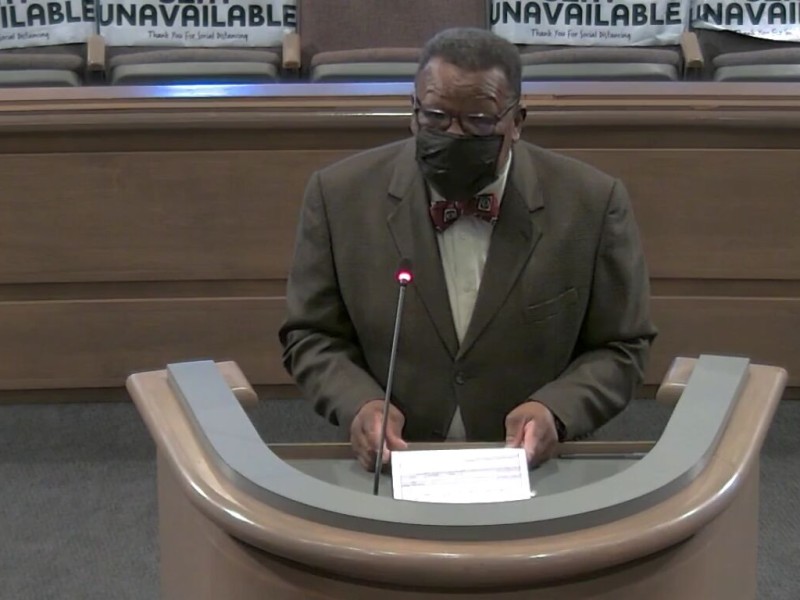
“We initially applied for a grant of $6 million, actually $6.6 million,” Chief Superior Court Judge Willie E. Lockette told Dougherty County Commission members on Monday. “Our plan initially was to address a huge backlog in multidefendant cases.”
One murder case awaiting resolution includes 14 defendants. Instead of holding a large trial that includes all 14 at one time, which would have been possible at the Civic Center, Lockette envisions limiting trials to four or so of those 14 defendants at a time instead.
The focus will remain on addressing violent felony cases. The state awarded $2 million, the maximum amount for the grants, to Dougherty County, and as of Dec. 31 there were 146 cases involving 303 defendants in that category.
The grant funds are limited to cases involving charges of murder, kidnapping, armed robbery, rape, aggravated child molestation, aggravated sodomy and aggravated battery.
Aggravated assault cases that involve shootings in which the intended victim lived, a category for which there are a large number of defendants awaiting trial, are not among the backlog, Lockette said.
The grant funds will be used to provide additional resources for personnel and security. In addition, plans are to begin in April holding two trials simultaneously in the courthouse building.
Violent felony cases will be the priority for courts for the foreseeable future, Lockette said.
“What we’re going to do, we’re going to have every trial for these cases for the remainder of the calendar year,” he said. “These cases rise to the top, and we’re going to focus exclusively on those particular cases.”
In addition to extra security, including salaries for the extra deputies who will be needed for the high-profile cases, and equipment, the district attorney’s office has requested seven additional assistant prosecutors. There also will be additional costs for locating witnesses needed for testimony and the costs associated with travel and lodging for expert witnesses.
Additional court personnel such as clerks also will be needed, and the courts also plan to enlist assistance from a semi-retired senior judge to help work through the backlog.
“Those are things that we have to be able to fund to be able to accomplish the goal of reducing these cases,” Lockette said. “We think we can efficiently and effectively make some great strides in reducing the backlog” that resulted due to the pandemic.
Author

Related Articles
Candidates debate health care, development, rural investment at Albany forum
Candidates seeking to represent Southwest Georgia called for greater investment in health care, education and infrastructure during an Oct. 1 forum, but differed over data centers, economic development and how to work across party lines.

Former Dougherty Commissioner Harry James challenges ‘dean of legislature,’ Gerald Greene
Georgia voters go to the polls on Nov. 3.Among the state House races on the ballot in southwest Georgia is District 154, where incumbent Republican Gerald Greene will face Democratic nominee Harry James.
County approves 198-foot Gillionville Road cell tower; no speakers at public hearing
Dougherty County commissioners unanimously approved a 198-foot cell tower behind a church on Gillionville Road, with no one speaking for or against it at the public hearing.
