
Brain drain in the Georgia legislature?
Ross Williams/Georgia Recorder
By Stanley Dunlap
Georgia Recorder
ATLANTA — The Georgia Legislature needs to replace a wealth of knowledge in coming years following the announced departure of the chief House budget writer, the lawmaker who controls which Senate bills receive a vote, the widely admired “dean” of the House, a GOP public education maverick and others who long carried their party’s standard.
The revolving door in the Gold Dome will continue this election season with several dozen seats up for grabs in 2022 in which no incumbents or former legislators are in the running, a number about in line with the previous election when 14% of the class of 236 lawmakers were freshmen. About 50 of this year’s 236 legislative races don’t feature an incumbent.
When you account for retirements, a large crop of legislators seeking higher office and redistricting, it’s leading to not only fresh faces joining the legislature, but also what portends to be some significant turnover and loss of experience when the new session arrives in January.
Longtime Georgia political observer Charles Bullock said that as some legislators spend more time in office and reach more powerful positions, there becomes a breaking point where the investment it takes for what’s essentially a full-time job for part-time pay gets old.
“Whatever they do to earn a living and doing this legislature gets to a point where, ‘I need to get to make politics full-time,’” the University of Georgia political science professor said. “‘And I can do that by getting elected to Congress — or to one of the state constitutional offices or I just gotta get out of here. I can’t continue to invest as much time as I am here for $17,000 a year.’”
This year’s brain drain also includes legislators credited with an ability to work successfully across the political divide. And multiple lawmakers who’ve spent 10 or more years representing their Georgia districts are making way for new blood.
One of the most significant losses of institutional knowledge comes from the retirement of Rep. Terry England, an Auburn Republican who was the point man overseeing Georgia’s budget through both lean and flush times as the chairman of the House Appropriations Committee. During his watch, the state rebuilt its reserve fund from depleted to more than $3 billion.
England cited some of the toxicity in today’s political discourse as a reason for him stepping down after entering office in 2005.
England’s resignation comes a year after the death of Sen. Jack Hill, the former senate budget chairman with whom England worked closely. Over the years, England and Hill frequently urged caution against rolling back income taxes, a politically popular proposal which he warned would drain the state’s rainy day fund.
Seeking to fill England’s House District 116 seat is Republican Bruce Bennington, who works in the aviation industry, and current Democratic Rep. Holly El-Mahdi, who now falls under the new boundary lines following state-level redistricting last fall.
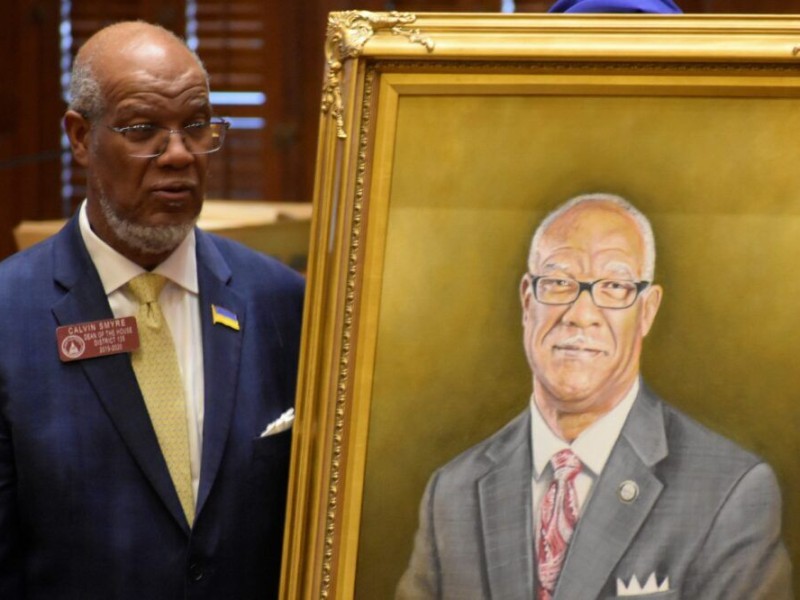
Meanwhile, after spending the last 48 years representing Columbus inside the state Capitol and becoming the first black legislator to serve as Rules Committee chairman and a sitting governor’s floor leader, Democratic Rep. Calvin Smyre is bidding farewell as he awaits confirmation of his appointment by President Biden as U.S. ambassador to the Dominican Republic.
House Minority Leader James Beverly, a Macon Democrat, said losing Smyre would deal a severe blow to a party that also will have to replace about 20 of its 77 sitting state lawmakers.
Other departures in state Democrats’ leadership positions include Rep. Erica Thomas, who is her party’s caucus vice chair, and East Point Rep. William Boddie, who has served in caucus leadership. After six years in the House, Boddie is running for Labor commissioner
In March, powerful Senate Rules Chair Jeff Mullis, a Chickamauga Republican, announced he would not run for re-election after 22 years in the Senate. In his farewell speech, the Senate’s gatekeeper of legislation, whose shrewd tactics have either helped or hindered other legislators’ efforts, talked about how much he’ll miss the gamesmanship.
Bullock said a great deal of institutional memory is leaving the legislature and also valuable expertise of members who have chaired committees, meaning another adjustment for those people accustomed to their leadership styles.
“There’s a lot of uncertainty trying to anticipate what this new chair is likely to do with the issues,” he said. “It’s also time for some juniors and younger legislators to step up and see if they’re up to the jobs that they’re going to be given.”
One of those vacuums is left by Cobb County Republican Sen. Lindsey Tippins, whose retirement means a loss of a GOP public school champion, a chairman of the Senate’s Higher Education and Youth Committee and an ex-chair of the Youth and Education Committee. Tippins often criticized the Republican push for private school vouchers, stating that he was not a believer that diverting money away from underperforming public schools would solve K-12 education problems. It was often a lonely position to defend.
Along with the retirements from elected office, both Democrats and Republican parties also are losing key voices and caucus leaders who are seeking higher office.
Among those are Senate Pro Tempore Butch Miller, who wants voters to give him a promotion from second-in-command in the Senate to make him the GOP’s candidate for lieutenant governor.
Other Republican senators leaving incumbency behind to run for higher office include Sen. Burt Jones, who also is seeking the office of lieutenant governor; Sen. Tyler Harper, who is running for the job of agricultural commissioner after 10 years in the senate; and Sen. Bruce Thompson, a four-term senator from White who wants to be Georgia’s next Labor commissioner.
Senate Majority Leader Mike Dugan, a Carrollton Republican, said his party is facing some significant departures, as are Democrats from his chamber with Sens. Jen Jordan, Lester Jackson and Michelle Au moving on. Dugan said those three state senators passionately represented their districts even though he disagrees with them on many issues.
“Any time nine of 56 Senators leave, there are going to be gaps stemming from a lack of experience and procedural knowledge,” the Carrollton Republican said. “I feel it is fair to say that, regardless of how each of us determines is the best way for the state to move forward, we all genuinely care about and have great respect for one another. These losses will be emotional for sure.
“But, and there is always a but, each of us will only serve a finite amount of time. We will come in and do the best we possibly can and then hand the position to another highly skilled person to continue the effort.”
After 16 years, LaGrange Republican Rep. Randy Nix, whom House Speaker David Ralston has referred to as a spiritual advisor, is stepping down. The Ethics Committee Chairman often railed against efforts to expand gambling as proposals gained more support in the last couple of years before fizzling out. And after two decades, a key figure in promoting medical cannabis legalization in Georgia, Rep. Micah Gravley, a Douglasville Republican, is not seeking a sixth term.
Meanwhile, Jordan’s seat will be filled as she runs to become the Democratic nominee to challenge Republican Attorney General Chris Carr. In addition to serving as an authoritative and fervent voice for Democrats in the chamber, the two-term senator and attorney also held the rare position of a minority party committee chair, leading the chamber’s special judiciary committee.
Author

Related Articles

How Trump’s Endangered Species Act revisions could affect Southwest Georgia
Earlier this month, the Trump administration finalized a rule rescinding the long-standing regulatory definition of “harm” under the Endangered Species Act, removing language that had interpreted the law to include significant habitat modification or degradation that actually kills or injures protected wildlife.

Mitchell County official refutes charges made by group opposing rezoning of land to be purchased by energy giant
“At no time has NextEra mentioned a data center,” James Eubanks said of negotiations with the world’s largest electric utility holding company.

Mitchell County group fights NextEra Energy project
On June 29, the Mitchell County Board of Commissioners voted to approve a rezoning request that would change 300 acres in the northern part of the county from Agriculture to Industrial.
