
CARLTON FLETCHER: A little self-discovery … finding out ‘what happened to you’

By Carlton Fletcher
[email protected]
“If you don’t know me by now, you will never, never, never know me.”
— Harold Melvin & the Blue Notes
The question, I’ll admit, caught me a little off guard.
“I want to know, what happened to you? You used to be …”
The question — and would-have-been follow-up, had not Raphael Warnock said he had to move on to his next appointment — came from John Hayes, not someone I’d spent a lot of time talking to lately. In fact, the last time we’d spoken had been the Saturday after he lost his Dougherty Country Commission seat to Victor Edwards. We were in the parking lot of an East Albany Community Center on a Saturday morning, just him and me.
“You know, you cost me the election with the stuff you wrote in the paper,” Hayes said.
Hayes had been involved in an embarrassing — for the county, for himself and for two very good men, both of whom I admire — situation that ended up costing the county $50,000 to settle a hostile workplace suit that, had it gone to court, would have cost the county’s taxpayers a whole lot more. Caught in the wrong place at the wrong time, Hayes had threatened a county employee, poking the employee in the face in the process.
And, yes, we wrote about that incident in this newspaper in the lead-up to the election. What Hayes failed to acknowledge, though, was that his opponent had had his own legal issues that we wrote about as well. We wrote stories the same length, with pictures the same size, and offered quotes by both candidates.
Here’s what I told Hayes on that Saturday morning when he accused The Herald and me of being the reason he lost the election. (And, let me be honest here, the language I used on that day was not as pure as I’ll offer here.)
“I find it odd, Mr. Hayes, that you would blame your election loss on The Herald and on my writing. Because, correct me if I’m wrong, but didn’t you, on a number of occasions leading up to the election, say this newspaper was the ‘white newspaper’ and that no black person would be caught dead reading it?”
You, and those supporting your candidacy, as a matter of fact, tried to turn anything written about you into a racial issue, even when racial animosity had no part in any of it. (Those two men that I admire who were so wronged by Hayes, incidentally, are African American men, men of substance. To try and turn anything written in support of these men into racial commentary is itself racist. But that never occurred.)
So, what happened to me?
Well, Mr. Hayes, as you prepare for your run for the state House of Representatives, let me tell you “what happened to me.”
Essentially, I had my eyes opened. See, I held you in regard on those days that I joined you in your office to talk about issues that concerned you, the days I rode with you through the streets of your district to talk about your vision for the county. I had no reason to doubt anything you said or claimed, and I spent a lot of time and ink telling the people of your district and of the county your plans.
However, all of those promises and visions of grandeur you presented turned out to be little more than idle talk. Instead, you did what you did. That, sir, is why you lost your election. While you were trying to chalk it up to race, the good people of your district — the overwhelming majority of whom, by the way, are African American — decided you’d cost them enough. And they voted for someone they trusted more than they did you.
What happened to me is I foolishly believed a politician who turned out to be more about himself than the people he said he wanted to represent. But at least I learned a valuable lesson. And I’ve sworn to base my future trust in people’s actions, not their words.
Author

Related Articles
Dawson police arrest wanted suspect after Flock Safety camera alert
According to police, May drove into the yard of a nearby residence instead of complying with officers’ commands. He then exited the vehicle and ran into the home on foot.
Lee County stands alone without E-SPLOST. Here’s what that means for schools, taxpayers and the county’s future
Following the defeat of its referendum, Lee County became just the second of Georgia’s 159 counties without voter approval for an active ESPLOST, leaving the school system without the state’s primary local funding source for major construction, renovations, school buses and other capital improvements.
Chamber celebrates new businesses, invites community to Coffee and Connections event
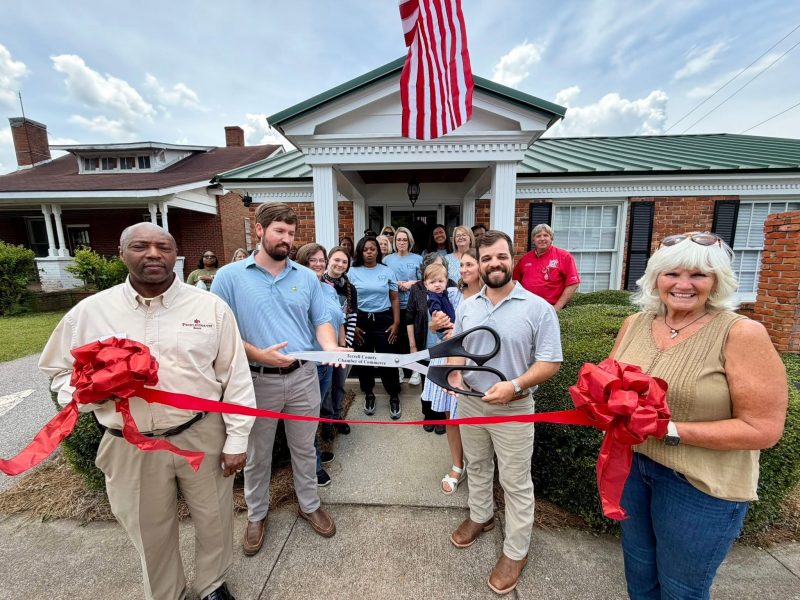
The Terrell County Chamber of Commerce is continuing its efforts to strengthen local business relationships through community celebrations and networking opportunities, recently recognizing two new businesses with ribbon-cutting ceremonies and announcing its next “Coffee & Connections” event in Sasser.
