
Newly re-elected Albany trio set to get back to work
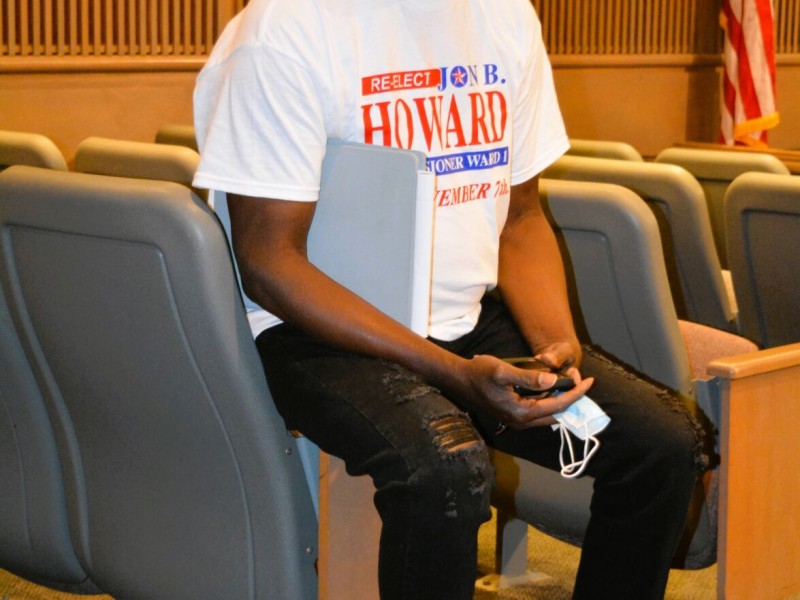
Staff Photo: Carlton Fletcher
By Carlton Fletcher
[email protected]
ALBANY — Moments after reclaiming their seats in Tuesday’s municipal election, Mayor Bo Dorough and Albany City Commissioners Jon Howard and Chad Warbington were already talking about building on the momentum the city had gathered in the weeks and months leading up to the election.
“We have the economic pieces in place to stimulate growth, in housing, commercial and retail,” Dorough said after surprising many political followers by winning a second term in office without a runoff. Dorough collected 4,569 votes, 52.81% of the total cast in the mayoral race. Former Albany City Commissioner Henry Mathis, who’d collected endorsements from several high-profile ministers in the community days before the election, finished second with 2,671 votes (30.88%), while Antonio Screen Sr. received 1,192 votes (13.78%) and Omar Salaam 219 (2.53%).
Howard, the city’s longest-serving commissioner, easily withstood his first challenge since 2007, collecting 74.23% of the Ward I ballots cast (743) to challenger Lawrence McCray’s 25.77% (258 votes).
Warbington earned a second four-year term by collecting 1,419 votes (59.65%) to challengers Marion Gaines Jones’ 726 and Larry Harris’ 234.
In a countywide referendum on the ballot, 66.94% of the voters approved a 1% transportation special-purpose local-option sales tax.
Dorough said he and other city officials are looking forward to working with almost $100 million worth of development planned in the city, including $18 million of residential funding that was recently approved for development of the Davis Building at the corner of Broad Avenue and Washington Street, directly across from the future home of the Albany Museum of Art.
“Let me give you the numbers: We have $35 million for the Herald Building and the old Gordon Hotel (downtown); $35 million for the Civil Rights Institute; $5 million for the St. Nicholas Building — the old Joe’s Cellar — that will include extended-stay housing, a bar and a 3 Squares restaurant; a $4 1/2 million-dollar project renovating the Ritz Cultural Center; and (millions) in stimulus and SPLOST money to improve recreation facilities,” the mayor said.
“With these kinds of projects, we can reinvent our downtown. I think the people are excited about that, and despite all the misinformation that’s been put out, we have wisely used $15 million in funding on our sewer separation project; we’ve prudently spent our funds. And even with the mandate to improve our sewer system, our monthly rate is $35. In Atlanta, which also was under a mandate to separate its combined sewer system, the citizens are paying $87 a month. And we haven’t raised our electric rates in the four years I’ve been mayor.”
Howard said affordable housing remains one of his priority concerns.
“I think we need — and I’m going to push — to have regular meetings with city and county officials, with school officials, with the chamber, the EDC … all the stakeholders, to talk about these issues — about the overwhelming poverty — that has plagued parts of our city for years,” Howard said. “I know I won’t be around to see the end of poverty — when LBJ started his war on poverty in 1965, there were 19 million poor prople. We still have more than 15 million.
“But I’m excited to be given four more years to try and work on these issues.”
Warbington said the final few days before Tuesday’s election proved to be harmful for the unity of the board as fellow commissioners he refused to name started tossing out “negative sound bites” to undermine his campaign.
“It’s disheartening, because there are only seven of us doing the work for the people of this community,” the Ward IV commissioner said. “The only way we’ll accomplish our goals is by working together. I think we need, for lack of a better term, a come-to-Jesus meeting.”
Warbington, too, said the commission had begun to “move the needle” in a positive direction in recent months and now stands ready to make significant improvements.
“I appreciate the fact the voters in our community did not listen to the negative rhetoric; they didn’t see Albany as a city that needs saving,” he said. “I think the election results reflect the fact that we are on the right path to keep moving forward.”
Noting a dismal 17.55% turnout among overall county voters for the T-SPLOST referendum and only slightly better participation in the contested races (28.31% among Ward IV voters, 14.22% in Ward I, and 19.10% in the citywide mayoral race), Elections Supervisor Ginger Nickerson said she was pleased with the work of staff working the county’s 26 precincts.
“Things went smoothly,” she said. “Certainly, we would like to see more people participate in every election, but we had no issues over the course of Election Day or the early voting period.”
Author
Related Articles
Congress weighs packaging bill with implications for Albany manufacturers
A congressional hearing this week on proposed national packaging-labeling standards could have implications for several of Southwest Georgia’s largest manufacturers, many of which produce or package products shipped across state lines.

Dougherty County Sheriff’s Office, GBI investigate inmate death
“The sheriff’s office will conduct an administrative investigation to determine if the staff response was appropriate. We have requested that the GBI conduct an investigation.”
Dougherty Jail graduates first class of female GED recipients
“It was an escape. I can say this has been challenging. I want to express my gratitude for being able to attend this program.”
