
Thandi: Gloria Gaines helps tell the amazing story of South African hero
Staff Photo: Carlton Fletcher
By Carlton Fletcher
[email protected]
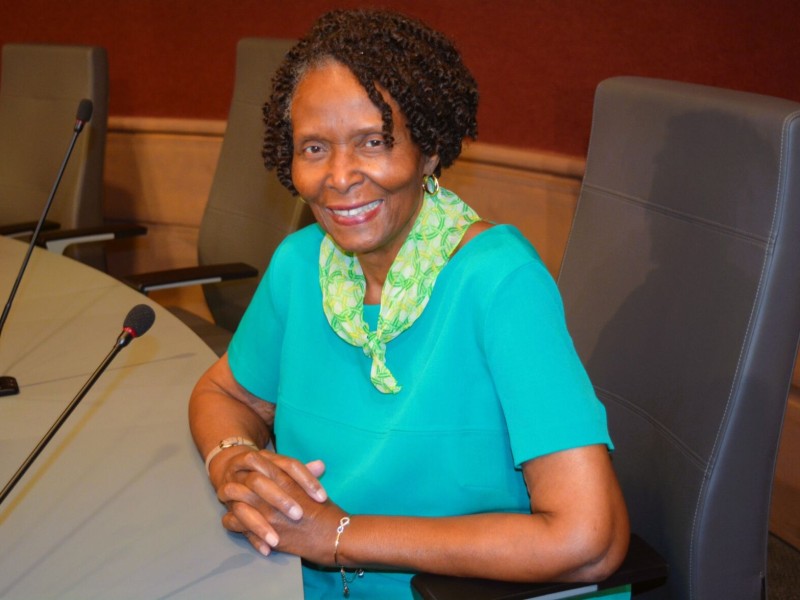
ALBANY — It was in New York and later Atlanta that south Georgia born-and-raised Gloria Gaines became a boots-on-the-ground warrior in the international battle against the horrors of apartheid in South Africa.
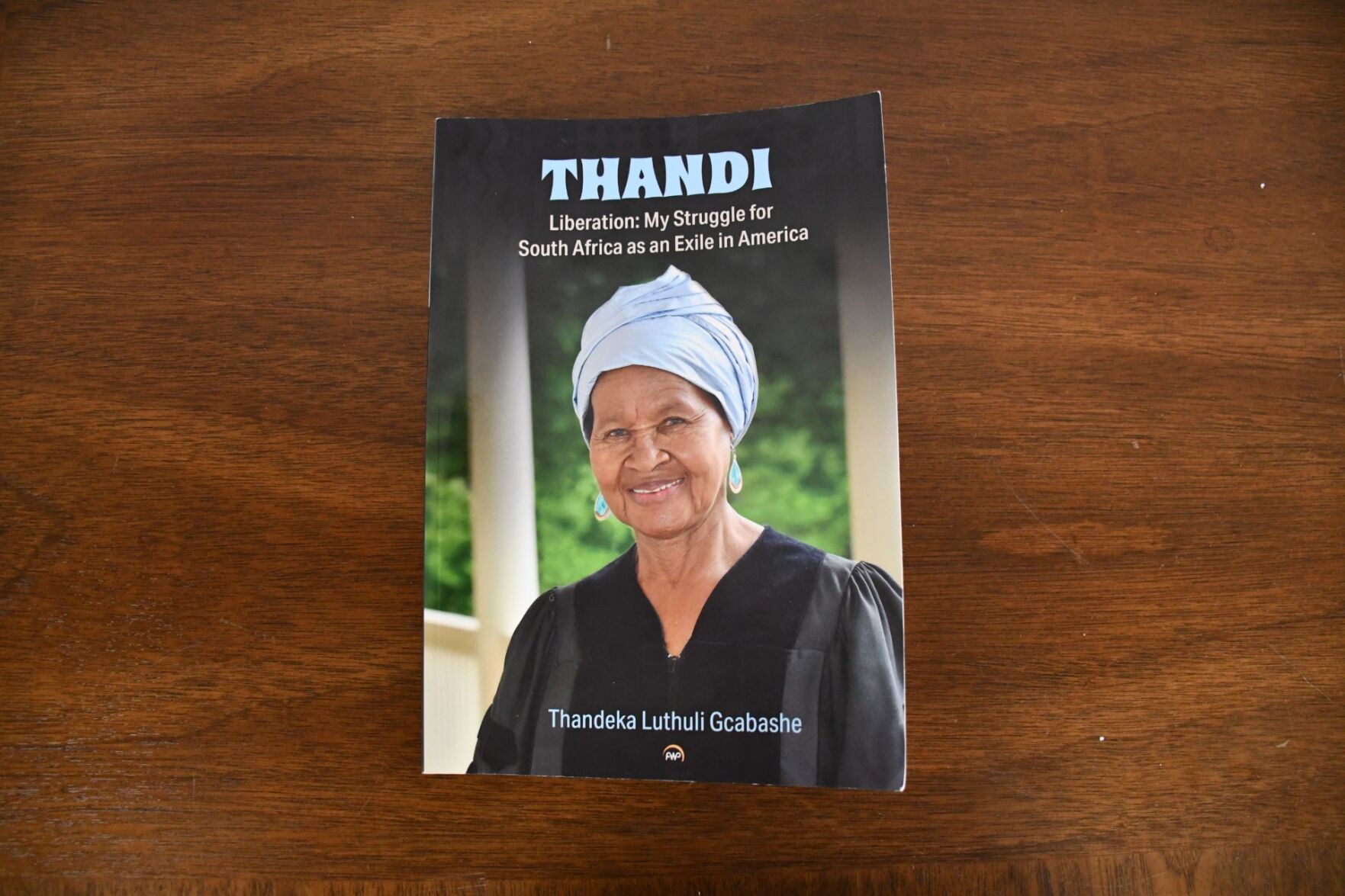
Gaines, an Albany native who is a long-serving member of the Dougherty County Commission, recently returned home from a free South Africa — one of “more trips to the country than I can count on all my fingers and toes” — a bona fide published editor having served in that capacity for “Thandi — Liberation: My Struggle for South Africa and Exile in America,” the riveting story of exiled — and triumphantly repatriated — freedom fighter Thandeka Luthuli Gcabashe.
Gcabashe — “Thandi” to her friends — was secreted to America in June of 1970, escaping the inhumane reality of apartheid with four young children in tow, sponsored in Atlanta by Coretta Scott King. Before returning permanently to her freed homeland in 1996, Thandi helped establish the first African National Congress chapter in Atlanta and was one of the principles, along with Gaines and others in America, who revealed the devastating impact of apartheid on a native people who suffered for decades under the racist ideology before finally gaining their rightful freedoms.
“Thandi and I became fast friends,” Gaines said. “She’s been here to Albany, been in my house, spoke to students at Albany State University. Her history is so rich, this wonderful person who escaped apartheid and lived in exile in our country.
“Thandi’s work on behalf of South Africa was historic. Her family was very much involved in the long-term history of her country, and she was a tireless fighter for a free South Africa.”
Gaines, who with Elizabeth Enloe (“another dear friend”) edited Thandi’s memoir, offered a loving tribute to her friend in “Thandi — Liberation’s” preface.
“Imagine that,” Gaines wrote. “Me, an insignificant little black girl from Albany, Georgia, forming such a strong bond with someone such as Tandi (the Americanized spelling). She, indeed, was not a respecter of status, but rather, what I hope, an astute judge of ‘the content of one’s character.’ It is that light in her that led Tandi to successfully prosecute one of the major international responses that helped to ultimately end apartheid.”
For those who learned only the most basic details about apartheid in South Africa, a policy of white rule in a country whose population was almost three-quarters black that evolved there after first the Dutch and then the British relinquished power (the latter in 1931), Thandi reveals its lived-in ugliness in her memoir. Both she and Gaines liken the concept to the Jim Crow laws of the American South after the Civil War.
“I learned about what was going on in that part of the world in the late ’70s, when I lived and worked for an architectural firm in Nigeria,” Gaines said. “People there asked me to look into what was going on, and when I repatriated to America, I made a promise to look deeper at and get involved in efforts to end apartheid.”
Before the abhorrent policy was finally ended through international pressure, much of it coming in the form of sanctions and divestiture, South African blacks were subject to random government attacks on their person, massacres, removal from their property if it was sought by whites, forced detention and imprisonment without a trial. Death Squads randomly massacred blacks without cause, and government policies, such as moving black citizens into “homelands” that made up only 13% of the country’s land, were enacted in an effort to secure white rule.
Thandi, whose father, Albert Luthuli, was chief of their native Groutville village, president of the powerful African National Congress, and a 1960 Nobel Peace Prize winner, became a nurse in South Africa before her exile in America. A friend in the nation’s government helped her secure a passport for her family at a time when blacks were typically not allowed to own them. She came to America, selecting Atlanta as her destination over Washington, D.C., and San Francisco.
“We loved the vibrancy of Washington, its politics and historical sites,” Thandi wrote. “San Francisco was beautiful and picturesque, and had a special appeal for its hilly topography, not unlike Durban (in South Africa). Atlanta won our hearts for a variety of reasons. It was comfortably small to raise our children without encountering problems of big-city life. It had civil rights organizations and institutions such as the Southern Christian Leadership Conference, the Martin Luther King Center for Nonviolent Social Change, the NAACP, the Urban League and many more.
“Other major draws to Atlanta were the strong religious culture of black churches and, in all honesty, the sizeable black population.”
As fate would have it, Thandi’s exile in Atlanta coincided with Gaines’ decision to get involved in the anti-apartheid movement. When Gaines was elected co-chair of the South African Divestment Center, the pair crossed paths.
“I stressed the need for individuals who would be willing to share their time and talents in working with me,” Thandi wrote. “Participants immediately formed a committee … including professors from Atlanta University Center … and Gloria Gaines, who had contacted me upon seeing the ad (announcing a public gathering) and met me for lunch. Gloria had recently returned to Atlanta from Nigeria, where she had been introduced to the struggle in South Africa. She was committed and energetic and a perfect leader. She became my good friend.”
Gaines worked with her friend on a divestment strategy, putting pressure on American institutions that were pouring money into South Africa. Much of their strategy revolved around financial issues, and they led a sustained boycott of Coca-Cola, whose corporate offices are in Atlanta.
“The idea was to offer a nonviolent response to this company that was making millions of dollars in South Africa,” Gaines said of the Coke boycott.
Other major corporations targeted by the anti-apartheid group were Ford Motor Co., General Electric, General Motors and National Cash Register, all Top 20 investors in South Africa and all with corporate or regional offices in Atlanta.
Thandi’s amazing life intersected with some of the world’s best-known leaders: Nelson Mandela, Desmond Tutu, Andrew Young, Jesse Jackson, Joseph Lowery and others who led rights struggles in both America and South Africa. For Gaines, involvement in the brilliantly written (and edited) “Thandi — Liberation: My Struggle for South Africa as an Exile in America” was a passion project whose completion was the realization of one of her life’s most fulfilling achievements.
“Those of us who knew her well had so much faith in Thandi,” Gaines said. “Because of who she is, I felt honored to be a part of this project. I am so pleased that we achieved our goal of getting the story of her struggle on paper and into her hands before she passes away.
“Thandi’s work was historic. She’s 90 now, but she can look back on a driven life that literally helped change the world. I am so proud to have had the opportunity to fight beside her.”
Author

Related Articles

From cotton to cloud: In the data center debate, is rural Georgia once again being asked to carry the cost?
Across much of rural Georgia, the abandoned cotton warehouses and shrinking tax bases remain — enduring reminders that industries built to serve distant markets do not necessarily stay rooted in the communities that first sustained them.
My Grandpa Was Killed in World War II. I Met Him Through His Letters Home
Gina Wolf’s grandfather died before she was born. His letters sent to her grandmother from Europe during World War II made it possible to know what kind of man he was.

‘Sounds Like a Mutiny.’ Secret Recording Exposes Claims of Toxic Leadership After a Marine’s Suicide
This week’s War Horse story follows the systemic failures before and after the death of Cpl. Drew Mobley who was the third in two years at Marine Corps Base Quantico to die by suicide.
