
A rearview mirror look at 2022
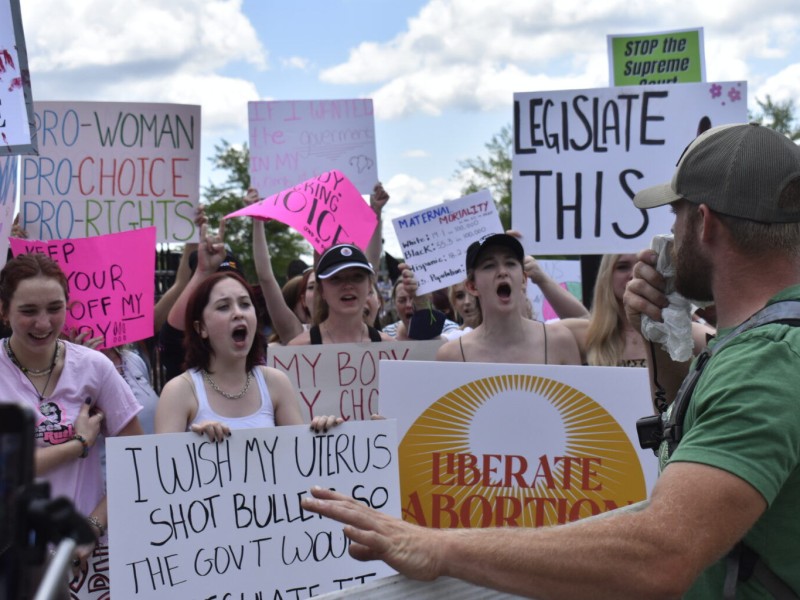
Special Photo: Ross Williams/Georgia Recorder
By Ross Williams
Georgia Recorder
ATLANTA — A lot happened in Georgia in 2022. The end of Roe v. Wade kicked off an ongoing court fight set to shape the future of reproductive care. The state lost one of its most vaunted leaders when House Speaker David Ralston died last month. The nation watched as a Fulton County district attorney launched a historic investigation into the actions of former president Trump following his election loss two years ago.
Through it all, the culture war and a high-stakes election provided a constant thrum of news.
As a new year approaches, here are some of the biggest stories the Georgia Recorder followed in 2022:
Culture war continues: For many, the seemingly ceaseless culture war represents little more than a distraction, a tiresome barrage of squabbling politicians, repugnant pundits and awkward conversations over the holiday dinner table.
But for those caught in the cultural crossfire, who often include racial, sexual and religious minorities, discussions of who and what ought to be valued in American culture are anything but insignificant.
Before abortion and elections took over the zeitgeist, the most significant cultural clashes came in the classroom, as the legislative session was dominated by arguments over how to teach the unsavory parts of American history.
Conservatives led by Gov. Brian Kemp said some teachers were seeking to divide and indoctrinate students by making white children feel culpable for historical wrongs like slavery and Jim Crow laws. Educators vehemently denied that teachers are seeking to make children feel bad about themselves, arguing along with Democrats that students should learn about how past injustices created current inequities.
In the spring, Gov. Kemp signed a raft of legislation banning teachers from teaching so-called divisive concepts, including that the United States or Georgia are fundamentally racist.
And transgender Georgians and their allies were blindsided by a last-minute bill reviving a previously stalled measure to ban transgender girls from playing on girls’ sports teams in school.
Other bills in the package set rules for public comment in school board meetings and for parental review of classroom and library materials.
The same month, Kemp signed legislation removing permit requirements for concealed handguns. The bill delighted gun rights activists, who said it brings state law more in line with what the founders intended and protects the right to self defense. It also incensed many liberals, who said the bill increases the risk of gun injuries and deaths.
Fulton DA investigates former president: If the culture wars have a human avatar, it may be former President Trump. Though his influence may be waning, his trials and tribulations remain front of mind for partisans of both flavors. To his die-hard supporters, he’s the voice for a swath of America ignored and despised by elites. To his opponents, he’s a dangerous and embarrassing oaf.
Those opponents are rooting for Fulton County District Attorney Fani Willis to prosecute the former president in connection with efforts to overturn Georgia’s 2020 election, exemplified by his 2021 phone call with Secretary of State Brad Raffensperger asking for him to “find” enough votes to tip the election in his favor.
At the start of the year, Willis got the OK to call a special grand jury to investigate whether those efforts violated election law.
That investigation has since delivered testimony from major GOP players, including Kemp, former national security advisor Michael Flynn and South Carolina Sen. Lindsey Graham, who took the stand reluctantly.
A report released by the Brookings Institute on Nov. 14 indicates that Trump is at risk of prosecution, and several of his closest allies have already been caught up in the investigation, including Graham, former personal attorney Rudy Giuliani and former White House Chief of Staff Mark Meadows, who late last month was denied by the South Carolina Supreme Court a motion to quash the summons to testify in Georgia.
Another potential target of the probe is Georgia’s newly elected Republican lieutenant governor, Sen. Burt Jones, who served as one of the 16 fake Republican electors who signed documents proclaiming Trump as the victor of the 2020 election.
Respected speaker passes: With the death of long-time House Speaker David Ralston, a Blue Ridge Republican widely respected as an effective statesman, next year’s session will begin with a new hand on the steering wheel.
Ralston, who was 68, died Nov. 16 following an extended illness. The longest currently serving state House speaker in the country at the time of his death, Ralston was remembered fondly by members from both parties as a kind man and a skilled politician adept at bringing people together while sticking to his conservative principles.
Ralston’s widow Sheree Ralston, executive director of the Fannin County Development Authority, was one of five Republicans to qualify to run to represent his district. Banker Johnny Chastain, airport manager Justin Heitman, talk show host Brian Pritchard and filmmaker Richie Stone are also set to be on the ballot during a Jan. 3 special election.
Abortion controversy roils: It was not a complete surprise when the U.S. Supreme Court reversed Roe v. Wade, ending the constitutional right to an abortion. A draft of the decision leaked in the spring, sparking protests across the country, including in Georgia.
It is now up to states to decide their own abortion policies, and in Georgia, the law now restricts most abortions after six weeks of pregnancy. That law was originally passed in 2019 and went into effect in July following the high court’s June ruling.
Opponents say the law puts the health of women seeking abortions at risk, and the language used in the bill raises questions in many areas of state law, particularly language defining an embryo as a legal person.
GOP lawmakers on the campaign trail largely said they were content with the six-week ban, which at the time of its passage in 2019 was considered the toughest in the nation. But while the six-week mark comes earlier than many women even know they are pregnant, other states have since passed more restrictive bills, and abortion clinics report women from other states traveling to Georgia to seek care.
Heated elections favor GOP, Warnock: Georgia’s political class logged many miles campaigning across the state in 2022, first for the May party primaries, then for the November general election — and voters got a December runoff for the U.S. Senate as a bonus.
Former GOP Sen. David Perdue sought to thwart Kemp in his re-election race against Democrat Stacey Abrams, but Kemp trounced Perdue, who had the backing of Trump, peeved at Kemp for his lack of support in overturning Georgia’s election results.
Across other statewide offices, Democrats offered a diverse field of polished candidates, many of whom cut their teeth in the state Legislature, a sign of the party’s growing strength in Georgia. They were hoping to ride the coattails of Abrams, who attained national prominence following her narrow 2018 loss to Kemp.
That would not be in the cards in 2022, however, as voters chose Kemp by a bigger margin than four years prior, and Republicans partied hard the night of Nov. 8, celebrating wins in every statewide office, with one big exception.
Though he was a darling for the conservative base, Trump-backed Senatorial candidate Herschel Walker’s campaign was riddled with gaffes and negative stories about his past behavior, turning off many voters not strongly attached to the Republican Party. Incumbent Democrat Raphael Warnock earned more votes than Walker on election night, but he did not get the 50% he needed to beat the Republican challenger outright, launching the whirlwind runoff shortened from nine weeks to four by last year’s controversial election overhaul.
The following four weeks featured non-stop campaigning with visits from former presidents and senators and an army of volunteers knocking on doors and texting voters. When the dust cleared, Warnock prevailed, giving him a full six-year term representing Georgia and handing his party a coveted 51st vote in the Senate. Nationally, Democrats outperformed expectations in November, but they lost control of the House, setting the stage for a split government.
The 2022 election could continue to reverberate in the state Legislature. Raffensperger has called for lawmakers to revisit runoffs, citing stress for counties to run multiple elections and for voters to cast their ballots a second time during the busy holiday season. Only a handful of states have runoff elections.
Raffensperger did not call for a specific solution, but lawmakers could consider options implemented in other states, including an instant runoff or ranked choice voting.
Author

Related Articles
Albany Herald – June 20, 2026
City Albany faces shortfall for police… Women’s Anchorage tentatively set to… Commissioner, school leaders clash over…

Classifieds – June 20, 2026
ALBANY HERALD CLASSIFIEDS JUNE 20, 2026
Public safety drives Leesburg’s $4.2 million Fiscal Year ’27 budget
The adopted spending plan reflects modest growth in city revenues and continued emphasis on maintaining core municipal services, particularly public safety and sanitation, which together account for a significant share of general fund expenditures.
