
Georgia Hunters for the Hungry program expands efforts with new funding
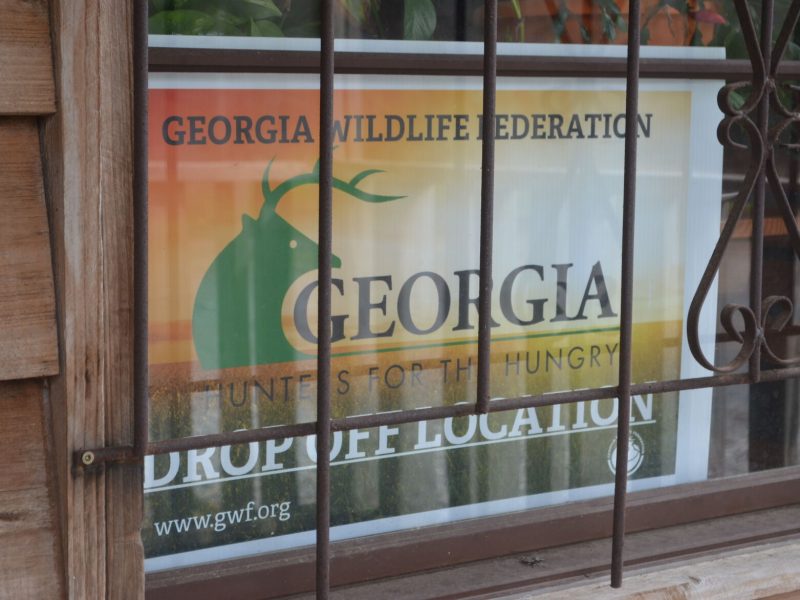
A Georgia Hunters for the Hungry sign sits in the window of a meat processing facility in Terrell County.
Staff Photo: Lucille LanniganBy Lucille Lannigan
[email protected]
ALBANY – Georgia’s Hunters for the Hungry program saw an explosion of growth in the last year.
The program, which began in 1993 and allows Georgia hunters to donate excess deer meat for those in need, was contracted to process and donate about 6,200 pounds and was struggling with funding last year. With the help of state legislation and the Department of Natural Resources, the program is seeing increased funds. With more money, the program upped its contract to donate 145,000 pounds. It also increased the number of processors from about 10 statewide to 52, with four more added to the state’s southwest region.
Lee Walker, the Georgia Hunters for the Hungry executive director, described the program as “a neighbor helping a neighbor.” Not only do processors donate meat to food banks, churches and food pantries in its area, supporting those in need, but by donating meat to the processor, area hunters are helping support small businesses in their community.
“That’s the greatest part of this program – the meat that is being hunted in that area is being donated to that area,” she said. “It stays local. It just comes full circle.”
Participating processors are paid $2.50 per pound for ground venison, and the processors choose where they will donate the meat locally. Walker said they try to disperse it evenly.
Last year, the 6,200 pounds of venison donated was equivalent to 24,800 meal servings. This year’s contracted amount will add up to 580,00 servings.
“The program has surpassed anything that we could have imagined,” Walker said. “We had this goal, and we were kind of hesitant. We thought it was going to be a far stretch, but pretty quickly, it just took off at the end of October. But there’s still room for growth.”
Walker said the program could increase its capacity even more with more funding. Deer season in Georgia runs roughly from Sept. 14 to Jan. 15; although, it is split up into different parts for archery, primitive weapons, firearms, gender and age.
“We’re not even halfway through the season, and I’m already at the max,” Walker said. “There’s still people calling, processors wanting to sign up, but I don’t have any more poundage to allocate to them.”
She said she’d like to see more processors able to join in the southern parts of the state that are more rural.
“When you’re looking at a map, it looks great because there’s 52 of them scattered all over, but in more rural counties … there’s more of an access issue,” Walker said.
Some hunters may have to travel a couple of hours to reach the nearest GHFTH-partnered processing facility. Walker said in that time, the deer could get contaminated or become spoiled. She said the program is looking to add more processors in southwest, southeast and northwest Georgia.
Brent Henry owns Brent Henry’s Deer House in Early County. His business is the most recent addition to the GHFTH program. He said he wasn’t aware the program existed in Georgia, but when DNR paid his shop a visit to tell him about it, he knew it would be a good cause in his community.
Three weeks into being a member, Henry generated buzz for the program among his customers who travel from surrounding counties to get their meat processed. In the week of Nov. 18, he said he already had a couple of deer donated.
Henry said it’s common for people to come into his business needing a place to give deer. He said GHFTH is a good way to ensure meat doesn’t go to waste and helps community members in need.
The need in Early County, he said, is large. Even before he joined GHFTH, Henry donated deer meat to area churches who provided them to families.
Food insecurity is an issue across the state and country, an issue exasperated by food shortages in food banks. Frank Sheppard, the CEO of Feeding the Valley Food Bank Network, said there was a 7% increase in food insecurity in the last year, placing rates at an all time high. Some Georgia counties have a child food insecurity rate as high as 45%.
“That means literally that every other child is critically hungry,” Sheppard said. “That has so many devastating effects on young children and their ability to grow.”
Sheppard said many seniors in the area are on a fixed income and being hit by inflated prices, meaning they often have to choose between food or paying for bills or prescriptions.
Meanwhile, food banks are struggling to meet the need due to a combination of post-pandemic challenges.
Sheppard said Congress’ failure to pass a budget for the last few years led to the continuous delay of a new Farm Bill, which is where federal commodities used by food banks come from.
“We’re hopeful with the new election and one party controlling the house, senate and the White House, that a farm bill will get passed,” Sheppard said. “We’re hopeful it’s one that will be positive and generous with food products for the food bank network.”
Because of the shortage in food bank supplies, Sheppard said Feeding the Valley has invested more in food sourcing. In the Albany area, which is a farm-rich area, the food bank is working with farming entities. It’s also engaged in food as medicine programs with United Health Care and Albany Area Primary Health Care to serve medically tailored food boxes.
Sheppard said GHFTH is another unique food sourcing opportunity that thrives in rural parts of the state. The program has partnered with Feeding the Valley for years. He said it’s become more popular in recent years.
Not only does GHFTH help address food insecurity, Henry said it also helps mitigate an “out of control” deer population. He said there’s been an explosion in the deer population in the Early County area, which is a farming community.
“The farmers need relief,” he said. “The deer are eating up so many crops that it’s become a huge concern in this area.”
Walker said having a place to actually bring the deer encourages people to help thin out the population that is bringing so much damage to farms in south Georgia, many of which already had their crops thinned out from hurricanes.
Anyone interested can find out more about the Georgia Hunters for the Hungry program at their site. Find a processing facility nearby with this map.
Author

Related Articles
From Ledo to Coston, Lee County’s summer road projects are underway
Updates provided during recent meetings of the Lee County Board of Commissioners show projects are underway or scheduled to begin on several county roads, while additional transportation improvements funded through the Local Maintenance and Improvement Grant (LMIG) program and Transportation Special Purpose Local Option Sales Tax (T-SPLOST) are expected to begin shortly after the July Fourth holiday.

PSC candidate Peter Hubbard makes case for election to full term
The reason why voters should pick me is I’m a rare breed in that I read everything that comes across my desk. I’m asking hard questions at the meetings. I want to get to the bottom of are data centers paying their fair share, are residential customers getting their fair share.

Dougherty Schools prepare for bell-to-bell student cell phone ban
As Georgia prepares to expand its statewide ban on personal electronic devices in public schools, Dougherty County School System leaders say they are working to balance compliance with the new law while giving individual schools flexibility in how they implement the policy.
