
Hurricanes, high input costs and low sales prices put Georgia pecan farmers in precarious position
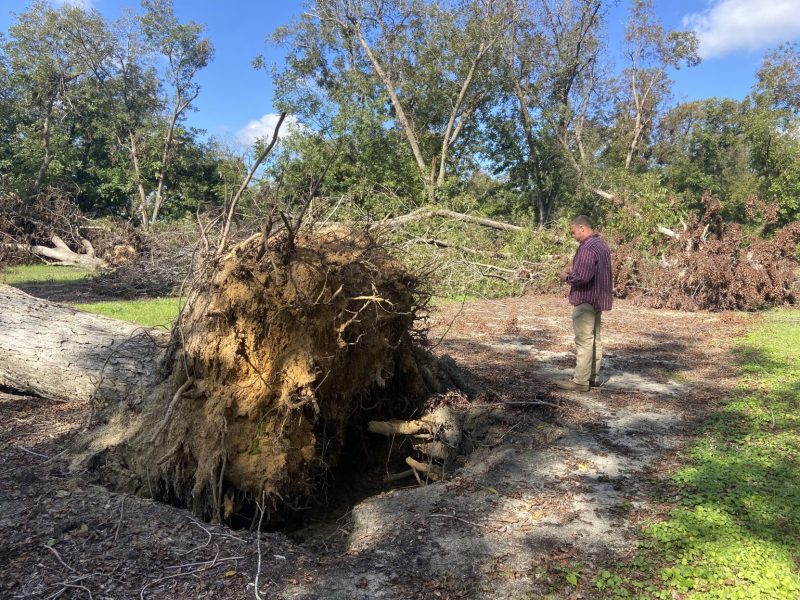
Scott Hudson, a fifth-generation pecan farmer from Ocilla, stands near a 60- to 100-year-old pecan tree that was lost during Hurricane Helene
Staff Photo: Lucille LanniganBy Lucille Lannigan
[email protected]
OCILLA – It’s been an arduous year for Georgia pecan growers.
Back-to-back hurricanes hit the eastern part of the state, while the southwestern sector grappled with weather extremes. All growers faced historic highs for input costs and lows for market prices. The looming presidential change and the tariff proposals that come with it add uncertainty, especially as Chinese tariffs continue to affect the pecan market.
As harvesting wraps up, Lenny Wells, a University of Georgia pecan extension specialist, said this year was a “weird season,” one that was split right down the middle of the state. In the east, farmers sifted through fallen trees and branches. In the west, they sorted through a somewhat large pecan crop yield but were stumped by poorer quality nuts.
Wells said about 75% of Georgia’s eastern pecan crop – about 36 million pounds – was lost to Hurricane Helene. Mary Bruorton, the executive director of the Georgia Pecan Growers Association, said direct tree loss from the storm adds up to about $118 million and future income loss of about $417 million.
“It’s hard to put into words what the loss truly is,” she said. “I’ve never seen anything like this.”
“A feeling of surrender”
Less than two months after Tropical Storm Debby, Hurricane Helene slammed into Georgia pecan farms. Wells said there is little farmers can do to prepare for a hurricane aside from turning irrigation off a few days before.
“For most growers, it’s kind of a feeling of surrender when you see a storm coming,” he said.
The tree branches in Scott Hudson’s orchards, spread across Irwin, Ben Hill, Wilcox and Dodge counties, drooped with thickly clustered pecans – a promising sight – in the days leading up to the storm. However, Helene destroyed all hopes of a profitable season.
The fifth-generation farmer said he felt helpless as Helene tore through his orchards, resulting in the loss of about 30% of his larger, older pecan trees. Younger, smaller trees fared better with only about a 5-10% loss.
“The weather that’s hitting us is making me scared that I’m going to be the generation that loses the farm,” Hudson said.
In response to the devastation, the Growers Association has been advocating for disaster relief and financial aid, including specialty crop block grants. After Hurricane Michael, the USDA allocated $800 million to affected producers, and the Georgia Department of Agriculture provided $347 million.
“We are working, advocating and lobbying for our growers and talking with Congressional offices daily regarding disaster relief,” Bruorton said.
“Something has been just a little off”
In southwest Georgia, pecan harvest season is a different picture but still yielding disappointing results.
Tim Sikes farms 165 acres of pecans in Dawson. He lost 500 trees during Hurricane Michael and said a direct hit from Hurricane Helene would have pushed him out of the pecan industry.
Sikes wrote in an email that this year was a challenge “just like every other year.”
“But something has been just a little off this year for farming, and I can’t put my finger on just what it is,” Sikes wrote.
He chalked it up to failed pollination from weather extremes. April was unseasonably cold and wet, much to the dismay of sun-loving pecan trees. June saw less than a half-inch of rain in its first 25 days, and then Tropical Storm Debby drenched the region in August.
Still, Sikes wrote that the pecan crop looked promising all year until the end, when poor quality began to reveal itself.
Alex Willson of Sunnyland Farms in Albany saw the same issue in his crop. His trees were packed with nuts by early summer, but cracking open the kernel in fall revealed meat that was 3% less full than it should have been.
“That doesn’t sound like a lot, but then you start talking about over hundreds or thousands of acres … then it starts to make a bit of a difference,” he said. “The higher the meat in the nut, the better price you get for it.”
Willson said he was bracing for Helene to be “another Michael.” His farm is still waiting for trees planted after the 2018 storm to become productive.
“We dodged this one, but unfortunately, it seems like this is becoming the new norm,” he said. “We’re going to really have to think about how we can plan for storms like this.”
Low supply and low prices
Beyond the challenges of weather, Georgia’s pecan growers are facing low prices in trying to sell their pecans – a problem exacerbated by tariffs on U.S. exports to China. When Donald Trump takes the presidential office again in January, he’s proposed a 10% across-the-board tariff on all imported goods.
“It’s just kind of an uneasiness at the end of the day,” Hudson said. “We’re worried about whether the tariffs ramp up, like the rhetoric’s saying, will their country (China) retaliate?”
He said his operation is built on international trade and thrived with the Chinese market. Chinese tariffs, in response to Trump’s 2018 tariffs on imported goods to the U.S., saw his sales slip.
Hudson said ultimately it’s out of growers’ control, and he’ll handle the cards he’s dealt. Still, he said he fears for his farm’s future. Higher production costs coupled with low prices mean farmers are struggling to break even.
Adapting and pushing forward
Low sale prices mean farmers are cutting costs everywhere they can.
They’re switching to pecan varieties that require less input costs: from fertilizer, irrigation, etc. However, Hudson said cutting input costs risks cutting quality.
Sikes turned to newer technologies that helped him cut costs. In 2022, he was the first pecan grower to start using Smart Guided Spray Systems. It uses an advanced mapping system on the trees to tell the fertilizer sprayer exactly how much chemical spray is needed. Sikes said it resulted in about a 45% savings on his chemical costs.
Many are diversifying their operations, turning to retail sales, e-commerce or growing other crops as well.
Farmers also implement management practices to build up some resistance to storms, which Wells said data show will continue to increase in intensity.
Most farmers have adopted hedge pruning, a strategy that reduces the size of the tree, making it less susceptible to high winds.
Wells said 10 years of research documented as much as a 60% reduction in damage from more moderate storms.
Despite the challenges that come with it, Hudson said there is nothing he’d rather be doing. He said he hopes open dialogue with lawmakers leads to assistance, both at the state and federal level.
Author

Related Articles
Dawson proposes borrowing up to $420,000 to stay afloat as finances unravel
Documents obtained by The Dawson News show city officials are proposing to balance the budget through a transfer from the Public Utilities Fund while simultaneously seeking authority to borrow as much as $420,000 from a private financial institution to continue meeting payroll and other operating expenses as Dawson works to complete financial audits that have remained unfinished since 2023.

Regional catering business finds new home at Warrior Creek Mercantile
For months, Marchbanks said she had been asking God for an opportunity to serve others. “I just kept praying, ‘God, use me as a servant,'” she recalled. “I didn’t care what it was. I just wanted to be used to help people.”

Leesburg business reflects growing trend toward multi-use downtown spaces
Beyond the pristinely curated lunch spot, owner Sheri Smith has created a small hub of health and wellness services, retail and local partnerships — an example of the type of multi-use business model many small communities are increasingly embracing as they reinvest in historic downtown properties.
