
The boy who drove the bus and helped build a school system
As Lee County grapples with questions of trust, leadership and the future of public education, the life of Dr. Robert Clay offers a reminder of the community values that helped build one of Georgia’s most respected school systems.

LEESBURG — In April 1943, a 15-year-old ninth grader climbed behind the wheel of a Lee County school bus because the district’s only bus driver had quit.
There was no commercial driver’s license. In fact, there was no license at all.
The superintendent simply asked whether the teenager knew how to drive.
“Yes sir,” he replied.
He drove the route each morning, attended classes during the day and continued driving until he graduated from Leesburg High School in 1945. His starting salary was $35 a month.
It is the kind of story that sounds almost impossible today.
“I’d been driving tractors and trucks around here,” Robert A. Clay Jr. would later recall, a skill common among farm children of his generation.
Lee County has not hired any 15-year-old bus drivers in recent memory, but the story shared by Dr. Robert “Bobby” Clay offers perhaps the best introduction to the life of a man who spent decades helping build what would become one of Georgia’s most respected public school systems.
Clay died May 6 at age 98, leaving behind a legacy of service, leadership and community stewardship that spanned much of the county’s modern history. His passing comes at a moment when Lee County finds itself engaged in passionate debates about schools, taxes, budgets, leadership and the future of public education.
Yet Clay’s death also invites a broader question:
How did Lee County become Lee County?
The answer is not found in a single superintendent, school board, election or controversy.
It is found in people like Clay.
Born in 1928 and raised during the Great Depression on Clay Spring Farms, Clay grew up in a Lee County that looked very different from the one residents know today. His father died when he was 13, leaving his mother to raise four children while preserving the family farm.
Despite those hardships, every one of the children attended college.
Years later, Clay often spoke less about adversity than opportunity. He remembered swimming in Chokee Creek, hunting, fishing and working alongside family members on the farm. Those experiences instilled values that would define the rest of his life: hard work, thrift, personal responsibility and service to others.
After earning a finance degree from the University of Georgia, Clay returned home to farm. At age 24, he was appointed to the Lee County Board of Education. Twelve years later, encouraged by community leaders and a retiring superintendent, he returned to college, earned the credentials necessary for educational leadership and successfully sought the superintendent’s office himself.
He took office in 1965.
Few periods in American education were more challenging.
Federal desegregation orders were reshaping public schools across the South. Communities grappled with racial tensions, political divisions and uncertainty about the future. Educational expectations were changing rapidly, and school leaders often found themselves navigating social issues far beyond the classroom.
Under Clay’s leadership, Lee County navigated integration, expanded educational opportunities, welcomed students with disabilities into public schools and began participating in federal Title I programs. Enrollment grew dramatically. Academic offerings expanded. The foundation was laid for the reputation that continues to draw families to Lee County today.
The timing was significant. Lee County’s transformation from a largely rural farming community into one of Southwest Georgia’s fastest-growing counties was still in its early stages. As families increasingly chose to settle in the county, the quality of its schools became one of its defining strengths. The relationship between community growth and educational excellence reinforced itself over decades, helping create the Lee County known today.
When asked years later about building one of Georgia’s strongest school systems, Clay characteristically declined to take much credit.
“Well, I had a lot of good help and a lot of good community support,” he said. “And it takes both.”
The remark reveals something important about both the man and the era he represented.
Modern discussions about education often focus on individual leaders. Success or failure becomes attached to a superintendent, school board, principal or elected official.
Clay saw things differently.
He understood schools as community projects.
The Lee County he inherited was not wealthy. It was not large. It was not nationally recognized. Yet it possessed something difficult to measure through budgets, rankings or test scores: a broad consensus that education mattered.
Teachers, parents, business owners, farmers, civic organizations and elected officials did not always agree. But they generally agreed that the success of the school system was tied to the success of the county itself.
That shared belief helped transform Lee County.
Over the decades, strong schools became one of the county’s defining assets. Families moved there because of them. Businesses considered them when investing. Property values and population growth were influenced by a reputation built steadily over generations rather than election cycles.
The challenges facing schools today, however, differ from those Clay confronted.
Parents balance increasing pressures on family life. Social media amplifies disagreements in real time. Questions about taxes, transparency, accountability and spending generate intense public scrutiny. Civil discourse often feels harder to maintain than it once did.
Recent debates surrounding school finances, taxes and leadership have exposed genuine divisions within the community.
Yet viewed through the lens of Clay’s life, another reality becomes clear.
Despite the disagreements, most stakeholders continue to want the same things.
Parents want quality education. Taxpayers want responsible stewardship. Teachers want support. Students want opportunities.
The debate is often over methods rather than goals.
Perhaps that is why Clay remained optimistic about education long after his retirement. Even in his 80s, he continued serving on the Board of Education, reading multiple newspapers each day, following public affairs and maintaining a keen interest in the future of schools.
One theme surfaced repeatedly in his reflections. The importance of trust.
Asked what trait a leader could not afford to be without, Clay answered simply “In education, they certainly have to have the trust of the people.”
Trust, however, is not built by leaders alone. It is also built by communities.
That may be one reason Clay’s generation produced so many civic leaders. They served on boards, attended meetings, volunteered, supported schools and accepted responsibility for outcomes. Participation was a part of citizenship, not just an optional extra. Leadership was about stewardship, not visibility.
What Lee County loses with the passing of Dr. Robert Clay is much more significant than institutional memory. It loses a living connection to the generation that transformed a small rural school system into one of Georgia’s most admired districts.
Today, Clay’s legacy is not found in buildings, budgets or administrative titles. It is found in the belief that schools succeed when communities view them not as someone else’s responsibility, but as their own.
The boy who drove a school bus at 15 years old understood that long before he became superintendent.
Nearly a century later, that lesson remains as relevant as ever.
Related Articles

‘We train leaders’: Albany’s Marl McCracken honored for 70 years of combined service
McCracken’s path to service began even before his military career. Growing up in western New York, he spent two years in Civil Air Patrol before enlisting in the Air Force at 17 in September 1955.
PHOTOS: Albany State and Central State MOU Signing
Click the arrow to scroll through the photos.
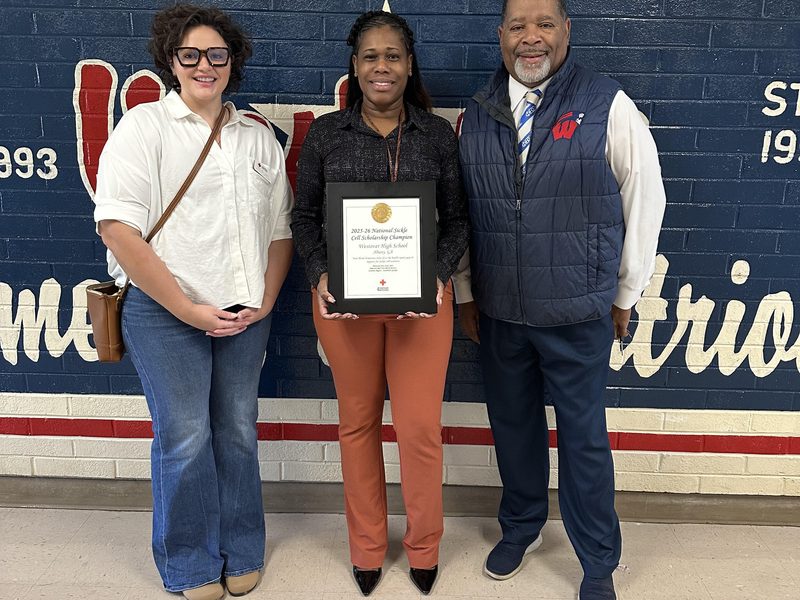
Dougherty schools celebrate national award, state honors, alumni support
From a national blood donation award to state recognition for schools and teachers, the Dougherty County School System is celebrating achievements in community service and education.
