
Weather conditions, water usage lead to dried-up Radium Springs
Radium Springs was purchased by DNR after the Flood of 1998, the second “500-year flood” that hit the area in a four-year period.
By Carlton & Tara Fletcher
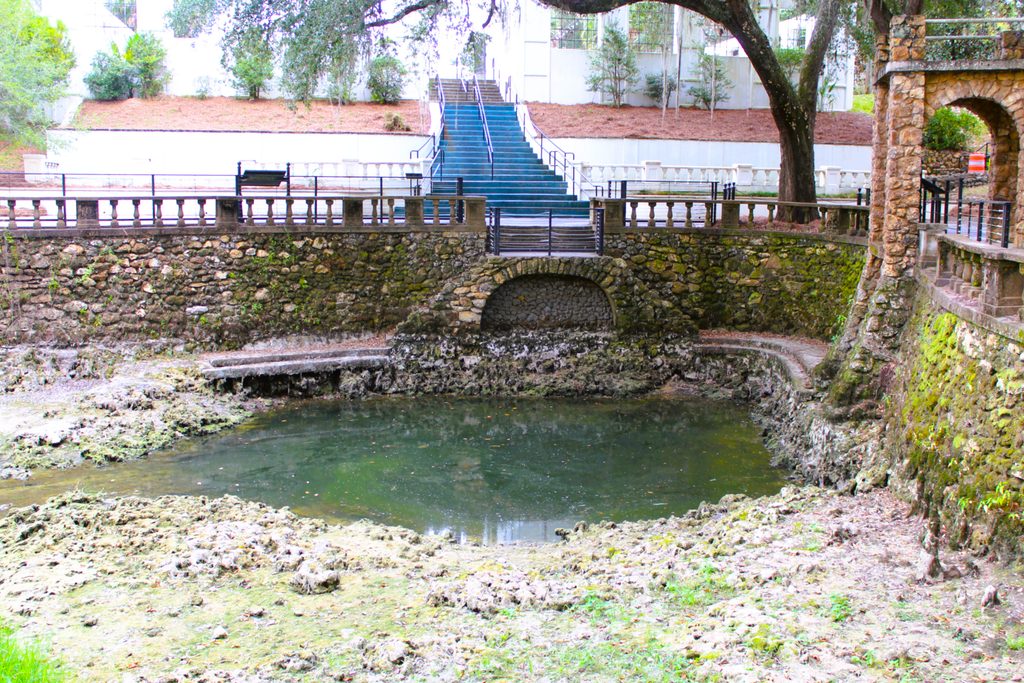
ALBANY — With experts at the United States University offering the warning that “the world has entered an era of global water bankruptcy” and that “human demand has permanently exceeded nature’s ability to replenish freshwater systems,” the virtually dried run of Radium Springs in south Dougherty County, once lauded as one of Georgia’s “Eight Natural Wonders,” takes on an even more ominous tone.And while local experts like Flint Riverkeeper board member emeritus and retired engineer David Dixon and Department of Natural Resources Wildlife Resources Division Fisheries Supervisor Rob Wueller say the occurrence is not exactly something new, they do note that issues that lead to the absence of water at Radium are preventable.
“The loss of water is typical of what happens when there is a dry spell or a drought — and we are in a drought right now, despite the recent rain,” Dixon, who has extensive knowledge of the history and natural faculties of the waterway, said. “The last one I can remember the springs being dried to that extent was around 2011.
“We have to deal with the fact that we are in a drought, and farmers are still irrigating with water from the Floridan aquifer and Procter & Gamble is using a lot of water from the aquifer.”
Wueller, who said changing weather patterns also play a part in the loss of water at Radium, was reluctant to place blame on any specific group, but he said the loss of water is mostly a “man-made” issue.
“I’ve only seen the springs dry up like this three or four times,” Wueller said. “There was another where there was a fish kill like we’re seeing now around 2008, and I think there was extreme drought in 2015. Weather patterns have changed, and that’s part of it. We’re still getting the same amount of rainfall, but it’s coming at different times.
“Certainly, farming use and the use by companies that get their water from the Floridan are part of the issues, but I hate to point fingers. Some of the possible influence here could come from miles away.”
Radium Springs was purchased by DNR after the Flood of 1998, the second “500-year flood” that hit the area in a four-year period.
Dougherty County Public Works Director Chuck Mathis said the initial concern around the springs drying up, a fish kill that left a large number of residents of the springs’ cold waters dead, had, as DNR officials had predicted, taken care of itself.
“(DNR) said fish and other scavengers would eat the dead fish, and that’s what’s happened,” Mathis said. “That issue has been cleared up. But seeing the springs pretty much dried up is an ongoing concern.
“The primary underlying issue here is water usage from the Floridan Aquifer. We’ve got to address issues like this, especially in drought conditions. We need to use this as an educational opportunity.”
The U.S. Drought Monitor notes that Arizona, Nevada, California, Utah and New Mexico are currently experiencing fresh water shortages, while several other states — including Georgia — are seeing much lower levels of fresh water. In September, Drought.gov reported that 59.38% of the lower 48 states are in drought, including 33% of Georgia.
“Extreme heat and widespread drought are a problem all over the world, including the U.S.,” officials with the Yale Climate Connection note. “These things cause depleted groundwater supplies, with the remaining water supplies increasing in temperature, which causes the chemistry of the water to change, leading to contamination.”
DNR’s Wueller says that despite the optics at Radium Springs now, there is no reason to panic.
“If we get a significant amount of rain, the Springs will bounce right back,” he said. “And, if conditions allow, it won’t take long for the Springs to return to normal.”
Author

Related Articles

Statewide candidates hit Albany for forum ahead of Nov. 3 election
Four candidates seeking statewide office, and two representaives for an additionaltwo candidates, participated in a Tuesday forum. Statewide early voting ahead of the Nov. 3 election starts on Oct. 13.
City officials to meet with downtown developer after default letter sent on North Washington Street project
City officials are still bullish on a project that will bring apartments, restaurant and Albany Technical College culinary arts instruction space to downtown Albany. However, the project has hit a snag with faulre to meet a Sept. 30 deadline to secure funding and a commitment from Albany Technical Colle to occupy off-campus culinary arts space in the development.

PHOTOS: Albany State Homecoming – Faculty and Staff Flag Football Tailgate
Four galleries…click the arrow to scroll through the photos.
