
Dawson seeks estimates for possible ABR Trucking cleanup
A city inspection indicated the ABR Trucking property remained out of compliance with city codes, prompting officials to gather estimates for a possible cleanup.
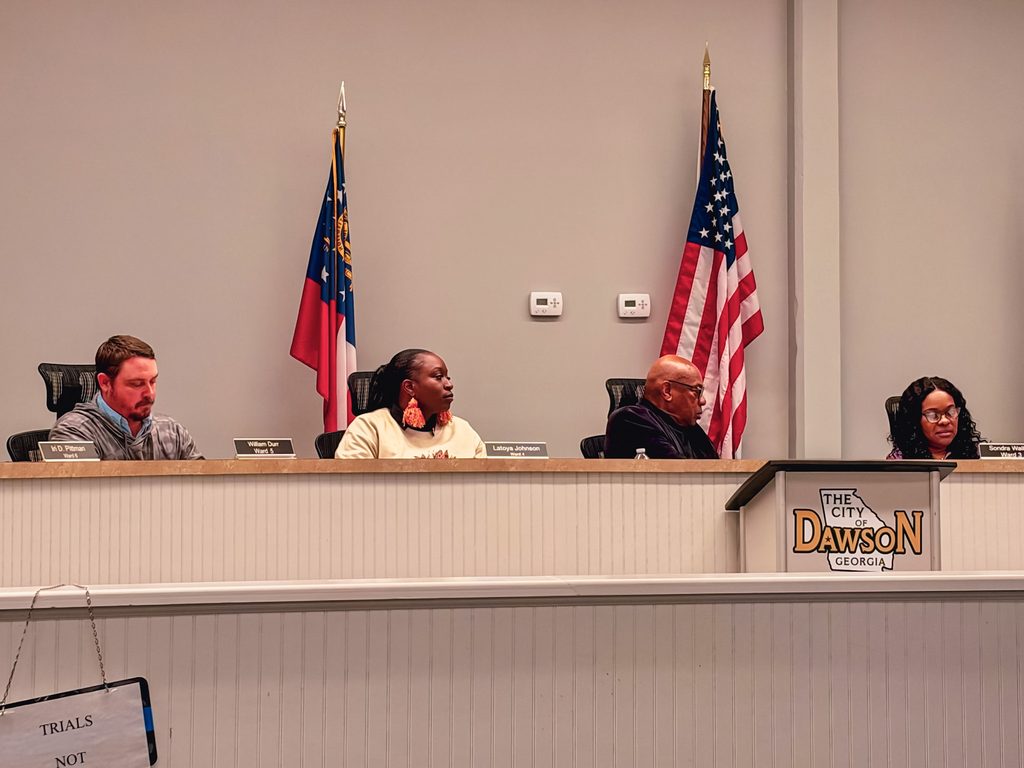
DAWSON — City officials are gathering estimates for a possible cleanup of the ABR Trucking property after an inspection indicated it remained out of compliance with city codes despite repeated court proceedings.
Attorney Joel Wright, representing City Attorney Tommy Coleman, told the City Council Nov. 12 that two court orders authorize Dawson to correct violations at the property. However, identifying vehicles, notifying their owners and arranging removal could make the work costly.
“We went out there this morning and did a walk-through inspection, and it appears that it’s still not in compliance,” Wright said.
The inspection followed several municipal court hearings, fines and deadlines for correcting violations, Wright said. A third party accompanied city officials to assess the property and begin obtaining estimates from vendors.
Council members took no vote on the matter, and no cleanup cost or start date was announced.
Mayor Robert Aaron asked how Dawson could recover money spent on the work.
Wright said the city would need to take reasonable steps to limit expenses and maintain detailed receipts. Dawson could seek reimbursement through a lien against the property, potentially recovering its costs through a sale or foreclosure.
The process would attach the debt to the property rather than pursue its owner personally, Wright explained.
Identifying which vehicles and equipment must be removed — and who owns them — would be a significant part of the work.
Some tractor-trailers reportedly belong to other people who left them at the property for repairs, Wright said. Officials would need to identify vehicles using identification or serial numbers, contact their owners and provide notice before removal. Hauling and storage could add to the expense.
Wright said officials planned to seek an inspection warrant and prepare an inventory documenting the equipment on the property.
The property’s zoning allows certain automotive repairs, so a cleanup would not require removing everything, he said. Vehicles being repaired within the permitted use could remain, while inoperable vehicles and accumulated junk identified as code violations would need to be addressed.
“It’s an expensive process,” Wright said.
One option under consideration is an auction at the property. Wright said the third party assisting the city owns a salvage yard in a surrounding county and suggested an online or in-person auction could reduce hauling expenses.
Councilwoman Sondra Walker questioned whether the business was operating as an automotive repair shop or a salvage operation and whether other enforcement options should be examined.
Wright said the city initially sought to encourage the property owner to comply with city codes and allowed extensions for correcting violations. With the problems continuing, he said officials could consider other enforcement approaches alongside the financial implications of a city-funded cleanup.
Before proceeding with cleanup work, Wright said officials would coordinate with the city manager and return with estimates and funding needs.
Related Articles

Terrell County returns to one-act competition after 21 years, earns acting honors
Eight first-time actors helped bring Terrell County High School back to the Georgia High School Association’s One Act Play Competition this fall, ending a 21-year absence and earning individual honors for three students.
Dawson City Council approves state audit assistance agreement in special meeting
Dawson will use a free state program to prepare financial records for three overdue audits, with completion projected by Thanksgiving 2027.

Radio personality tackles teen violence with 300-mile walk
Todd Burnett will start his holiday journey to visit relatives in Orlando, Fla., on Thanksgiving Eve, leaving the east Albany Walmart parking lot – on foot – to kick off a 300-mile journey Burnett is undertaking to draw attention to the teen violence problem that plagues Albany and southwest Georgia.
