
Lack of energy code hurts Albany renters
Carlton Fletcher
ALBANY — When Tom Berry came to Albany as interim Water, Gas & Light Commission general manager, he said he hoped to help create a program that would allow tenants to better manage utility bills and improve living conditions of rental units in the community.
Berry, who now serves as interim city manager, is working on just such a proposal as the city’s Utility Board deals with what a growing number of customers says is spiraling utility costs among some of the city’s residents least able to pay them.
Tiffany Walker and Jontobivous Daniels called the Albany Utility Board’s Customer Service Department asking for an energy audit after the utility bill for their small, two-bedroom trailer in east Albany’s Cardinal Court neighborhood surpassed $500 last month. Utility Board Customer Service Technician Larry Evans, a 30-year veteran with the utility, said after conducting the audit that the trailer should not have used near the electricity it did, but he points out several reasons for the costly bill, the primary of which is the absence of duct work connected to vents in the residence.
An inspection of those vents from inside the trailer reveals the ground beneath the residence with no duct work in sight. That, Evans explains, means the conditioned air that should be cooling the trailer is being dumped under the residence.
“We’ve called our landlord, but he hasn’t done anything about it,” Walker says. “We’ve had all kinds of problems in the seven months we’ve lived here. We’ll be sitting, watching TV at night, and the electricity will just go out.”
Adds Daniels: “If you get in there around the junction box, it gets very hot and starts to smell like smoke.”
And, Walker says, the young couple makes monthly rental payments fully and on time.
“We pay our rent every month, haven’t been late,” she says. “I’ve got two small children here, and the conditions scare me. The only thing we can do about it is move, I guess.”
Not if Berry’s in-the-works proposal, which would require rental property to meet a specified energy code, gains momentum.
“Rates are up a little bit, but Albany Utility rates are among the lowest in the state of Georgia,” Berry said. “Certainly the rates are not up enough to double or triple a bill (as some have claimed). The only explanation is, if someone’s bill is out of wack, they either have a problem on their property or they have significantly increased usage. It’s all driven by usage.
“There could be any of a million different things wrong: a leaking water heater, insufficient insulation, inefficient appliances. We provide an energy audit free of charge to our customers to help them find ways to use our products more efficiently. One of the biggest problems is that 60 to 70 percent of the citizens in Albany live in rental property, and the property owner is not required to meet any energy code. I’d like to change that.”
Evans, for one, said such legislation would be welcome.
“You wouldn’t believe some of the stuff I see,” the veteran technician said. “And the sad thing is, there’s not much most of these folks can do other than move.”
Despite a large number of squawks to The Albany Herald lamenting unusually high utility bills, officials with the Albany Utility Board (formerly the Water, Gas & Light Commission) say current rates do not support claims of significant increases.
Claims of bills that have doubled or even tripled in recent months, most noting increases that have occurred “since the city took over WG&L,” are not being reported to the utility authority, according to Assistant City Manager for Utilities Stephen Collier.
“We haven’t received those kinds of complaints, not at this time of year,” Collier said when asked of the large number of squawks sent to The Herald. “We usually get complaints in the winter or when there is intense heat — the times when increased usage generally occurs — but not with the relatively mild weather we’ve had lately.
“But our customers should note that when we get a complaint of this kind, we normally send an audit team to see if there are problems. Sometimes there are things like water heater leaks or insufficient insulation. I live in an old house, and a check showed that the blown-in insulation in my attic had settled. I added insulation, and it made a significant difference. Trust me, I watch my (utilities) carefully.”
Evans said he and other utility personnel perform an average of 120 energy audits a month.
“One of the biggest problems we have is with heat pumps that are supposed to help warm a house in extreme temperatures,” he said. “If their compressor is not working efficiently, the heat pump may run constantly, and it uses 45-50 amps, much more than a typical heating unit.
“There are other problems: Freon pressure may be low; attic hatches may not close properly, creating negative pressure that draws cool air into a home from the attic; a water heater element may be out or a draft spillover switch not working properly; filters may be dirty; insulation may be needed; windows need caulking or doors need insulation. If there’s a space for (warm or cool) air to escape, it will.”
Utility officials said audits may be requested, free of charge, by calling the Utility Board’s Customer Service department at (229) 883-8330, extension 502.
Evans gave Walker and Daniels a run-down on their residence’s problems after conducting the audit on Tuesday.
“The main thing is the air conditioning duct work,” he said. “They also need new filters, the doors need insulation and the property owner should look into the issues they have with their electricity. We try to help folks when they have issues, but most of the time there’s nothing we can really do. Not until the tenants’ landlord or property owner makes needed repairs.”
Related Articles
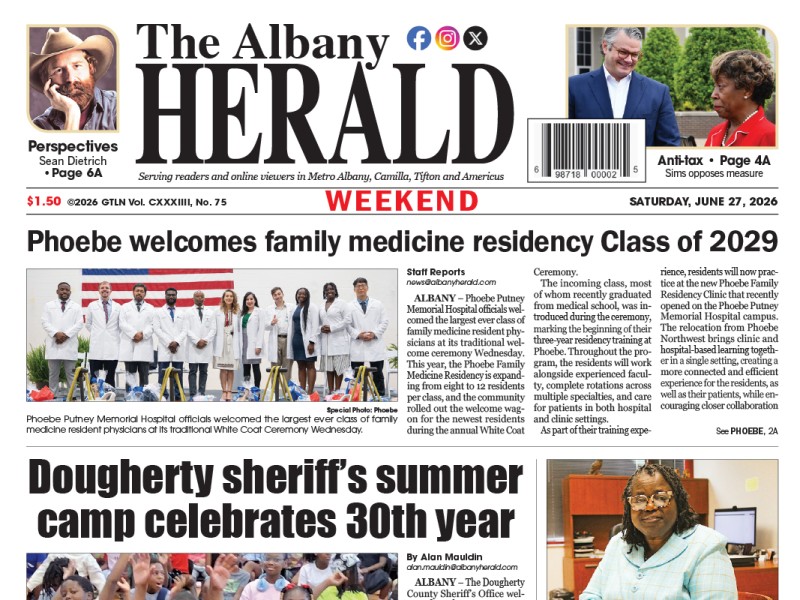
Albany Herald – June 27, 2026
Phoebe welcomes family medicine… Dougherty sherrif’s summer camp celebrates… For Community Care Department head Debra Wiley…

Special Sections – June 27, 2026
Interesting facts related to Independence Day,,, Fire up true American flavor on the grill… The nicknames of all 50 states… 9 facts about the Declaration of Independence…

Classifieds – June 27, 2026
Full Time Job: Women’s Recovery & Substance Use Services Director… Real Estate for Sale: 230 Frost St…
