
MARY BRASWELL: Looking Back at the War to End All Wars

Mary Braswell
Each week Albany Herald researcher Mary Braswell looks for interesting events, places and people from the past. You can contact her at (229) 888-9371 or [email protected].
On this eve of Memorial Day, here is a look back at the Great War, the war that, at the time, involved more countries and caused more devastation than any in history.
READ ALL ABOUT IT
—The war was triggered on June 28, 1914 by the assassination of the Archduke Franz Ferdinand of Austria and his pregnant wife, Sophie. Serbian terrorist group The Black Hand, was responsible for the murders. One month later, on July 28, Austria-Hungary declared war on Serbia. A few days later, Germany invaded Belgium and on Aug. 10, Austria-Hungary invaded Russia. The war was on.
— In August 1914, German troops shot and killed 150 civilians at one location. The killing was part of the German war policy known as Schrecklichkeit (frightfulness). The purpose was to terrify civilians in occupied areas into not rebelling.
— Both sides of the war thought victory would be swift. The war, however, lasted four years and took the lives of nearly 10 million troops.
— Some Americans disagreed with the initial refusal of the United States to become involved in the war and joined the French Foreign Legion or the British or Canadian armies. A group of U.S. pilots formed the Lafayette Escadrille, a part of the French Air Force and went on to become one of the top fighting units on the Western Front.
— Named after the wife of its inventor, Big Bertha was a 48-ton howitzer used by the Germans. It could fire a 2,050-pound shell a distance of nine miles. It took a crew of 200 men about six hours to assemble. Germany had 13 of these weapons.
— The trench network of the war stretched a total distance of 25,000 miles from the English Channel to Switzerland.
— The manpower of about 140,000 Chinese laborers was used to dig the trenches along the Western Front. Many of the Chinese Labor Corps continued to serve throughout the war.
— Close to two-thirds of the military deaths in WWI were in battle. In previous conflicts, most deaths were caused by disease. The Spanish flu was responsible for the majority of the disease-related deaths during this conflict.
— Russia mobilized 12 million troops, making it the largest army in the war. More than three-quarters of those men were killed, wounded or declared missing.
— “Little Willie” was the first prototype tank in the war. Built in 1915, it could carry three men and travel up to 3 mph. The term “tank” was used to trick the enemy into believing the monstrosity carried water. The female tank had a machine gun while the male tank had a cannon.
— Many women joined the workforce during WWI. The skin of those who worked in TNT factories turned yellow as they suffered from toxic jaundice. These women were sometimes called canaries.
— Woodrow Wilson ran his presidential campaign with the slogan, “He kept us out of war.” Not long after being re-elected to office, Wilson declared war on Germany. The U.S. officially entered the war on April 6, 1917. Although in combat for only 7 1/2 months, 116,000 troops were killed and another 204,000 were wounded.
— To increase the size of the U.S. Army, the Selective Service Act was passed. By the end of the war, 2.7 million men were drafted and another 1.3 million volunteered.
— By 1918, Britain and France had produced 6,506 tanks. Germany had produced 20.
— The American hatred for Germans and all things German was quite obvious during the war. Schools were ordered to stop teaching German language (the second most-used language in America) and German books were burned. Some German shepherd dogs were shot. Frankfurters were called liberty sausages, hamburgers became liberty sandwiches, sauerkraut was known as liberty cabbage and even dachshunds were called liberty dogs.
— “Stubby,” a mutt who wandered into the Connecticut National Armory, went overseas with the 102nd Infantry Regiment during WWI. The dog saved his regiment from surprise mustard gas attacks and located wounded soldiers. “Stubby” was decorated for valor by Gen. John Pershing.
— During the war, the U.S. shipped 70,000 horses or mules, nearly 50,000 trucks, 27,000 freight cars and 1,800 locomotives to France.
— Millions of soldiers suffered from “shell shock” because of the horrors of trench warfare. The men often whimpered for hours, had uncontrollable diarrhea, couldn’t sleep, ceased talking and twitched uncontrollably. The majority recovered, but many never did, spending their remaining lives in hospitals.
—The British trenches were breeding grounds for disease, smelly, cold and damp, as well as rat, frog and lice-infested. Many of the German trenches were more permanent and comfortable with bunk beds, water tanks for faucets, cupboards, tables, electricity and some even had doorbells.
— During WWI, 11 percent of France’s population was killed or wounded.
— Even though the U.S. government did not grant them citizenship until 1924, 13,000 Native Americans served during this conflict.
— British soldiers had a daily tea ration of six pints per day.
— “Rin Tin Tin,” a German shepherd dog, was born in a trench in 1918 and rescued by an American Soldier. The dog became the nation’s most famous dog and starred in more than 40 films. The son of another war dog, Buddy, became the first seeing-eye dog.
— On Christmas Eve 1914, soldiers on both sides of the Western Front sang carols to one another. A truce was called the next day and there were even visits and games among the enemies. A year later, such was not the case. Christmas or no, sentries were ordered to shoot anyone who attempted such antics.
— After witnessing the facial destruction caused by shrapnel, Harold Gillies, an English physician, pioneered the use of skin grafts and the beginning of what would become known as plastic surgery.
— About half of the men killed during the war have no known grave.
FIRSTS
The War to End All Wars was the first …
— to be fought on three continents;
— in which chlorine and mustard gas were used;
— in which a flame thrower was used;
— in which tanks were used in battle;
— with mass airplane combat;
— to have a blood bank on the front line (1917);
— to use IQ Tests (given to Doughboys of 1917);
— to have seeing-eye dogs for blinded soldiers;
— to produce a four-star general, Gen. John J. Pershing;
— to have artwork commissioned for propaganda.
ALUMNI OF WORLD WAR I
Humphrey Bogart, Walt Disney, Charles DeGaulle, Ernest Hemingway,Winston Churchill, Bella Lugosi, Adolf Hitler, Benito Mussollini, Harry Truman, Gen. George Patton, Walter Brennan.
QUIK QUIZ answer:
d) Each week about 12 million letters were delivered and by the end of the war, about 2 billion letters and 114 million parcels had been delivered.
Related Articles
Albany Herald – June 27, 2026
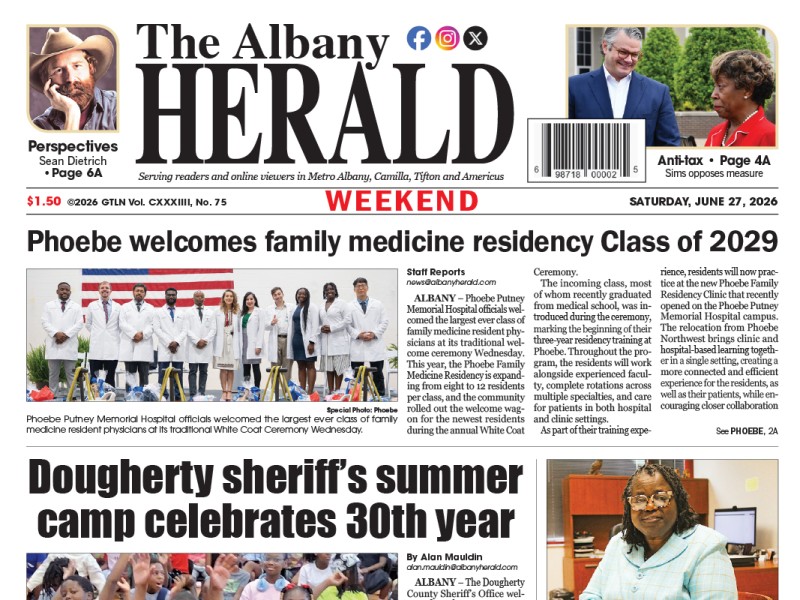
Phoebe welcomes family medicine… Dougherty sherrif’s summer camp celebrates… For Community Care Department head Debra Wiley…
Special Sections – June 27, 2026
Interesting facts related to Independence Day,,, Fire up true American flavor on the grill… The nicknames of all 50 states… 9 facts about the Declaration of Independence…

Classifieds – June 27, 2026
Full Time Job: Women’s Recovery & Substance Use Services Director… Real Estate for Sale: 230 Frost St…
