
Southwest Georgia NAACP leaders come together after mass shooting during Albany State University homecoming celebrations
Staff Photo Lucille Lannigan
By Lucille Lannigan
[email protected]
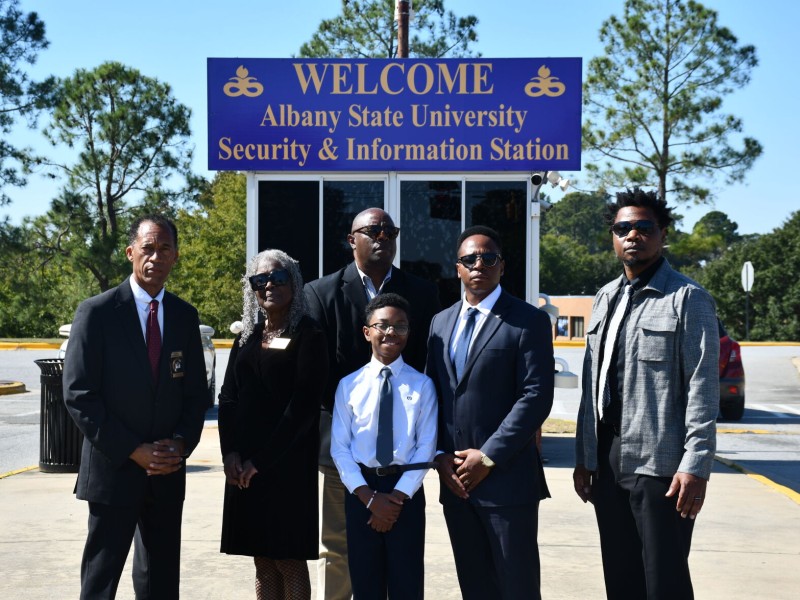
ALBANY – Leaders from three southwest Georgia NAACP chapters came together Friday afternoon to discuss forming a trilateral partnership in the wake of a shooting that killed one and injured four at Albany State University.
The incident happened during an ASU Homecoming event Oct. 19, just about four hours after the homecoming football game, in a crowded area on campus. One other person was injured running away from the area. De’Marion Daniels, a 19-year-old from Newnan, was killed. The youngest person injured was a 13-year-old girl. No arrests have been made, and the GBI is still investigating the incident.
Eugene Edge, the president of the Sumter County NAACP, said he called a meeting with the Dougherty-Albany NAACP and Crisp County NAACP leaders because he believes they need to work together to combat gun violence, which he says primarily affects black communities.
“All too often you turn on the local news … what you see is the black communities are the victims of gun violence, and so I think that we as leaders of the black community have to take the most proactive measures,” Edge said.
Gun violence is something the three NAACP presidents agreed is plaguing their communities beyond the ASU shooting. Just four days before the shooting at ASU, two people were shot and injured at the Flint Ridge Apartments, right next to ASU’s east campus. At the beginning of October, a teen was shot and killed in Americus. Four other teens have been arrested in connection with that crime.
Dravian McGill, the Cordele-Crisp County NAACP president, said Crisp’s location along Interstate 75 makes it vulnerable to crime.
“There’s something going on almost on a daily basis over in Crisp County,” McGill said. “Gun violence and drugs are infiltrating our community on the way to these other communities outside of 75.”
The NAACP leaders discussed working more closely with local law enforcement, finding ways to be more present among youths in their communities and calling attention to this issue by holding marches and rallies.
Tracy Taylor, the president of the Albany-Dougherty NAACP branch, has already been active in rallying against gun violence in the Albany community, working with the Wear Orange campaign, which began locally by the mother of Nigel Brown, a young boy who was shot and killed in a drive-by shooting while he slept.
“We’re going to be real proactive in the community … by collaborating and showing a force … pushing the NAACP brand down to the forefront, because we are known for standing against injustice,” Taylor said. “Back in the days it was formed … (the NAACP) dealt with lynchings. Today, it might not be a rope, but it can be a bullet.”
Dedrick Thomas, the first vice president of the Albany-Dougherty NAACP branch, said the chapter collaborates with the ASU NAACP to reach the younger generations.
“We do that … thinking that people who may be at a similar age maybe can talk on a level with others that maybe I can’t,” he said. “Coming from me, it may sound like a dad preaching, but maybe coming from somebody who is a peer, it may sound like they’re really speaking from the heart.”
Edge said he sees a lot of fear among young people in coming forward to law enforcement when they know about a threat. So his county’s NAACP chapter makes its phone number available as a confidential hotline for people to share information. The NAACP will then communicate with law enforcement. That number is (229) 389-8275.
Edge said he also plans to work with the other NAACP chapters to host a state of the black union address, during which members of the black community can come together and discuss solutions and actions they can take to help mitigate the violence issue.
He said this wasn’t always a problem.
“We used to see each other as family – as brothers and sisters,” Edge said. “This only started happening in the late ’60s where we started getting this type of behavior from the black community. What changed?”
Edge said the change comes from disenfranchisement in the black communities and a lack of fathers being active in their children’s lives.
“There’s an old African saying that it ‘takes a village,’” he said. “It’s our sons.”
McGill said the shooting during ASU’s homecoming weekend had a resounding impact. HBCU homecomings are a part of black culture, he said – a time for family, friends and students to gather and enjoy themselves.
He said the shooting at ASU “deflates everything as a race” to him.
“Now you’re saying, ‘Well that’s just an HBCU. That’s what goes on over there,’” McGill said. “It’s a reflection of our culture, of our people. They think this is expected behavior, and it’s not.”
He said that while it was an isolated incident, the impact will bleed over.
“It’s a sore eye on next year’s homecoming,” McGill said. “It’s a black eye. Now we’re trying to find a killer, a shooter. This was something positive. This was a homecoming. This was a family event that’s now turned tragic.”
Taylor said he’s been disappointed by the lack of response from the Albany mayor.
“I do have a lot of respect for our mayor, but he is the face of Albany, Georgia,” Taylor said. “When a situation takes place like this at our beloved ASU, he should be on the forefront of this type of situation to show empathy and true leadership.”
Edge pointed out that Albany is now on the list of mass shootings in the U.S. in 2024.
“Albany, Georgia, is a city with a mass shooting, and the mayor hasn’t said anything about it,” he said. “This is why we’re here as leaders of the black community … to call on other leaders.”
Taylor said it’s a call to action.
“We’re calling on the clergy, local law enforcement … because it matters,” he said. “We can’t be complacent and feel like this is the norm.”
Author

Related Articles
Albany State football gives Dougherty County Xtreme players day to remember
Richard Brigham has conducted more football practices than he can count.
PHOTOS: Albany State and Central State MOU Signing
Click the arrow to scroll through the photos.
Albany State inducts 2026 Hall of Fame class
Festive ceremony at ASU!
