
As Edison grapples with financial crisis, its citizens bear the brunt
Staff Photo: Lucille Lannigan
By Lucille Lannigan
[email protected]
EDISON — Edison, located some 30 miles south of Albany, is a southwest Georgia town with a population of about 1,250 that’s generally been known for its annual Christmas parade and display.
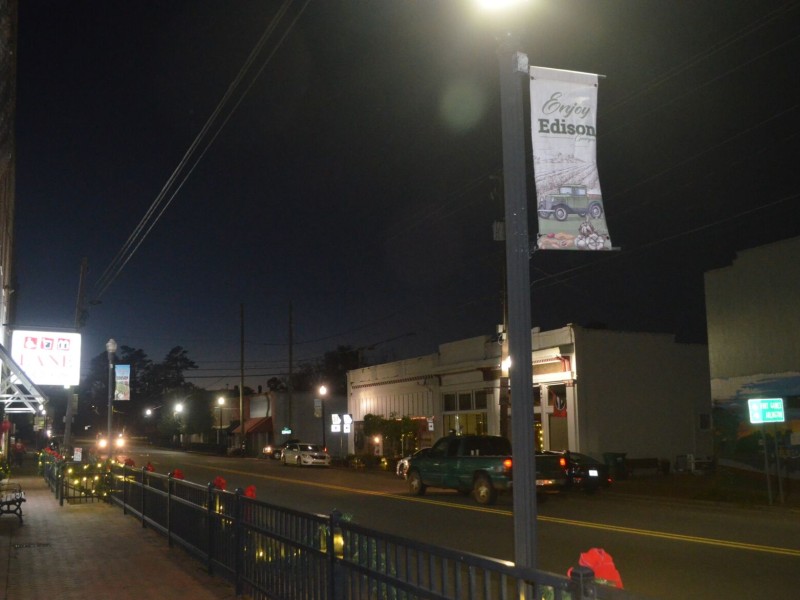
No lightpost or shop railing was void of twisting green garland, bright red bows and twinkling angels in Christmases past. The parade drew people in from neighboring cities and counties to watch local business owners, city council members, school sports teams and the Police Department make their way through Edison’s downtown on State Highway 37.
This Christmas — except for chunks of display in front of former Edison Mayor Reeves Lane’s pharmacy and K&W Primitive Newbeez antique store — Edison’s downtown is in the dark. There will be no Christmas parade or festive lights.
The city doesn’t have the manpower, the time nor the money to do it, Mayor Shirley Worthy said.
Edison is upwards of $500,000 in debt and is in noncompliance with the state as the city failed to file a required city audit for the last five years. This revelation came in July, and city leadership has spent the last five months trying to recover. Signs of this recovery include a new mayor and hefty increases in tax rates and water and sewer bills for residents.
Worthy and hired accountant Lori Moore began working to sort Edison’s financial books in early October. They’re trying to get to the bottom of where the city’s money was going. Their work is revealing mismanagement of funds and disorganization.
Spending on new Christmas light hookups, after Hurricane Michael in 2018, was prioritized over dire infrastructure needs like updating the failing sewer system along State Highway 216 and fixing broken water meters that are incorrectly reading residents’ water usage, Moore said.
Without completed audits, Edison is ineligible for state funding that could help get it out of this hole. City leadership is calling on state lawmakers and the Department of Community Affairs to create opportunities for cities or counties in this situation to apply to receive help under extenuating circumstances.
Right now, the citizens are the ones paying the price for mistakes they didn’t know were being made, Moore said. That’s the sad part, Councilman Curtis Adams said in a council meeting on Dec. 11.
“The only people that can help us are the citizens,” he said. “The only people that can help us is us.”
A BITTER PILL TO SWALLOW
Bill Powell walked into Edison’s Dec. 11 council meeting with a flash drive presentation in his pocket.
Powell, a member services worker with Georgia Rural Water Association, a nonprofit that helps address rural water and wastewater needs, has provided water and sewer budget and rate analyses for municipalities all across Georgia. The GRWA has been in Edison helping the city address its sewer system, broken water meters and a burst water line. It’s been providing these services for free.
All of the cities Powell has worked in have different needs, but the last slide of each presentation contains the same message: “When your outcome is more than your income, then your upkeep will be your downfall.”
Edison had been operating at a deficit until the city could not do it anymore, Worthy said at the last council meeting of 2023. Tax, water and sewage rates were not raised to meet the inflation and rising costs over the years, he said. Citizens were not being charged enough for garbage and sanitation, causing the city to go into debt with the servicing companies.
As the mayor and Moore have unveiled these failures, they’ve had to work out ways to get the city back on track. Edison makes money by selling natural gas and the services provided to its citizens; therefore, bills need to change to reflect inflation and to keep the city profitable.
Some of these changes included property tax rates increasing from 18 to 29 mills. Solid waste bills moved from $27 to $38.50 per month. A $14 law enforcement charge also was implemented to fund the police department, which had to cut down to two working officers.
The Dec. 11 council meeting brought higher sewer and water rates.
Powell counseled the city to establish its water and sewer operating budgets as well as its debt. This came out to be about $644,000, which must be generated from customers. The new base charge is $13.46 for water and $15.36 for sewer. There are additional debt services and administration charges.
If a customer uses 2,000 gallons of water during a billing cycle, they will see their bill jump from about $33.20 to $66.71, Powell said.
The average customer uses about 3,100 gallons of water in Edison, which would generate a $29.46 water bill and $50.66 sewer bill or about $80 total, he said.
Edison residents are being stretched to their breaking point to pay for somebody else’s error, Janice General, an Edison resident, said. General said she understands the city has to fix its debt and it’s going to take the citizens to get there, but she noted each meeting brings a new expense.
“What are we going to do?” she said on Dec. 11. “Are we gonna be breaking for the city of Edison?”
It’s going to come to a point where the citizens are not going to be able to help get the city of debt, General said.
Courtney Ayres, an Edison resident who live-streams each council meeting on the community Facebook, said the new charges feel like a slap in the face. Ayres and her husband moved to Edison six years ago and bought a home. In those years, their money has been doing nothing, she said.
“We’ve just been paying and there’s no books for it … there’s no paper trail,” Ayres said. “We thought we were doing what we were supposed to do.”
Ayres is taking care of a young family on top of the growing utilities bills. She’ll have to cut costs elsewhere to pay these bills, she said.
“It’s scary and it’s hard,” Ayres said.
The citizens are between a rock and a hard place, Moore said. The council is, too, the mayor added.
Calhoun County is one of the poorest in Georgia. In 2022, the Georgia Department of Community Affairs named it as one of the rural counties with populations under 50,000 with poverty in excess of 10%.
“We know the situation with the people who live around here — what their income is — and we know their limitations, and then we have to ask them for more money,” Moore said. “It’s a hard pill to swallow … especially during the holidays.”
It’s going to take longer than officials would like to have the books audit ready, Moore said. She said she expects the city will receive either a modified or unqualified opinion on the audit, meaning not everything in the books could be verified. She isn’t sure if this will place the city on the compliant list.
Moore said she is hoping for a law that would allow cities in situations similar to Edison’s to apply to get off the state’s noncompliant list and be eligible for state grants and funding. Edison could apply for grants or sell bonds that could potentially get it out of debt, she said.
“It would be huge for the citizens … a relief,” Moore said. “It’s very sad that they’re paying the price for something that had literally nothing to do with them.”
Adams said he hopes the council can revisit these rates and bills in the future once the city gets its “whole head above water instead of just our nose.”
SLOW BUT SURE PROGRESS
Rep. Gerald Greene, R-Cuthbert, has been tracking the progress in Edison. He said he plans to introduce Edison-inspired legislation in the upcoming session that would allow state auditors some more warning when a city is entering a crisis with its audits.
He’s worked with Georgia auditors and the legislative council to look for avenues to accomplish this, he said.
Greened said he is committed to standing by his constituents in Edison and Calhoun County during this time of need. The state’s longest-serving representative was instrumental in bringing in the GRWA to provide free services.
He said he’s also looking into other opportunities for the city to receive financial assistance without an audit.
City Attorney Tommy Coleman said he is working with state officials to try to secure a GEFA loan that would address the broken sewer system along State Highway 216. While compliance with city audits is required, he said he’s hoping Edison’s special situation is recognized. However, nothing has been confirmed, Coleman said.
Overall, he said he’s impressed by the progress the new mayor and Moore have made in just about three months.
“They’ve made tremendous, unexpected progress,” he said.
The biggest concern for the city was getting its revenue in order, Coleman said. And Edison’s done this. Since Moore arrived, she’s sorted the city’s money. The books were in shambles, she said.
Her job is to prepare these books to be audited. She’s taken scattered documents and transaction records from cardboard boxes and put them into a system. She created separate financial accounts that make a clearer picture on where money is being spent and brought in.
Edison originally had its money flowing through a single account.
The city has set up negotiations and payment plans with most of the companies and contractors it has outstanding debts with, Coleman said. The city now has an established system to pay off its debt.
Progress is slow for the city, and Mayor Worthy said it seems like it doesn’t show up. However, she and other officials are working each day to sort through the mess.
“It’s been a jigsaw puzzle, and we’re still putting the pieces together,” she said.

Author

Related Articles

That ATV you drive around might not be legal. Edison, GA, looks into passing local ordinances
The use of golf carts, UTVs and ATVs and low speed vehicles has grown in popularity in recent years. Some cities have specific ordinances, allowing these different vehicles. Others, like Edison, never developed any local laws to address them, but Edison Councilman Curtis Adams said he’s noticed more and more on the streets. This prompted discussion on potential ordinances during Edison’s council meeting,
Arlington business owner accuses Police Department of failing to make arrests for repeated robberies
An Arlington business owner plans to close two of his businesses in the city next Wednesday in protest of what he said is “unequal protection under the law.”

No. 2-ranked Calhoun County wins thriller over Monroe, 63-60
The No. 2-ranked Calhoun County Cougars (8-0) remained undefeated Friday night with a hard-fought 63-60 victory over Monroe in front of a packed home crowd in Edison.
