
Exhibit at Thronateeska Heritage Center Museum celebrates U.S. immigration stories
Staff Photo: Lucille Lannigan
By Lucille Lannigan
[email protected]
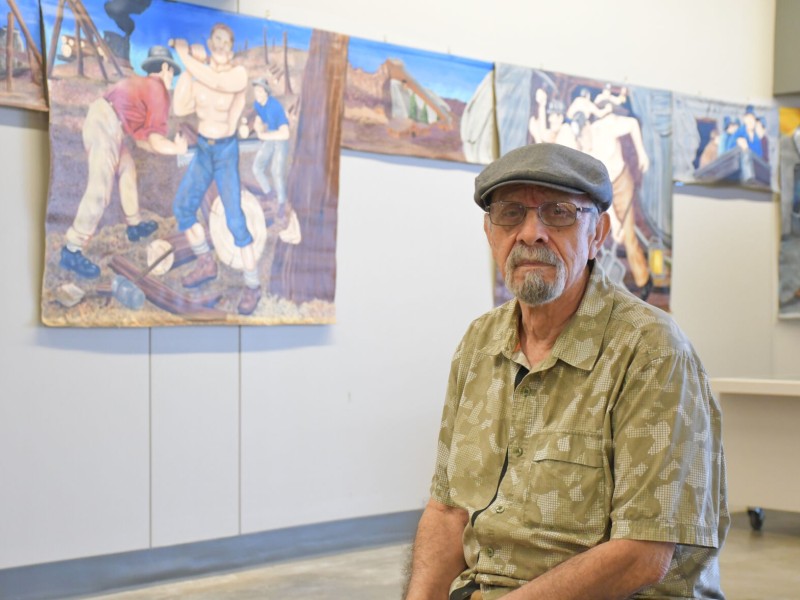
ALBANY – Andrew Sabori’s artwork “The Forgotten Mural” has been traveling around the country for about 16 years and is making its second stop in Albany at the Thronateeska Heritage Center Museums and Planetarium.
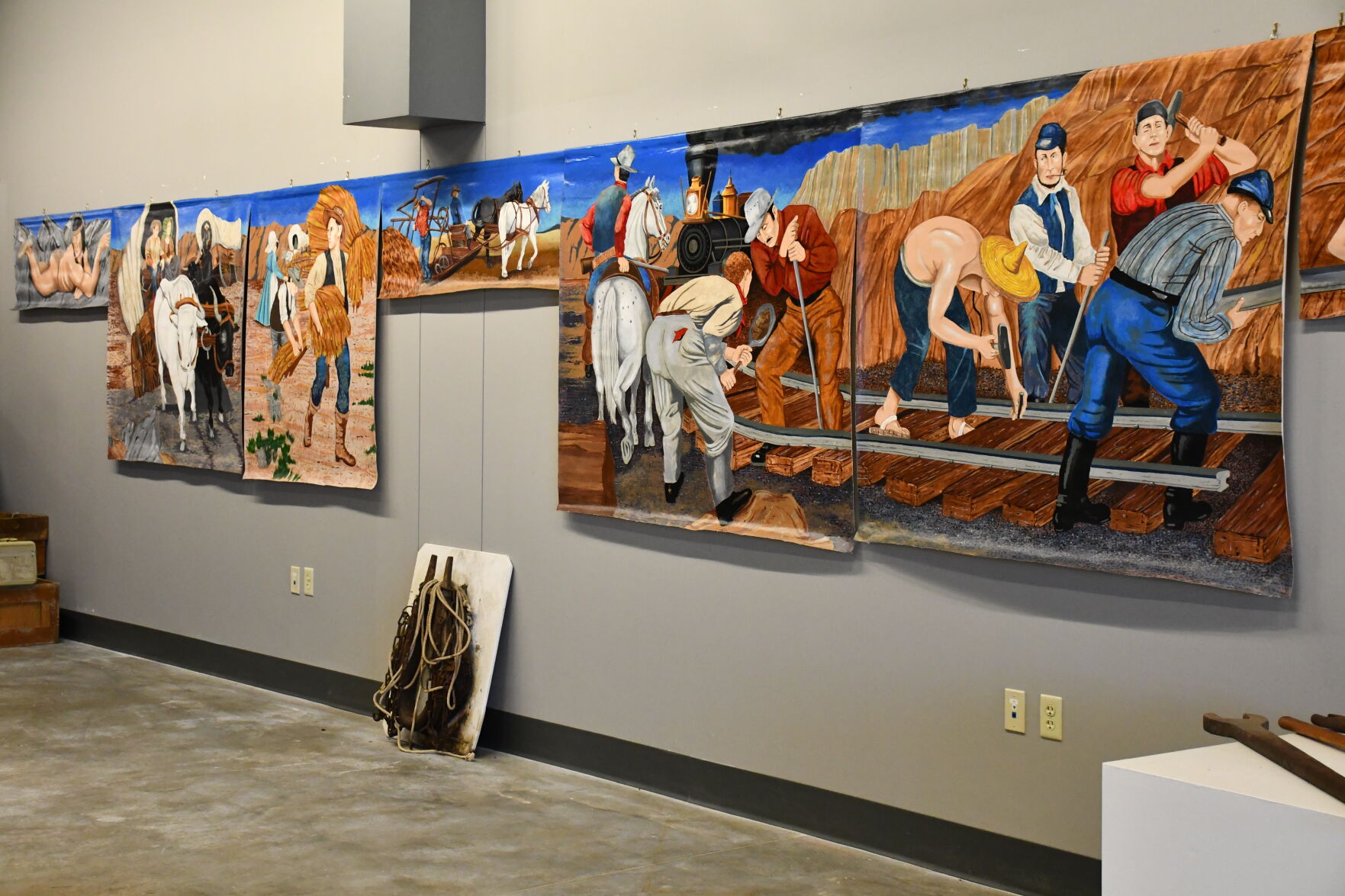
The work consists of 19 canvas panels, measuring a total of 88 feet in length. It’s a recreation of Edward Laning’s 1938 work “The Role of the Immigrant in the Industrial Development of America,” which originally hung on the walls of a cafeteria in Ellis Island, looking over new immigrants to the U.S. who dined after their voyage. It depicts immigrant workers from Ireland, China, Italy, etc. working on farms out west, building the Transcontinental Railroad, and chopping trees on lumber farms.
The exhibit is often used as an educational tool for students who, Sabori said, are lacking in knowledge of U.S. immigration history. In fact, he said, many of the students he’s spoken with didn’t even know what Ellis Island was.
“They never heard about our history, and it saddened me to think because right now, 40 million Americans today can trace their heritage through Ellis Island,” he said. “We’re a nation of immigrants.”
Sabori’s artwork pays homage to the contributions of hard-working immigrants in the U.S., but for decades the original work was forgotten.
Sabori’s father came to the U.S. through Ellis Island from Spain – a story the artist said his father did not like to talk about. On a journey to find out more about his family’s history, Sabori visited Ellis Island in the early 2000s. While there, his wife noticed a mural in the background of a tiny black and white photograph.
“She said, ‘You know, there used to be a mural here,’ and I said, ‘Nah, I’ve never heard of a mural at Ellis Island,’” Sabori said.
As he searched for more information about the lost mural, he soon learned that almost no one had heard of it. He went to officials at Ellis Island, the Smithsonian, the Library of Congress, the Princeton University Library. He finally found answers at the prestigious Juilliard School in New York.
Sabori learned that Laning was commissioned to paint the mural in 1938. It took him and four assistants one year to complete the project. The original was twice the size of Sabori’s recreation. It was in the WPA style, which were murals in federally owned buildings painted during the Great Depression. It stood for “Works in Progress Administration.”
The mural hung at Ellis Island in a restricted cafeteria, meaning the public, aside from immigrants and workers, never saw it. Ellis Island closed down during World War II and was abandoned in 1954. In 1958, a storm caused the cafeteria roof to cave in, destroying a great portion of the mural.
The surviving portions of the mural were peeled off, rolled up and stored away.
“There were no write ups. There’s very few photographs, so hardly anyone saw it,” Sabori said. “I thought, ‘Wouldn’t it be a kick if I reproduce it … and show people this mural that’s paying homage to our ancestors.”
Slowly, Sabori retrieved more and more photos of the mural. He learned that the original panels were in a Brooklyn courthouse, which he visited to see the original colors used in the work. By 2008, his recreation was hanging in a school in Las Vegas.
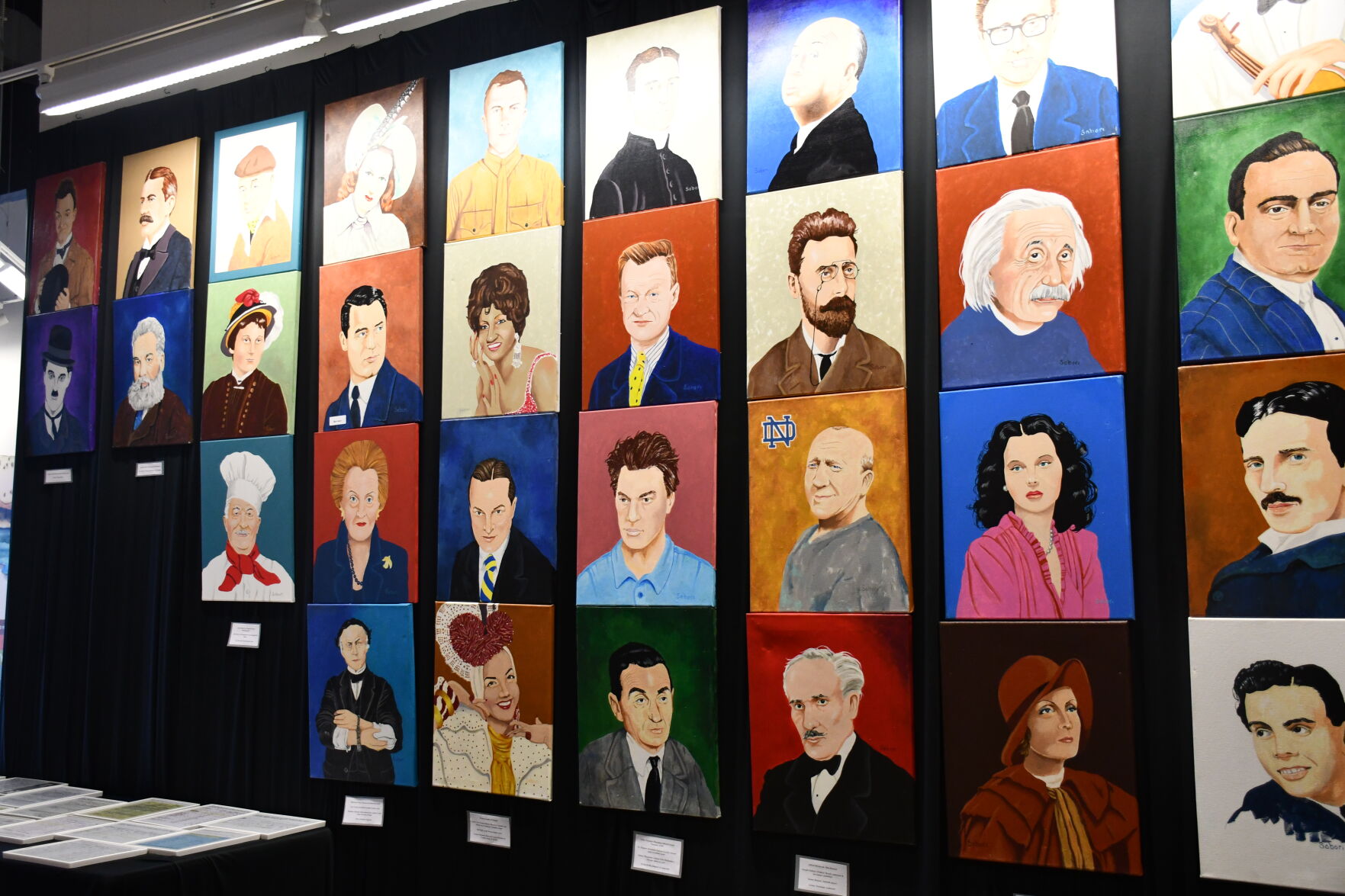
Over the years, “The Forgotten Mural,” has grown to be the opposite of its name. It’s been displayed in Nevada, Utah, Oklahoma, Georgia and South Carolina. Sabori added additional pieces to the entire exhibit, including portraits of famous immigrants to the U.S. Two of the exhibit’s paintings now hang in the U.S. Embassy in Tajikistan.
In the next two to three weeks, Sabori said a filmmaker will travel to Albany to shoot the exhibit for a film he hopes to broadcast on PBS’ “The American Experience” and at the Sundance Film Festival.
Sabori said it’s important for people, especially young people, to learn immigrant stories in the U.S., especially in the current political climate where immigration is a heated topic amid the presidential election. Many voters express concerns about security at the U.S. and Mexico border.
KFF, a health policy organization in the U.S., reported widespread misinformation is being spread about immigrant populations in the U.S. by candidates and elected officials. Donald Trump’s campaign has repeatedly accused immigrants of being a source of crime, a burden for taxpayers and a drain on government programs like Medicare. Kamala Harris’ campaign focuses on her tough crime stance while also highlighting her family’s immigrant roots.
Sabori said in recent years he’s had organizations reject displaying his exhibit, citing immigration as “too touchy of a subject” or “too controversial.”
“They said, ‘We don’t want to make waves,’” he said. “But this isn’t making waves. This is remembering yesterday.”
Andrew Wulf, the executive director of the Albany Museum of Art, said it’s important for museums to display these kinds of stories.
“They can help us create a more inclusive society … help people understand global issues, and on a very human level, it can actually serve to physically welcome refugees and migrants, and to be able to tell stories of people who sometimes feel unseen, invisible, not valued,” Wulf said.
Last fall, the AMA displayed the exhibit, “Familias,” which included works by Ramiro Davaro-Comas. It depicted families that maintain physical closeness during moments of immense transition as they migrate through new landscapes.
“Looking at Ramiro’s work … was really special because we often forget just how truly diverse our society is,” Wulf said. “Until we recognize that and bring these stories to the surface … we often forget just how rich or diverse our culture is.”
Danie’lla Patterson, a records keeper and archivist at the Thronateeska Heritage Museum, said she hopes “The Forgotten Mural” sparks conversations around Albany’s immigration history.
“We don’t have a lot of history of the transition of people coming here,” she said. “We just don’t have it in the archives yet, and it makes me sad.”
The Good Life City’s immigrant population as of 2022, was about 2.6%.
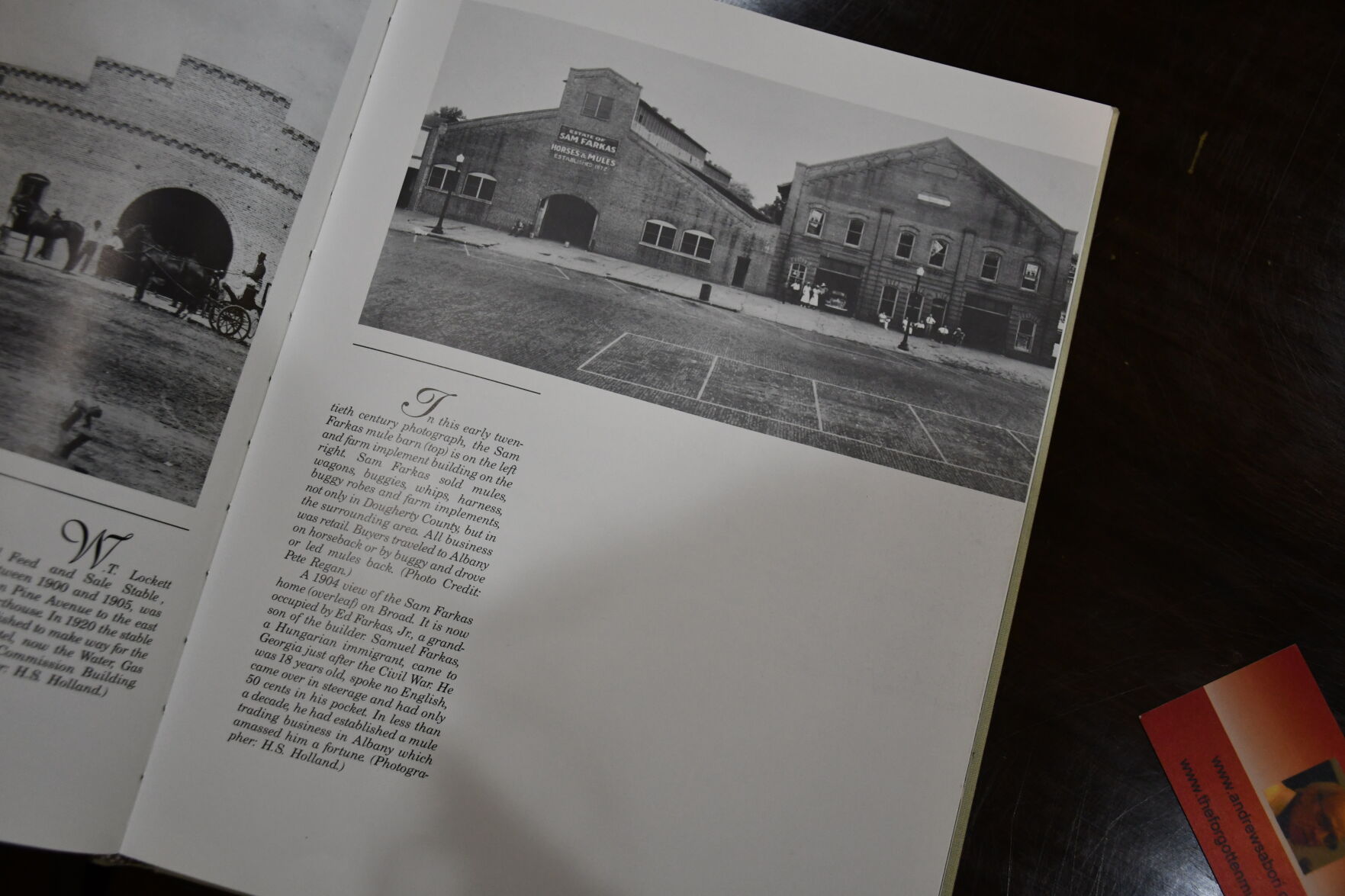
While digging through archives, Patterson pulled out a book titled “Glancing Backward, Albany, Georgia,” which takes a look at the city from 1836 to 1986. One page displays a twentieth century photograph of the Sam Farkas mule barn. Farkas was a Hungarian immigrant who came to Georgia after the Civil War. He was 18 and spoke no English, but in less than a decade, he had established a mule trading business in Albany that would amass him a fortune, according to the book.
The Sam Farkas Estate would go on to build the Albany Theater in 1927 and other notable Albany sites.
South Georgia also has a storied history of Jewish migrants. In 1862, a group from the Jews of the 32nd Regiment, Georgia Volunteers, gathered outside of Savannah to protest against the expulsion of fellow Jewish people who were expelled from Thomas County, according to Volume I of The Journal of Southwest Georgia History.
One of the organizers, Charles Wessolowsky came forward to challenge “the gentleman of Thomasville.”
“See how many Jews and foreigners, more or less, are in each (Georgia regiment); ask them to peruse the lists of donations and see how liberal and free-hearted the German Jews and foreigners are in behalf of aiding their adopted country,” he said.
Patterson said her mom first noticed more Asian immigrants coming to Albany in the 1980s.
“I think the exhibit’s impact could be a conversation-starter,” she said. “It could hopefully provoke people to want to learn more, especially with the political climate that we’re in right now. I think it’ll be something that will cause people to hopefully want to … understand their history, ancestry.”
The exhibit will be at Thronateeska until January 2025.
Author

Related Articles
From cotton to cloud: In the data center debate, is rural Georgia once again being asked to carry the cost?
Across much of rural Georgia, the abandoned cotton warehouses and shrinking tax bases remain — enduring reminders that industries built to serve distant markets do not necessarily stay rooted in the communities that first sustained them.
My Grandpa Was Killed in World War II. I Met Him Through His Letters Home
Gina Wolf’s grandfather died before she was born. His letters sent to her grandmother from Europe during World War II made it possible to know what kind of man he was.
‘Sounds Like a Mutiny.’ Secret Recording Exposes Claims of Toxic Leadership After a Marine’s Suicide
This week’s War Horse story follows the systemic failures before and after the death of Cpl. Drew Mobley who was the third in two years at Marine Corps Base Quantico to die by suicide.
