
Fading faith?
Stats show number of Christians in America falling dramatically
By Carlton Fletcher
ALBANY — Despite figures from an extensive 2014 Pew Research Center study that show the number of Americans who call themselves Christians is declining dramatically, local religious leaders say that while they agree there is an overall decline nationwide, the numbers are not so dramatic in the heart of the Bible Belt.
The Pew study, released last year, noted that the number of adults in this country who consider themselves Christians dropped from 78.4 percent in a similar study conducted only seven years before to 70.6 percent. The study also found that the number of Americans who are religiously unaffiliated jumped from 16.1 percent in 2007 to 22.8 percent in 2014.
Americans who identify with non-Christian faiths also increased considerably from one study to the next, rising from 4.7 percent to 5.9 percent.
The significance of those results comes more sharply into focus when real numbers are added to the equation. The number of American adults who identified themselves as Christians in 2007 was around 178 million. That number shrank to 173 million in 2014, despite an increase of around 18 million in the adult population. So while the net result was a decrease of 5 million, the percentage drop was a significant 8 percent.
Meanwhile, the number who declare themselves unaffiliated religiously, called “nones” by many in the religious community, increased by a staggering 19 million to 56 million in the seven years between the studies. That number, according to Pew, is greater than the number of either Catholics (50.9 million) or mainline Protestants (36 million) in the country, second only to the number of evangelical Protestants (62.2 million).
Father Lee Lowery, the rector at Albany’s St. Paul’s Episcopal Church, said he has no reason to doubt the Pew numbers. But he said their significance may be skewed because they’re generally compared to American church attendance in the late ’50s, ’60s and early ’70s, a period he calls the “high point of church attendance” in the country.
“I can only base what I think on observation, not fact, but I believe the Pew numbers are accurate,” Lowery said. “There are a lot of people out there, and even quite a few in this region commonly known as the Bible Belt, who have no church home. But I think many adults’ memories of church date back to the high point of religious growth, to the late ’50s, ’60s and early ’70s. Instead of seeing that as a high point, we tend to think of it as ‘normal.’
“During that era, church attendance was seen as a typical part of life. I think part of what’s reflected in the numbers today is that there is no longer a stigma attached to saying that you don’t attend a particular church. People are no longer leery of you if you say that.”
The Rev. Lorenzo Heard, pastor of Greater Second Mt. Olive Church in Albany, offered remarks that validate statistics offered in a recent Gallup survey. That study said that of the 40 percent of poll respondents who said they attend church services regularly, only around 17 percent actually did.
“In our area, I haven’t seen a significant decline in the number of people who claim to be church members,” Heard said. “But I’d have to speculate that there is probably a large difference in the number of people who claim to hold church membership and who actually attend services regularly.
“It’s something of a paradox. I think a great number of people throughout America today — even in our section of the country — have grown increasingly apathetic about their service to the church. But they’re still committed to the faith.”
The Gallup study offered a compelling breakdown of its respondents, providing fodder that will no doubt surface during the fast-approaching political campaign season. The study showed that, demographically, the largest number of regular church attendees are conservatives, non-Hispanic blacks and Republicans, all coming in at 55 percent. Among segments of the country, the South had the highest percentage of regular attendees at 51 percent.
Some other interesting numbers from the survey: Democrats who claimed regular church attendance came in at 39 percent, the Western United States 37 percent and Liberals 27 percent. Gallup numbers also showed that attendance at Presbyterian churches fell by 46 percent from 1965 to 2005 and that the United Methodist denomination had lost 4.5 million members since 1964.
An article in a New York Catholic publication indicated one-third of the Catholic churches in that state will merge or close in the next few years.
Ri Lamb, a deacon at St. John’s and St. Mark’s Episcopal Church in Albany, said a large percentage of the decline in Christian churches is due to the institutions’ failure to attract the 18- to 33-year-old millennials. Pew’s report bears her out. Fully 36 percent of the younger members of that age group (those between 18 and 24) fall in the religiously unaffiliated category, along with 34 percent of the older millennials (25-33).
“You can’t pull the wool over the eyes of 20- and 30-somethings,” Lamb said. “These younger adults are not inclined to look on religious leaders as infallible, which has been the case in the past. Young adults see religious leaders say one thing and do something else, and they respond to the hypocrisy. They’re not going to come to a church where the leader is telling people one thing and doing the opposite. In that way, religion damages its congregants.
“Churches today just don’t seem to be answering young people’s needs. A lot of them will get involved in programs like ‘Young Life’ where they’ll meet at a school function, an athletic event or some kind of hangout where the kids gather. But when those kids are no longer in school, they’re no longer welcome. They don’t know where to go.”
Byne Baptist Church pastor the Rev. Kerry Reeves said the Pew report is an indication that Christianity is becoming less of a cultural identity, except in more conservative areas like the South. The country’s movement toward becoming a “post-Christian nation” is enough, he says, to constitute a crisis of faith.
“There’s an overall movement nationally away from the church being the center of our communities,” Reeves said. “In the past, it was not only the spiritual center, it was the cultural and social center as well. That’s why I believe it’s more important now than ever to hold on to the absolute truths of our faith: Our relationship with Jesus and the God-man-sin foundation.
“But if we want the church to continue to be responsible for the spiritual development of our community, we have to hold onto our traditions while changing our approach in order to be received. I believe there’s ‘wiggle room’ so long as we don’t compromise on the fact that there is an absolute truth to our faith and it is non-negotiable.”
Father Jay Weldon, the rector at St. Patrick’s Episcopal Church in Albany, said that while he is confident that the Pew Research Center report is an accurate depiction of the changing face of Christianity in America, he’s part of a church that defies those numbers.
“While I think the results of the Pew report about the decline of the Christian church in America are absolutely true, there are plenty of examples of churches going in the opposite direction,” Weldon said. “Our church has actually doubled its membership and participation in the last seven years, and I believe one of the reasons is at St. Patrick’s we’re not afraid of the changing dynamic in American society. Because we’ve loved and embraced diversity, there is no fear for the future of the church here.
“We believe in the traditions of our church, but we’re not a church that values one group over the other. The church is always challenged to reach out in its community, and our body does a good job of making everyone feel welcome, whether they’re 25 or 95. A lot of this nominal crisis of faith that the Christian church is experiencing has come down to the fact, I believe, that the obligatory attendance that was common in a different time turned out to be a trend.”
Theological followers point to the massive growth of so-called megachurches like Lakewood Church and Second Baptist in Houston, North Point Community Church in Alpharetta and Willow Creek Community Church in South Barrington, Ill., as evidence that the Christian faith remains strong in this country. But studies show that such growth at large urban churches does little to offset the overall loss of believers.
The Pew report shows that 19.2 percent of adults who were raised Christian left the faith in the seven years between 2007 and 2014. But the Rev. Gary Sanders, the pastor at First Mt. Olive Baptist Church in Albany, said faith can’t be about numbers.
“You have to stay the course, stay faithful to the roots of your faith,” Sanders said. “The ministry of God is not about numbers. Bigger doesn’t necessarily mean better.
“There are rich spiritual roots in our region, particularly in the African-American community, but if there is any decline it’s in the dedication to our churches. In this technological age, I think you have to really reach out to the young people in a way that impacts their lives. But you can’t ever forget the church’s foundation. Those roots that were there 23 years ago when I started in the ministry are still just as strong today.”
Like Sanders, the Rev. Ron Holman, associate pastor at First Baptist Church of Albany, said numbers cannot distract a church body from its mission.
“Any organization is going to face changes; we live in a changing world,” Holman said. “But what identifies us as Christians does not change. You have to put your core mission before anything else, even the number of people who attend services. The churches that hold onto the essentials of the gospel are the churches that will grow.
“We’re seeing decisions made for Christ, we’re advancing the Kingdom and we as a church body are supporting our church. What we’re doing is no big secret: We’re being faithful to the word of God. And we’re reaching out to our community. Because even the people who checked ‘none’ in that survey or the people who haven’t even thought about it before can be a part of the body of Christ.”
While many see the decline in Christian church affiliation as something of a crisis of faith, noting that spikes in attendance often occur around periods of crisis such as the 9-11 attacks but quickly abate, others see it as little more than a byproduct of the country’s current state of flux. First United Methodist Church pastor the Rev. Don Adams is among this latter group.
“This study that shows a decline in the number of people who call themselves Christians is a multi-layered matter,” Adams said. “I think it’s fair to say that the millennials are coming at spiritual matters with a much less institutional point of view. And when you consider the so-called Greatest Generation, they were much more oriented to institutions, and not just churches. With those two age groups, there’s a different dynamic.
“I’m no sociologist, but I don’t think there’s as much a lack of church interest among the 20-somethings as the numbers indicate. I just think that group doesn’t seek answers from institutions. As they marry later in life, there’s a tendency to start looking for more structure and meaning in their lives. That’s when there’s more of a tendency to come back to established institutions like the church. These numbers may change dramatically, but there’s always going to be a place for the gospel and for our churches.”
But those churches are going to have to give more of an effort, according to syndicated columnist and retired pastor Creede Hinshaw.
“Good preaching is rare,” Hinshaw said. “For most Protestants, the sermon is the main reason to attend church. Preachers are not investing the time in the art and craft of preaching, and much that comes from the pulpit these days is more like self-help with the window-dressing of the Bible. A person who is only half-hearted about church attendance will very likely conclude that there will be nothing to be gained by listening to a boring, trite, cliche-filled sermon.
“The concept of Sabbath-keeping, like most of the rest of the Ten Commandments, has drastically waned over these last decades. I just read an article on Donald Trump’s religious practices. He says he never misses church on Easter and Christmas and in times of national emergency. In this, he shares a lot in common with many people. There are, however, another 50 Sundays per year to account for after Christmas and Easter are over.”
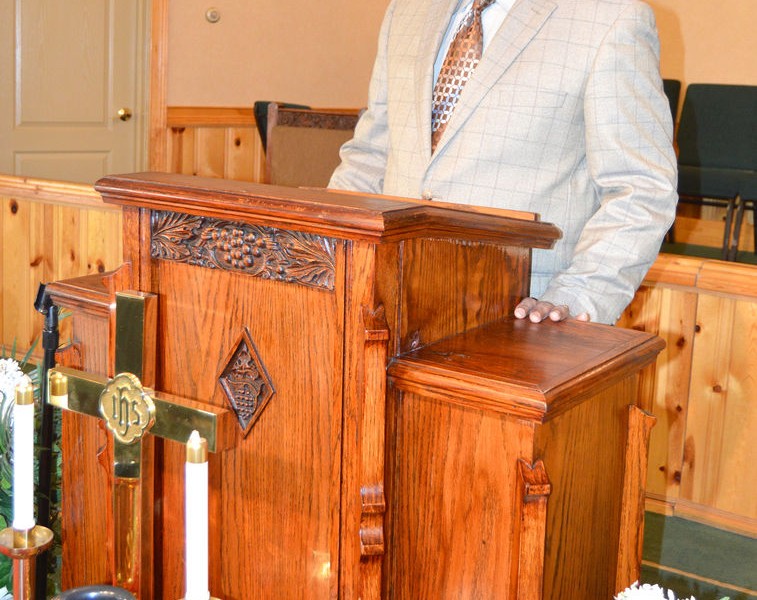
St. Patrick’s Episcopal Church rector Father Jay Weldon said the west Albany church has grown dramatically in the past seven years, doubling its membership. (Herald File Photo: Carlton Fletcher)
Author

Related Articles

From cotton to cloud: In the data center debate, is rural Georgia once again being asked to carry the cost?
Across much of rural Georgia, the abandoned cotton warehouses and shrinking tax bases remain — enduring reminders that industries built to serve distant markets do not necessarily stay rooted in the communities that first sustained them.

My Grandpa Was Killed in World War II. I Met Him Through His Letters Home
Gina Wolf’s grandfather died before she was born. His letters sent to her grandmother from Europe during World War II made it possible to know what kind of man he was.

‘Sounds Like a Mutiny.’ Secret Recording Exposes Claims of Toxic Leadership After a Marine’s Suicide
This week’s War Horse story follows the systemic failures before and after the death of Cpl. Drew Mobley who was the third in two years at Marine Corps Base Quantico to die by suicide.