
Ivey Hines overcomes vision disability to run Albany’s Snickers Marathon
Despite blindness, the former Albany city commissioner completes the 26.2-mile run
By Carlton Fletcher
ALBANY — The world around him little more than an endless succession of blurs, Ivey Hines kept doing the one thing the men who trained him told him he had to do.
“I just kept moving,” Hines, the former Albany city commissioner and retired supply systems analyst, said. “I picked one foot up, then put it down, another step ahead.”
The infamous “wall” that distance runners dread loomed large as Hines moved into uncharted territory … 19 miles, and then 20, 21, 22 …
“I’d never run this far before, and the pain in my back, knees and ankles was almost unbearable,” Hines said. “But Harry was right there with me, telling me, ‘Come on, you can’t quit. Pick it up.’”
His will stretched to the point of breaking as he passed miles 24 and 25, Hines found an adrenaline-charged reserve of strength when he passed the marker at mile 26. And then the crowd, realizing that this was no ordinary runner headed for the finish line, shouted its collective encouragement.
“Man, when we made that last turn and all those people started hollering, it turned something loose inside me,” Hines, a minister, said. “I started hollering, too. And then I started running.”
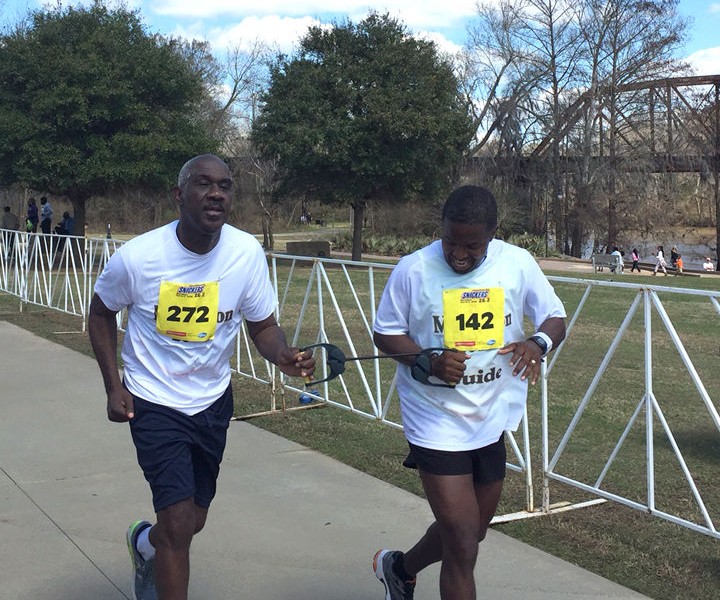
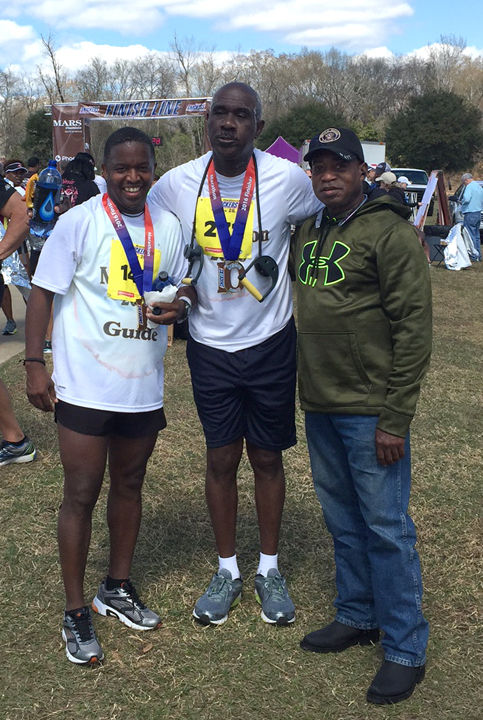
When Hines and retired Marine Harry Davis, the “Harry” who had talked him away from the wall, crossed the finish line at Albany’s Snickers Marathon on March 5, what they’d done together was monumental, a seemingly unrealistic “plan-the-rest-of-your-life” goal that others said was impossible.
But those people underestimated the inner strength that drives Ivey Hines.
“Once Ivey sets his mind to something, he’s generally going to do it,” Davis, a runner who agreed to train Hines for the marathon, said. “You can’t ever doubt him.”
That Hines had never run a distance greater than a few hundred yards in his life was not what made his 26.2-mile journey legendary. The fact that he’d started training for the run only six months before, while amazing, was still not what made his accomplishment so remarkable.
Hines, you see, is blind. Has been since 1977.
“I have a hereditary disorder, retinitis pigmentosa,” Hines told a visitor to his central Albany home a few weeks removed from completing the Snickers Marathon. “If I lean my head against something, I can see a blur, but my ability to distinguish color is gone.
“The back of your eye is like a mirror, and when light comes in and hits that mirror you’re presented with an image. All the silver’s gone from my mirror.”
Born in Macon and an Albany resident pretty much full-time since he came to Albany State University in 1971, Ivey Hines has never been one to let his blindness define him. When, at age 24, he was declared legally blind, he studied braille in Warm Springs, Ark. It was at a rehabilitation facility there that Hines also received therapy that allowed him to, slowly, accept his blindness and learn to cope with it.
Denied a diploma at Albany State when he failed an exit exam (“I couldn’t make out the words on the test”), Hines got his history degree when he was allowed to have an instructor read the questions on the exam to him. He was an instructor in a crime prevention program at the Medgar, Malcolm & Martin Education Center in Macon, then came back to Albany in 1980 for a job with Georgia Legal Services.
A short while later, after hearing a TV ad that announced jobs were open at Marine Corps Logistics Base-Albany for people with disabilities, he applied and landed a supply systems analyst position. He remained a “civilian Marine” for the next 32 years. But last year, Hines decided it was time to leave his career behind.
“I’d done all I could do there,” he said. “Sometimes you reach a point in you career where it’s like winning the Super Bowl. What’s left to do?”
Before he left MCLB-Albany, though, and followed through with his plan to return to Macon, Hines came upon an online program that purported to “help you plan for the rest of your life.”
“I’m reading this thing, and it started to kind of make sense,” Hines said. “Then I came to this part where it suggested running a marathon. Now, I had played a little baseball, football and basketball when I was a boy, but I never participated in structured sports. And I certainly had never run any long distances.
“But the more I talked with people who had run marathons, the more this idea started sticking in my head. I finally talked to a friend who said he knew of a six-month training program that would get you ready to run a marathon, and I asked him if he could train me. When he said yes, I made up my mind.”
That friend, certified exercise instructor Isom Williams, who had retired from his position at the Marine base to teach his “Fit to Serve” program at Mt. Zion Baptist Church, admits now to an initial reluctance to meet his friend’s request, given Hines’ disability.
“This was a new one on me,” Williams said. “But Ivey convinced me that he was serious, so I devised a program for him. We started working out on the treadmill and the weight room at the YMCA. I’d have him doing stuff, and he’d say, ‘I don’t want to do this.’ I’d say, ‘Ivey, lets get our roles straight. I’m the trainer, you’re the trainee.’”
With Williams working on his strength and cardio, Hines called on Davis to train him for his roadwork.
“I’d been a runner myself, picked up the bug in my 30s while I was stationed in Japan,” Davis, who does civil service work at MCLB-Albany now, said. “I ran my first marathon in ‘96 — the Marine Marathon, of course — and ran several more over the next few years. But I hurt my leg around 2008, tried to run anyway, and hurt it again. Finally, around 2013-14, I stopped for a year.
“That’s one of the reasons I decided to work with Ivey. I finally talked myself back into running a half-marathon (in 2015), and I wanted to do another marathon. Ivey’s proposal became my motivation.”
Not that Davis was immediately on board.
“I said, ‘Ivey, you’re blind’ when he initially approached me,” Davis laughs. “But he was persistent. I had a mission trip planned to Haiti in July, and I told him if he still wanted to run a marathon when I got back, I’d work with him. He did, so we started to work. It was a very gradual process. We started off running a couple of hundred yards, then worked up to a mile. While we were training, I talked with him about his eating habits.
“I unknowingly worked with Isom to get Ivey ready. He had Ivey in the weight room, which was very important. I wasn’t sure how I was going to bring up that subject with him, but it turned out that Isom had him at the Y working on the treadmill and with weights, and I trained him for road work.”
Hines admits that the process was not exactly a fun one, but all of his pain and doubt disappeared when he crossed the finish line of the Snickers Marathon.
“It’s difficult for me to be in crowds, and gathering at the starting line was hard,” he said. “There were so many people there, and as they crowded in around me I got nervous. Once things thinned out, though, I was OK. The only thing is I never could get into the rhythm I needed. One of the things Harry preached is that you have to get your running and breathing synchronized. I couldn’t quite get there.”
But Hines persevered and, tethered to Davis for the entire 26.2 miles of the race, accomplished the goal people said he’d never manage.
“I was amazed, amazed I could actually physically do this thing that everyone said was impossible,” he said. “Once the adrenaline wore off, though, I started to hurt in ways I’ve never hurt before. It took me a good month to fully recover.”
But was the accomplishment enough to get him back on another marathon course?
“I haven’t ruled it out,” he said. “I’ll see how I feel around May or June.”
Hines is serene as he talks of his athletic day in the sun, the thing that an Internet website suggested was a nice checkmark off someone’s retirement bucket list. But he admits that it would please him if his accomplishment inspired someone else to take on a task that had been deemed “too tough.”
“I got two very big things from this,” he said. “One: What we accomplished proved that whenever you want to do something, you can do it. And, two: This thing in life about doing something so out of character for me when people said, ‘You can’t do this thing,’ made me realize that part of my calling in life is for people to see someone do things they’re told they can’t do.
“There are two words that people use when they’re talking about folks like me: ‘handicap’ and ‘disability.’ A handicap is something people put on you, and they’re not just physical. They handicap you because of your size, your color, your education level. A disability is a natural thing, something you have to overcome. I’ve overcome my disability.”
Hines allows himself a wide grin.
“I have a friend I haven’t seen since I ran the marathon,” he says. “I know she’s heard about it, though. And when I see her, the first thing she’s going to say is, ‘What you gonna do next?’”
Author
Related Articles

WAYNE FOWLER: Do you have the courage to showcase your faith?
A pair of college football stars put their faith on display.
Tuesday Bible Verse
Tuesday Bible Verse
CREEDE HINSHAW: In measuring the awe of God, silence is golden
Church can be a noisy place.
