
Last significant battle of Civil War fought in Columbus
Special Photo
By Tom Seegmueller
[email protected]
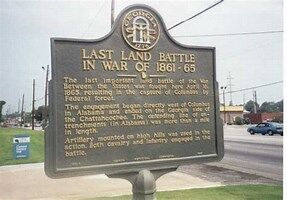
COLUMBUS — The last important land battle in the U.S. Civil War of 1861-1865 was fought here on April 16, 1865, resulting in the capture of Columbus by Federal forces.
The engagement began directly west of Columbus in Alabama and ended on the Georgia side of the Chattahoochee. The defending line of entrenchments (in Alabama) was more than a mile in length.
Artillery mounted on high hills was used in the action. Both cavalry and infantry engaged in the battle.
Most people know that the War Between the States ended on April 9, 1865 when Gen. Robert E. Lee surrendered to Lt. General Ulysses S. Grant at Appomattox Court House. However, troops in the western theater and the deep South were not aware of this event. This included Maj. General James H. Wilson, who had received orders in December of 1864 to march into the deep South and destroy the manufacturing center of Columbus.
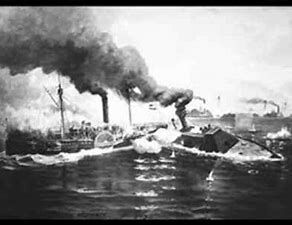
At this point, Columbus was the largest remaining manufacturing center of the Confederacy and had been second only to Richmond, Va., during the war. Textile mills, foundries, grist mills and shipworks lined the banks of the Chattahoochee there. The recently completed ironclad the CSS Muscogee also was docked there waiting to be stocked and launched.
On April 14, President Lincoln was fatally shot, dying the next day. This news also did not reach remotely stationed troops fighting in the heart of the Confederacy.
On April 16, local newspapers warn the citizens of Columbus to evacuate the city as it is generally believed that the city will be shelled by artillery prior to a frontal assault. Confederate Maj. Gen. Howell Cobb begins developing a defensive plan to best use his 3,500 men to maximum effect against the Union’s superior forces.
Cobb decides that his best option is to defend Columbus from the western side of the Chattahoochee using defensive breastworks that were partially completed in the city of Girard (Phenix City). His defensive strategy involved trying to retain control of the high ground in Girard, preventing Wilson’s artillery from setting up batteries there to bombard Columbus. He also knew that he could use the two bridges to funnel the attacking forces into shooting lanes.
This plan included Cobb ordering that the bridges, which were built by master bridge builder Horace King, be prepared for the torch. As a result of this order, the pilings and base of the bridges were wrapped with cotton and soaked with turpentine. In the event that the bridges could not be held from Federal control, they could be burned, preventing easy access to Columbus.
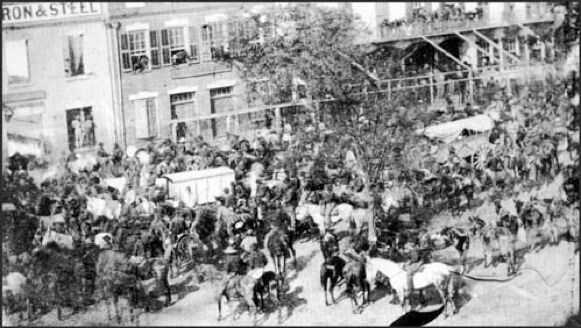
On Easter Sunday, April 16, Wilson’s troops began arriving outside Girard. Around 2 p.m., the Union launched an initial attack on the southern bridge. Gen. Emory Upton led the attack and, meeting little resistance, stated, “Columbus is ours without a shot being fired.” However, this was a strategic move by the Confederate defenders who rapidly removed planks from the eastern side of the bridge, making it useless for passage into the city.
Gen. Wilson then turned his attention to the Northern, or 14th Street Bridge. As the sun was setting, Confederate Gen. Robert Toombs sent a telegraph to Georgia Gov. Joseph E. Brown that there would be a “decided fight” the next day. However, Wilson surprised him with a late evening assault at around 8:00 p.m. Union Col. Fredrick Benteen was ordered to lead a charge across the bridge. He would later serve under Gen. George Armstrong Custer at the Battle of the Little Bighorn.
With the realization that only one bridge remained, Confederate troops raced toward the bridge in an attempt to reach safety on the eastern bank. At the same time, Union troops rushed the bridge to get across before it too was rendered impassable. In the bedlam that ensued, the bridge became packed with a fighting swarm of the opposing armies.
However, any attempts to burn the bridge were delayed as the Confederate forces in Columbus did not want to injure their comrades. The same dilemma faced Toombs who commanded two cannons on the Georgia side loaded with cannister (grapeshot). Knowing his troops were now intermingled with the Union forces, he chose not to fire.
By 11:00 p.m., Wilson attempted to cross the bridge. Although his horse was shot out from under him, he made it to the Georgia side, where he set up his headquarters in the house nearest the bridge. Interestingly the house belonged to Randolph Lawler Mott, who had remained loyal to the Union, flying the Stars and Stripes over the house throughout the war.
The Union lost 60 men during the assault, and the Confederacy lost 151. The majority of the Union dead are now buried at Andersonville Cemetery, and the Confederate dead are buried in Linwood Cemetery in Columbus.
The last fatality in the action was Col. C.A.L. Lamar who led a futile cavalry charge on “Mott’s Green.” When he refused to surrender, he was shot by a dismounted Union cavalryman. Lamar had previously achieved notoriety by underwriting the illegal voyage of the ship Wanderer, which landed on Jekyll Island in 1858 carrying an illegal cargo of 409 slaves.
On April 17, the destruction of Columbus and Girard began in earnest. Millstones were smashed, factories destroyed. The boatyard at Port Columbus was destroyed The C.S.S. Muscogee, an ironclad, was burned and sank. Confederate shipyard workers had scuttled the C.S.S. Chattahoochee. (Remains of the ships can be viewed at the National Civil War Museum in Columbus.) The resulting fires burned for days after the Union troops departed on April 18.
A number of side notes to the battle are interesting. Gen. William Tecumseh Sherman identified Col. Lamar as the last Confederate to die in the war. He was initially buried at Linwood Cemetery. Linwood Cemetery is also the final resting place for Noble Leslie Devotie, who was recorded as the first death associated with the Civil War when he slipped, falling into the water and drowning as he attempted to board a steamer in Fort Morgan, Ala., on Feb. 12, 1861.
Devotie was a founding father of Sigma Alpha Epsilon fraternity at the University of Alabama.
In early May, Wilson’s troops captured the most wanted men in America: Henry Wirz, the commandant of Andersonville Prison camp, was captured on May 7, and Jefferson Davis, president of the Confederacy, was captured at Irwinville on May 10.
There is no way to escape the fact that as individuals and as a nation, we are still dealing with the impact of a Civil War that took place 155 years ago.
But one of the more lasting results of the war took place during the bedlam on the 14th Street Bridge when a Confederate soldier, Dr. John Pemberton, attempted to fight his way back to the Columbus line of defense.
Pemberton received a saber wound to his chest. As a result, he, like so many veterans of the war trying to ease their physical and mental anguish, became a morphine addict. As a biochemist graduating from Reform Medical College of Georgia, he began experimenting with various natural remedies and painkillers in an attempt to free himself from his addiction.
The result was the formulation of a beverage to prevent alcoholism and addiction, treat pain, anxiety, and “Neurasthenia” among “highly-strung” Southern women. His experimentation with coca, kola nuts and other ingredients lead to a world-famous concoction, Coca-Cola.
Off and on since the 1890s, efforts have been made to designate the battlefield in Columbus and the remaining earthworks in Alabama as a national battlefield park, but to no avail.
Related Articles
From cotton to cloud: In the data center debate, is rural Georgia once again being asked to carry the cost?
Across much of rural Georgia, the abandoned cotton warehouses and shrinking tax bases remain — enduring reminders that industries built to serve distant markets do not necessarily stay rooted in the communities that first sustained them.
My Grandpa Was Killed in World War II. I Met Him Through His Letters Home
Gina Wolf’s grandfather died before she was born. His letters sent to her grandmother from Europe during World War II made it possible to know what kind of man he was.
‘Sounds Like a Mutiny.’ Secret Recording Exposes Claims of Toxic Leadership After a Marine’s Suicide
This week’s War Horse story follows the systemic failures before and after the death of Cpl. Drew Mobley who was the third in two years at Marine Corps Base Quantico to die by suicide.
