
Smoke in the air signals conservation efforts underway in Georgia
By Jeffery Cannon
[email protected]
ALBANY — As spring emerges in south Georgia, faint smells of smoke signal that an ancient tradition continues, and forest conservation is underway.
February brings so-called “bluebird days,” which give the first hint that the grip of winter is loosening. Realizing the first bluebird day had arrived dawned slowly upon me this year. It started like most other winter mornings. As I walked outside, the sunrise cast long shadows of trees across the lawn. The dull grass was dusted with white frost, giving it a matte finish. I stuffed my frigid hands into my pockets for warmth, scraping the skin of my knuckles, cracked by several days of cold, dry air.
But within several hours after sunrise, the grey winter was broken. Every cloud in the sky dispersed and the sun rose high, shining white-bright through the vast, azure sky. Gentle but steady winds picked up, giving life to the still, cool air.
The winds delivered another hint that today would be a bluebird day. The late-morning breeze brought a faint, but detectable whiff of smoke. This was not the acrid tinge of a chimney. Instead, the smoke carried the distinct, resinous smell of burning pine needles.
As I stepped into the car and started my long commute through the rural county, I spotted the definitive sign of a true bluebird day: a temporary road sign. It was a large, diamond, nylon sign politely pleading that commuters “Pardon our smoke.”
The smell of smoke was wafting from one of the many piney hunting estates nestled among the farmland between Albany and Thomasville.
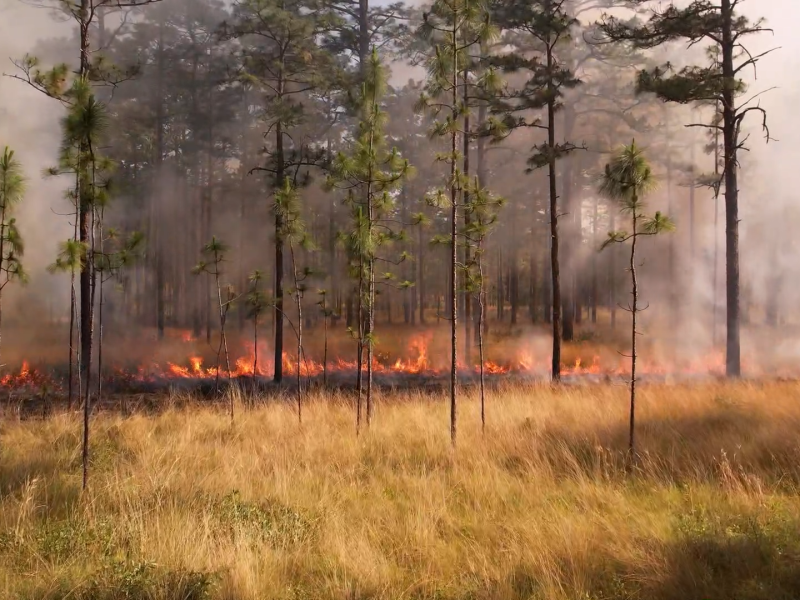
The cool, dry air and steady breezes of bluebird days are perfect conditions for prescribed burns, which are used to conserve some of Georgia’s native ecosystems. The pine woodlands that were burning are part of what remains of a once vast ecosystem that stretched across southern Georgia.
Longleaf pine once covered 90 million acres of the Southeast, including much of what is now Albany. Mature longleaf pine woodlands can support tremendous biodiversity. In some cases, you can find up to 40 species of plants underfoot in a grassy patch of ground no larger than a school desk. This level of plant diversity is usually found only in tropical rainforests. It should be no surprise that longleaf pine woodlands also house many rare and imperiled species of reptiles, amphibians, birds and mammals.
Rather than a dense forest, it is better to think of longleaf pine woodlands as grasslands with occasional trees. They differ from the forests we typically choose for a leisurely stroll. Instead of crowded trees forming a shady canopy, healthy longleaf pine woodlands have widely spaced trees, and shade is scarce. Woodlands do not have a thick layer of leaves that form a smooth brown carpet beneath our feet. Instead, they are filled with tall grassy plants, bursting with spring colors.
Changes in land use (for timber, farming, and development) have replaced all but 5% of the longleaf pine woodlands that once existed in the Southeastern US. Because so little of this ecosystem is left, it remains a true treasure to Georgia. Continued efforts will be needed to protect the habitat and the wildlife it supports.
The best way to conserve longleaf pine woodlands is to use fire. The tall, grassy plants in the ecosystem are, at once, beautiful and highly flammable. After a few days without rain, the grass dries and becomes perfect tinder for fire. Once ignited, fire spreads easily through the continuous carpet of grass, consuming the plants, and blackening the soil. Fire rarely kills the plants. In fact, most plants in longleaf woodlands are adapted to re-sprout, re-seed, or otherwise recover quickly from fire.
Most trees survive fire too. The creeping fire of a longleaf pine woodland is not intense enough to kill the pine trees, which have thick, corky bark. This feature is found in many tree species that evolved around frequent fires. As the trees grow and mature, they shed their lowest branches, lifting their more vulnerable needles out of harm’s way. Longleaf pine seedlings, even those as young as one or two years old, can grow thick stems that stand a good chance of surviving fire.
Longleaf pine woodlands depend on fire to filter out competing plants. While pine trees and grasses can escape a fire unscathed, hardwood trees, especially small ones, are much more vulnerable. Common Southern trees such as oaks, maples, elms, and sweetgum are much more sensitive to fire. They lack the fire adaptations of the pines. Instead, these trees often have thinner bark and exposed buds, making them more sensitive to fire.
Frequent fire helps to erode any foothold that competing plants might gain. If left unchecked by fire, the hardwood trees can quickly grow. They can expand into thick, leafy crowns that create deep shade. Shade may make for pleasant conditions during a hike, but the dense growth chokes out many of the native plants that make this ecosystem so special and diverse.
Historically, lightning supplied the ignitions needed by longleaf pine woodlands. For millennia, Indigenous Americans intentionally used fire to manage pine woodlands for food, game, and medicinal plants. Now, many landowners across Georgia continue this ancient tradition of burning pine woodlands to promote the wildlife habitat and rare plants they support.
The widespread use of fire is not without its challenges and trade-offs. Some questions remain about the potential dangers of smoke pollution from widespread use of prescribed fire. Research shows that smoke impacts from prescribed fires are comparable to other sources of air pollution like vehicles. But advocates of prescribed fire maintain that smoke effects from prescribed fires are small, planned, and vastly preferred to unexpected smoke emissions from wildfires that may otherwise occur.
Landowners can limit prescribed burns to days when the atmosphere easily transports smoke away from population centers and busy roads. More research on smoke effects is needed to fully understand how to balance demands for conservation and air quality.
Protection of longleaf pine woodlands requires sustained restoration and conservation efforts throughout the Southeast. Frequent fires are needed to support and restore the high biodiversity that makes them irreplaceable. So, when you smell a whiff of smoke on a clear, cool morning, know that Georgia conservationists are working to support this unique woodland treasure. And please, pardon our smoke.

Author

Related Articles

From cotton to cloud: In the data center debate, is rural Georgia once again being asked to carry the cost?
Across much of rural Georgia, the abandoned cotton warehouses and shrinking tax bases remain — enduring reminders that industries built to serve distant markets do not necessarily stay rooted in the communities that first sustained them.

My Grandpa Was Killed in World War II. I Met Him Through His Letters Home
Gina Wolf’s grandfather died before she was born. His letters sent to her grandmother from Europe during World War II made it possible to know what kind of man he was.

‘Sounds Like a Mutiny.’ Secret Recording Exposes Claims of Toxic Leadership After a Marine’s Suicide
This week’s War Horse story follows the systemic failures before and after the death of Cpl. Drew Mobley who was the third in two years at Marine Corps Base Quantico to die by suicide.
