
While fear of snakes is common, most are actually helpful
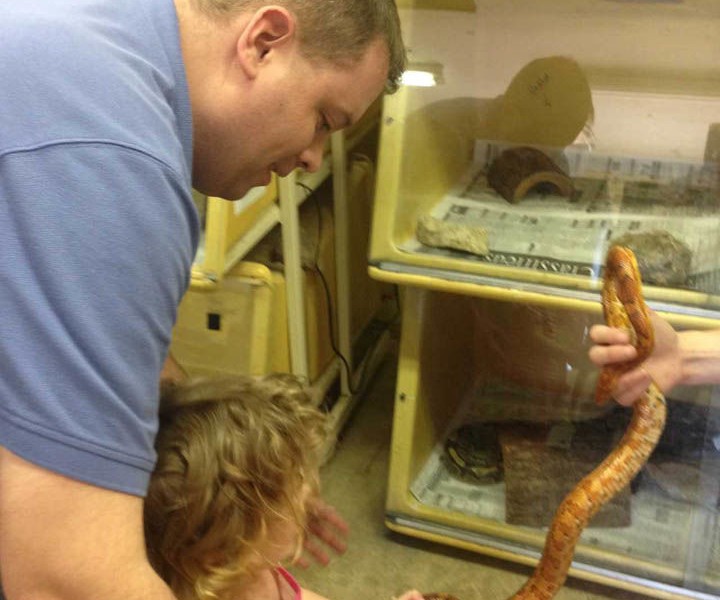
Special Photos: Tom Seegmueller
By Tom Seegmueller
Special to The Herald
ALBANY — There are those who say 99% of the things you worry about in life happen. They contend that worrying about something is not productive. Obviously, that last little percent hasn’t bitten them in the rear.
However, when it comes to something that can actually bite you, it turns out that ophidiophobia, the fear of snakes, is one of the most common phobias, even though many of those who suffer from it have never personally seen a snake.
“The idea is that throughout evolutionary history, humans who learned quickly to fear snakes would have been at an advantage to survive and reproduce,” Vanessa LoBue, a postdoctoral fellow in psychology at the University of Virginia, said. “Humans who detected the presence of snakes very quickly would have been more likely to pass on their genes.”
The fear of snakes is not totally unfounded. Each year In the USA, between 8,000 and 10,000 snakebites are reported. Of these, 30% are venomous. However, with medical advances, there are now only three to five deaths annually.
Ignorance is the most common reason for the fear of snakes and also the most common reason people get bit. Fortunately, there is a wealth of information on the subject that can not only minimize our fear of snakes but lead to a peaceful coexistence benefiting both humans and reptiles.
When it comes to snakes in Georgia, there’s good news and bad news. The good news is Georgia has one of the highest biodiversity of snakes in the United States, with 46 species residing here. In this era of political correctness, it needs to be pointed out that none are poisonous! The bad news is that six are venomous.
Since these six are the only ones that can cause harm to humans, it is best to at least learn to identify them. Not only does this help you avoid danger, it allows you to inform medical personnel with a critical piece of information if you are bitten.
Of these six, five are known as “pit vipers.” Both words being descriptive. “Pit” refers to the heat-sensing pits located midway between the snake’s eyes and nostrils. This is a thermoreceptor that can detect slight differences in temperature, helping the snake locate its prey, especially warm-blooded animals. All vipers have long hinged fangs allowing for deep penetration and injection of venom.
The term “viper” is derived from the Latin word vivus (living) and parere (to beget), referring to the trait of giving live birth, which is common among vipers but not snakes in general. Most lay eggs.
The Eastern Diamondback Rattlesnake is the largest venomous snake in America and is predominantly found in the wiregrass areas of south Georgia. It is an apex predator, and adults can reach more than 6 feet in length. They are generally irritable and will defend themselves when threatened. Their coloring is light to dark brown with a distinct diamond pattern of brown and yellow with a banded tail and rattles.
The Canebrake, or “Timber Rattlesnake,” is found everywhere in Georgia from woodlands to swamps. Adults can reach up to 5 feet in length. Their coloring is a greyish brown with black V-shaped cross bands. They have a black tail with rattles. Some may have an orangish-brown strip down the center of the back and hues of pink. Although it has long fangs and can produce a high yield of venom, it is a fairly laid-back snake, rarely attacking if left alone.
The Pigmy Rattlesnake is found in wooded areas and wetlands across most of Georgia. Although adults are heavy-bodied, they seldom exceed 1 foot in length. However, their bite belies their size. Due to their smaller size and dull grey coloring with darker grey or brown blotches along the sides, they are more difficult to see in leaves and pine straw.
The Cottonmouth is a member of the viper family and can be found in every wetland habitat in central and south Georgia. Adults can reach lengths of 3-4 feet and vary in their coloration. Their backs may be flat brown or olive with darker crossbands. The belly is a dull yellow and brown. Young snakes will have a yellow tip on their tail. They are characterized by standing their ground in an open-mouthed threat display. Generally, as with most snakes, if you give them some space, they will give you some space.
The Copperhead can be found in wet and dry hardwood stands and is found across most of the state. Adults will reach 2-3 feet in length, and young snakes will have a yellow-tipped tail that is used to lure small prey. They are light brown to pinkish in color with brown saddle-shaped cross bands that look like Hershey Kisses from the side. They are most active in the evening and night and are fond of cicadas as a midnight snack. Copperheads are a more aggressive snake and should be given a wide berth.
The Eastern Coral Snake is venomous but is not a pit viper. It is an Elapid, the family that includes cobras and kraits. It has short, fixed fangs, and the snake’s vibrant pattern of alternating bands of red, yellow and black are a contrast to the vipers in Georgia. They can reach up 2 feet in length.
I bet right now many of you are trying to remember a popular folk rhyme: “Red, yellow, black jump back!” (Coral Snake). “Red, black, yellow, friendly fellow.” (Scarlett King Snake). Sadly, most Coral Snake bites occur while someone is holding the cute little fellow trying to figure out if red is touching black or yellow.
One of the most important take-aways from these statistics is that the majority of people who are bitten by snakes were handling or harassing the snake. I can personally attest to this. My first snakebite occurred while I was “playing” with a juvenile Diamondback. Fortunately for me, playtime ended with a “dry strike” (no venom was injected) in the web between my thumb and index finger. The second bite was from a large Canebrake an inch below the top of my snake boot while I was moving him with a snake hook. I’m a big believer in, “three strikes and you’re out.” My snake handling days are over.
The second-most common occurrence for bites comes from people not being aware of their surroundings. They either reach down to pick up something and disturb a snake or step too close to one.
For decades I have altered my plans to prepare for a “third strike,” as first aid recommendations for snakebite have evolved. Two weeks ago, the plan was put into action when my wife’s Golden Retriever puppy was bitten by a snake.
However, things weren’t anything like I had envisioned. First, I did not see the actual strike or find a snake to identify. Instead I just found a lethargic pup with a swollen muzzle. No barking, no frantic yelping, no dog attacking a snake. Just a drooling dog.
I immediately called the vet from the number stored in my cellphone for just such an occasion to inform them I was bringing Ranger in with a suspected snakebite so they would be ready when I arrived.
Upon arrival at the doctor’s office they immediately inspected the bite, determining that it was indeed made by a venomous snake. I suspected a Copperhead as my daughters’ dog had been bitten in the same yard a few months earlier. Yep, in the backyard. Not in the boonies.
Ranger had previously received a vaccine for protection against Rattlesnake bites, but this has no real impact on a Copperhead or Cottonmouth. With an unknown bite, we elected to observe him overnight and determine whether antivenin was necessary. In the meantime, Ranger received steroids, fluids and antibiotics. Fortunately, antivenin was not necessary, and two weeks of rest and air conditioning brought a full recovery.
As it turned out two items critical to Ranger’s successful recovery are critical to humans as well — car keys and a car.
If you believe that you or someone else has been bitten by a venomous snake, stay calm. Try to identify the snake. (Do not try to catch the snake.) Keep the bite area below the heart if possible. Remove rings, watches and any tight-fitting clothing before swelling begins. Go immediately to the nearest hospital or Emergency Medical Center. Consider calling 911 to let them know you are en route.
Don’t eat or drink anything, including alcoholic beverages. Don’t run or engage in strenuous activity. Don’t cut the bite marks. Don’t try to suck or draw the venom out. Don’t apply a tourniquet after a viper bite. Don’t use a stun gun or other source of electrical shock. Don’t freeze or pack the bite area in ice.
In reality, the best snakebite kit is your car keys.
If, after reading this article, you decide to join “the only good snake is a dead snake” club, get your checkbook ready.
For good reason in Georgia, it is illegal to kill any non-venomous snake. Snakes are a key to a healthy environment and are excellent in the control of unwanted rodents. Although venomous snakes are also beneficial in this regard, they are not protected in the instances where they pose a threat to humans.
If possible, just leave them and walk away. Remember, “Don’t start nothin’, there won’t be nothin’.” It’s also illegal to keep native snakes as pets without a proper permit.
Here are some recommended resources for further information: Georgiawildlife.com, and two Facebook groups are also excellent resources: National Snakebite Support and Wild Snakes: Education & Discussion.
Related Articles

From cotton to cloud: In the data center debate, is rural Georgia once again being asked to carry the cost?
Across much of rural Georgia, the abandoned cotton warehouses and shrinking tax bases remain — enduring reminders that industries built to serve distant markets do not necessarily stay rooted in the communities that first sustained them.

My Grandpa Was Killed in World War II. I Met Him Through His Letters Home
Gina Wolf’s grandfather died before she was born. His letters sent to her grandmother from Europe during World War II made it possible to know what kind of man he was.

‘Sounds Like a Mutiny.’ Secret Recording Exposes Claims of Toxic Leadership After a Marine’s Suicide
This week’s War Horse story follows the systemic failures before and after the death of Cpl. Drew Mobley who was the third in two years at Marine Corps Base Quantico to die by suicide.
