
MCG dean: Southwest Georgia campus a medical trailblazer that is building leaders
MCG campus based in Albany part of effort to address physician shortage in Georgia
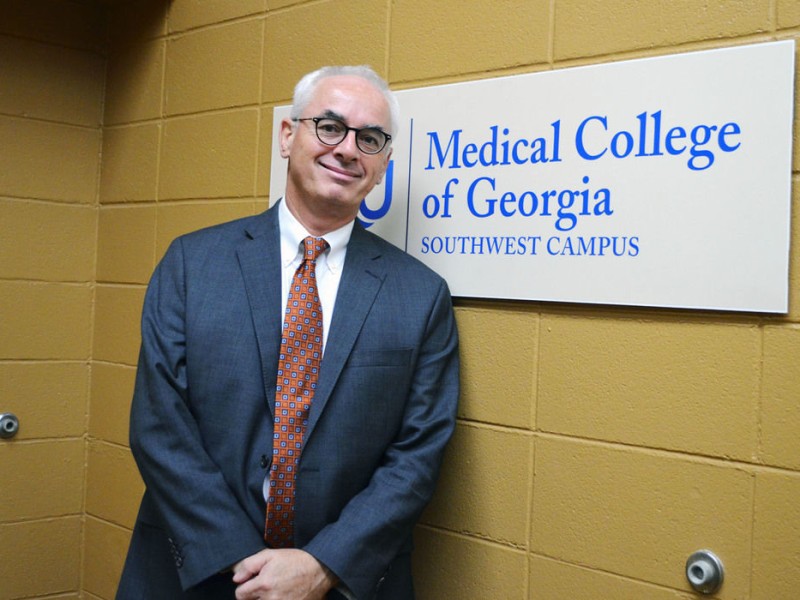
Jennifer Parks
ALBANY — Last week, Dr. Peter Buckley, dean of the Medical College of Georgia at Georgia Regents University, stopped at the college’s Southwest Campus base in Albany to get a feel for the campus’ health.
Based on an interview with The Albany Herald late Thursday afternoon, he is optimistic about the campus’ future.
The medical school still maintains a presence in Augusta, the site of the main campus, and there are satellite campuses operating throughout Georgia. The first such campus was established in Southwest Georgia in 2005, with the primary base now in a former school facility located on North Jefferson Street, directly across from Phoebe Putney Memorial Hospital.
Now, 40 percent of the training conducted by MCG is done outside of Augusta. Since the Southwest Campus was established, that has included training at campuses based in Athens, Savannah and Rome.
“(The Southwest Campus) is a medical trailblazer,” Buckley said.
The dean said he visits the campuses regularly to see how things are going and to thank the communities, and their leaders, for support — which in the Southwest campus’ case includes leadership with Phoebe Putney Health System. While in town, he was also helping to drum up support for the medical student housing complex officials are hoping to soon break ground on at the corner of West Fourth Avenue and North Jackson Street.
The hope is that the complex will be able to take the medical education efforts in Southwest Georgia to a whole new level.
“After 10 years, we have an opportunity upgrade,” Buckley said on the proposed $5 million complex.
The housing units are anticipated to be opened up to MCG students, those studying with the Southwest Georgia Family Medicine Residency Program, the University of Georgia Pharmacy School campus based in Albany and others studying in the region for a medical career.
The accreditation currently held by MCG will be up in January, so the institution will be going through an accreditation visit for the first time in eight years. Currently, the school is allowed to have 230 students per class, which could change following the accreditation visit, Buckley said.
UNIQUE EXPERIENCE
Aside from the campus based in Albany being the first satellite campus, it is unique in that it is located — comparative to other parts of the state — in a rural setting. That, the dean said, provides the third- and fourth-year students rotating through it a different education they might get elsewhere.
“Participants get unique experience in rural medicine … it sows the seed that (if) they like it, the may come back (for medical residency training),” Buckley said. “They are getting a broad experience. It’s to ensure a good work force here (is) continually available.”
Advocates in Southwest Georgia for expansion of medical education opportunities have had the goal of using those opportunities as a pipeline for prospective physicians to come to the region and stay long enough to set up practice in Southwest Georgia, in turn hoping to reverse the state’s position as the 41st in the nation for the number of physicians per 100,000 population.
If current projections hold true, Georgia will be falling 5,000 short of the needed physician levels by 2030.
Buckley said, to that end, there has been priority in recruiting students with rural Georgia roots. He is also of the opinion that the Southwest campus, which has rotated 30 students over the last year, has been successful in helping to fill that gap.
“Students get a terrific training here, and there is opportunity to give good feedback,” he said. “(Leadership with MCG and hosting hospitals) are continually working to be responsive to have a good program.”
Officials with MCG say Southwest Campus students have priority for clerkship rotations within a commutable distance from Albany. For rotations in Valdosta, Thomasville, Tifton, Moultrie, Columbus and LaGrange, housing is provided by the hospitals and managed by the Area Health Education Centers in those areas.
When it comes time to chose a satellite campus, students are taken on a bus tour to each campus to visit the facilities as well as the respective communities.
“The students who are here (at the Southwest campus) have not been sent here,” Buckley said. “They come of their own free will.
“It doesn’t matter which campus they are in … your chances of landing a job is just as good.”
PRODUCING LEADERS
Each regional MCG campus offers something different, which means one is not typically competing with another — although interest in the Southwest campus continues to remain strong. Buckley said he maintains strong faith in the hospital facilities and doctors the students are exposed to.
Officials have said there is more one-on-one interaction among students and physicians associated with the Southwest campus, providing a more meaningful learning experience as well as chances for students to get involved with community leaders and community activities.
“They get training on how to be a good professional and a good doctor,” the dean said.
The MCG campus’ home base also serves as a base for the Southwest satellite campus for UGA’s pharmacy program, contributing to a well-rounded learning experience for the budding doctors.
“(The UGA campus offers a chance for) learning to work with other professions,” Buckley said.
There are 220 faculty doctors mentoring students connected to the campus, who Buckley said have served as “an amazing support system.”
“They are giving of their time, resources and exposure,” the dean said. “(Students) get to know doctors much more as a person … they are invited to civic events with doctors.”
The leadership aspect of a medical student’s education can be especially important in those who intend on serving a rural patient base.
“In a rural community, the role of a doctor as a community leader is much more visible,” Buckley said. “The impact of leadership a good doctor can have is much more profound.
“(The MCG institution) should not just be producing doctors but leaders for Georgia. We are very proud of the (Southwest) program, and very proud of the commitment of this community to education and health care.”
Statistics available from MCG say that 95 percent of its student body of 920 are Georgia residents. There are 2,556 total faculty, including 181 part-time and 1,823 community-clinical and adjunct faculty. One in five Georgia physicians are MCG alumni, or have completed a residency associated with the institution, and 30-40 percent of those doctors are practicing primary care.
Related Articles

Dawson police arrest wanted suspect after Flock Safety camera alert
According to police, May drove into the yard of a nearby residence instead of complying with officers’ commands. He then exited the vehicle and ran into the home on foot.
Lee County stands alone without E-SPLOST. Here’s what that means for schools, taxpayers and the county’s future
Following the defeat of its referendum, Lee County became just the second of Georgia’s 159 counties without voter approval for an active ESPLOST, leaving the school system without the state’s primary local funding source for major construction, renovations, school buses and other capital improvements.
Chamber celebrates new businesses, invites community to Coffee and Connections event
The Terrell County Chamber of Commerce is continuing its efforts to strengthen local business relationships through community celebrations and networking opportunities, recently recognizing two new businesses with ribbon-cutting ceremonies and announcing its next “Coffee & Connections” event in Sasser.
