
Night hunting in Georgia is allowed under certain circumstances
Special Photo
By Tom Seegmueller
[email protected]
ALBANY — With the attention and debate focused on the recent local “Critter Round-Up,” a more comprehensive look into night hunting might be warranted. Hunters taking to the woods after the sun sets is nothing new.
References of hunters “jacklighting” deer and other game date back to the 1800s. In all likelihood, the practice of using a bright light to locate nocturnally active animals goes back much farther.
Today, for many, the term may evoke connotations of poaching and unlawful hunting practices. That was not always the case, and under certain circumstances, is not today. President Theodore Roosevelt, who was a founder of the Boone and Crockett Club, which was built around the highest standards of ethical hunting, recalled jacklighting deer in the Adirondacks in his teens.
“I have never been willing to kill another deer in this manner; I cannot say I regret having the experience,” the former president said.
Although it is no longer legal or acceptable to hunt deer in this manner, several invasive species — including coyotes, feral hogs and armadillos — may legally be hunted nocturnally in Georgia. Private landowners may hunt and allow others with written permission to do the same in pursuit of opossums and raccoons.
The origins of jacklighting can be traced to the old English phrase “jack-o-lantern,” for a man with a lantern, which is exactly how early nocturnal hunters sought out their game by using a hand-held torch or lantern to reveal the eyeshine given off from the targeted animals. This reflective eyeshine provides a very visible point of aim or target that is in sharp contrast to the surrounding darkness. In some instances, the light also seems to freeze the targeted animal, allowing the shooter to get closer to a stationary target for an easier more ethical shot.
Today, technology offers the nocturnal hunter advantages far beyond that of a lantern or flashlight. Colored spotlights, night-vision googles and scopes, as well as thermal imaging systems developed by the military, are now available on the commercial market.
Although white light sources have been used successfully for hunting a variety of game species over the centuries, consensus now seems to be that red or green light tones are more effective for a variety of reasons. As an example, hogs have dichromatic vision, seeing in two colors and having difficulty seeing longer wavelength colors. Red and green would make it harder for hogs to see, seemingly making them the obvious choice. However, the human eye is more receptive to green, allowing the hunter to see better and farther into the surrounding darkness with better contrast on dark objects like most hogs. So, in many ways, this becomes a matter of personal choice.
A wide variety of lights and filters are available in many configurations, including handheld spotlights, headlamps, as well as those with firearm and vehicle mounts. Georgia laws specify that artificial lights may be used to hunt raccoons, opossums, coyotes, armadillos and feral hogs. However, lights must be carried by hand, affixed to a hat or helmet. There are no restrictions on the use of night-vision or thermal optics for non-game species, including armadillo, coyote and feral hogs.
Night-vision optics highlight the infrared spectral range, which is just above the range of human vision. Cameras sensitive to this light capture the “unseen images” and create a monochrome image on a display screen. Today, these systems are miniaturized so they may be built into a monocular, goggles and scopes for firearms. These optical devices are available at local gun stores or from a wide range of online sources. Prices vary widely depending on the quality and capability of the device.
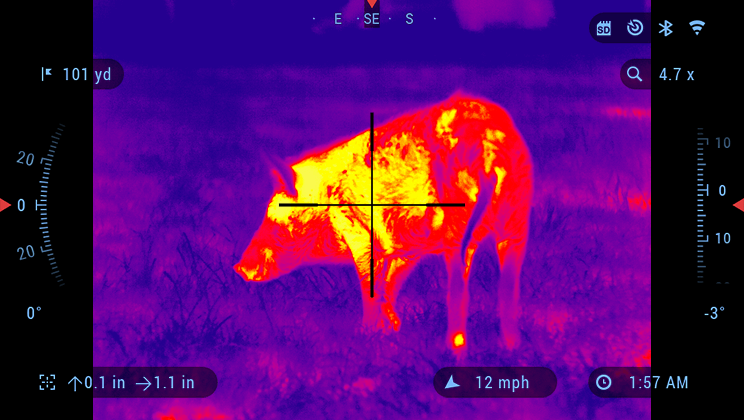
Recently, thermal optics have become available on the commercial market. Thermal devices detect thermal differences of the target and background, requiring no additional source of illumination and providing an image through fog, rain and smoke. Thermal radiation shows up as a multicolored image based on thermal intensity. Currently, these are the most expensive options for hunters. However, for many the efficiency and clarity is well worth the price. Thermal optics are also available at local gun stores and online.
Night hunting presents a unique set of challenges including those related to safety. It is imperative that hunters have in-depth knowledge of the property they will hunt after dark. The location of buildings, residences and roads is critical due to the fact that any and all may be in the background of any offered shot. However, they may not be illuminated at that time. Remember, one of the 10 rules of hunter safety is to know your target and what is beyond. This can be tricky in the dark, so pre-hunt scouting is imperative, especially when hunting a tract for the first time.
As with any other hunt, most normal rules and regulations are still in effect: All Georgia residents 16 years of age or older must possess a hunting license to hunt or trap feral hogs, except when hunting on land owned by them or their immediate family (blood or dependent relationship) residing in the same household. Nonresidents must possess a nonresident hunting license. Hunting from a vehicle under power is prohibited. The use of spotlights to harass non-targeted species such as deer is also illegal.
Coyotes, armadillos, groundhogs, beavers, starlings, pigeons, English sparrows and nutria are unprotected species. In general, the hunting of these species is permitted year-round on private land, with no closed seasons or bag limits. Legal hunting methods include firearms of any caliber, archery equipment and trapping. Lawfully owned suppressors may be used for hunting unless otherwise specified. Permission of the landowner is required.
Weapons for game animals are limited, even when hunted on private land, by the use of any legal weapon allowed during the regular season. For opossum and raccoons, this limits their harvest to rifles and handguns .22 caliber or smaller rimfire, or smaller rimfire, muzzleloading firearms, any caliber air gun. There is no restriction on magazine capacity for rifles. Shotguns must use any shell 3 to 5 inches or smaller in length with No. 2 shot or smaller shot.
The rules and regulations mentioned above relate to hunting on private property and additional exemptions to many other restrictions are available by permit for agricultural producers by permit. Contact a local Game Management Office for more details. Region 5 covering SOWEGA can be reached by calling (229) 430-4252.
Author

Related Articles
Lee County homeowners have until Aug. 15 to claim property tax exemptions
Lee County homeowners have until Aug. 1 to apply for homestead and other property tax exemptions for the 2026 tax year, a deadline members of the Lee County Board of Tax Assessors highlighted Monday as they encouraged eligible residents to take advantage of available tax relief.

Dawson police arrest wanted suspect after Flock Safety camera alert
According to police, May drove into the yard of a nearby residence instead of complying with officers’ commands. He then exited the vehicle and ran into the home on foot.
Lee County stands alone without E-SPLOST. Here’s what that means for schools, taxpayers and the county’s future
Following the defeat of its referendum, Lee County became just the second of Georgia’s 159 counties without voter approval for an active ESPLOST, leaving the school system without the state’s primary local funding source for major construction, renovations, school buses and other capital improvements.
