
Proper gun maintenance will keep weapons operating safely, efficiently
Staff Photo: Tom Seegmueller
By Tom Seegmueller
[email protected]
ALBANY ‒ With primitive weapons season for deer a week away and the opening of the regular firearms season scheduled Oct. 19, time is running out for your preseason preparations.
For about a decade, I worked in a local gun shop, cleaning and repairing a wide variety of firearms. Each year, I was amazed anew at the number of hunters who had eagerly anticipated the next opening day without properly caring for or preparing their firearms during this almost 10-month hiatus.
The Monday following opening weekends always was one of the busiest of the year, with a steady stream of customers needing immediate help with a variety of issues. They brought in guns that would not chamber a round, guns that would not fire, guns that were gunky, rusty and dusty. Scopes were loose and cloudy, while others seemed to be miraculously hanging on by a screw. Most were presented with accompanying tales of woe relating to missed shots and opportunities that could be attributed to the condition of their firearm.
The majority of these guns had one thing in common: neglect. Many appeared fine at first glance, but closer inspection revealed dirty bores and chambers. Some appeared to have not seen oil since they left the store where they were purchased. Others ironically were so compacted with oil, dirt and grease that the combination of their parts could not function properly.
Most new firearms today should come with an instruction manual outlining the basic cleaning and maintenance procedures necessary to keep them functioning safely and efficiently. If the manual is no longer available, many manufacturers will provide a replacement free of charge. There are also a wide range of videos available on YouTube and other social media relating to the care of a specific firearm. I would offer a word of caution: Not all self-professed experts should be offering advice. With this in mind, I recommend watching several videos before attempting to disassemble a firearm for cleaning and maintenance.
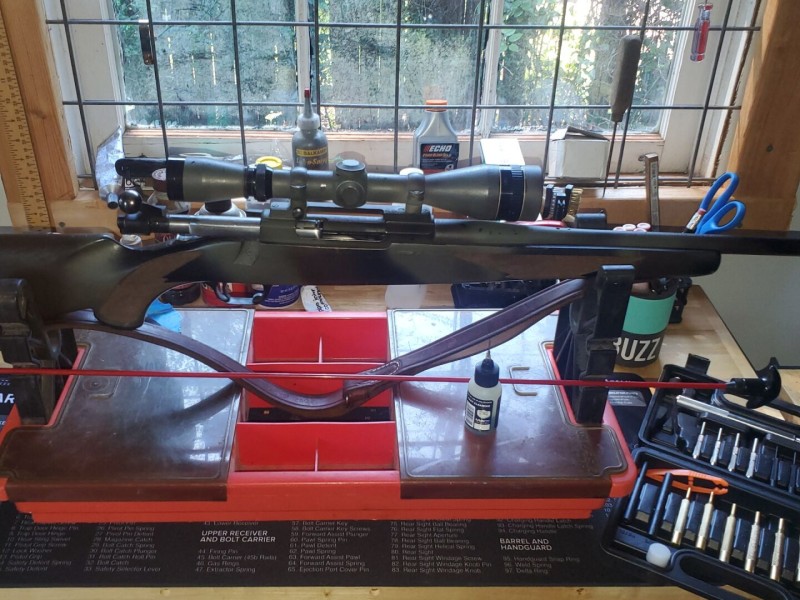
Before working on any firearm, be sure that it is unloaded. The magazine as well as the chamber should be empty. Many firearms require the trigger to be pulled to disassemble them. Next, you should work on a clean, well-lighted surface. Whenever possible, use a gun cradle or vise to hold the firearm securely. If this is not possible the firearm can be laid on a table and protected by a towel.
A minimum of items and tools are essential to properly clean a firearm, including:
• Appropriate cleaning solvents and lubricants
• Bore brushes and jags of the correct caliber or size
• An assortment of cleaning patches and cloth
• Cleaning rod
• Toothbrush or other small nylon or brass brushes
• Cotton swabs
• Microfiber cloth
• Safety glasses
Most problems will relate to a dirty bore and/or chamber. A build-up of carbon or oil, dirt and dust will not only affect accuracy, it can prevent the action from working properly, causing cartridges to not feed or eject. The chamber and bore should be cleaned by running brushes, patches or bore snakes through the firearm in the same direction the bullet travels when fired, from breech to bore.
Do NOT pull the patch, brush or snake back through the barrel toward the breech as this will redeposit crude in the barrel or dump it into the chamber, creating a bigger issue. Push it through and remove the patch, jag or brush before pulling the cleaning rod back to the breech to repeat the process. I generally do an initial pass through the barrel with a patch soaked in solvent. Nine out of 10 times it will come out black. Let the barrel sit for about minutes, giving the solvent time to soak into the fowling in the barrel. I then run a brass or nylon brush through the barrel 10 times. I’ll follow that by running another patch with solvent and follow this with dry patches until the patch comes out clean.
The feed ramp and magazine well can be cleaned with small brushes and swabs. The chamber should be cleaned with an appropriately sized brush and/or swab. This should be done with a twisting motion to remove carbon build up in the chamber.
Do not leave excess solvents or oil on the firearm, as this will act as an attractant and adhesive for dust, grit and powder residue. The bolt and bolt face should also be cleaned and lubricated. I cannot overemphasize the importance of not over-oiling a firearm. Over the years, I have seen more problems as a result of over-oiling than from a firearm lacking appropriate lubrication. I made a lot of money from people that just kept on spraying WD-40.
Consult your owner’s manual or video to determine what type of lubricant should be used and where critical points of lubrication are located. A small needle applicator is helpful in this regard. Magazines, whether detachable or built-in, should be cleaned and lubricated as well. When this is completed, and the firearm is completely reassembled, a light coat of oil should be applied as rust protection.
Use a clean rag to wipe off excess oil. Microfiber rags are great because they do not shed threads and fibers. Many of today’s firearms are constructed with synthetic materials that may not react well to all solvents and lubricants, and a mismatch can result in a ruined or tacky finish.
While cleaning your firearm, be sure to check all accessories — especially scopes or other optic devices — making sure they are clean and securely attached. Today, a variety of economical optical cleaners and antifogging wipes are available for use on the cleaning bench and in the field. It’s also a good time to be sure that sling swivels and slings are firmly attached for safety reasons.
One of the greatest threats to keeping firearms rust-free in southwest Georgia relates to humidity. I have seen countless firearms that were stored by owners who did everything right other than placing them in long-term storage inside canvas-, leather- or foam-lined cases. If these cases are not stored in a humidity-controlled area, they will rust. These linings trap the moisture in the air, holding it close to the firearm’s surface, resulting in rust that not only severely impacts a firearm’s appearance, but its investment value as well.
Regardless of how guns are stored, they should be checked routinely for surface rust.
Whether a firearm is treated as a work horse or a show horse, scheduled routine cleaning and oiling not only keeps it working but ensures that it has the potential of being a family heirloom that can be enjoyed for generations.
Author

Related Articles

Lee County homeowners have until Aug. 1 to claim property tax exemptions
Lee County homeowners have until Aug. 1 to apply for homestead and other property tax exemptions for the 2026 tax year, a deadline members of the Lee County Board of Tax Assessors highlighted Monday as they encouraged eligible residents to take advantage of available tax relief.

Dawson police arrest wanted suspect after Flock Safety camera alert
According to police, May drove into the yard of a nearby residence instead of complying with officers’ commands. He then exited the vehicle and ran into the home on foot.

Lee County stands alone without E-SPLOST. Here’s what that means for schools, taxpayers and the county’s future
Following the defeat of its referendum, Lee County became just the second of Georgia’s 159 counties without voter approval for an active ESPLOST, leaving the school system without the state’s primary local funding source for major construction, renovations, school buses and other capital improvements.
