
Southwest Georgia played a key role in War of 1812
Special Photo
By Tom Seegmueller
[email protected]
ALBANY – The War of 1812 has often been referred to as America’s second fight for freedom. When most people think of the conflict, their thoughts turn to battles fought on this fledgling nation’s northern border, iconic seas battles, the burning of the White House, and Andrew Jackson’s famous defensive battle of New Orleans. However, early settlers in southwest Georgia played an important role as well.
Reasons for the conflict tend to vary. Spain was aligned with Great Britain against France, which was under the powerful military leadership of Napoleon. One of the primary reasons often cited for America’s entry into the conflict was the seizure of American ships by the British Royal Navy between 1793 and 1812. During that period, it is estimated that more than 15,000 Americans were impressed into military service in this manner.
There was also growing evidence that Great Britain was offering aid and incentives to indigenous tribes to use “depredation” against settlers on the growing nation’s expanding frontiers. During this period, France and Spain would also form Native American alliances to strengthen their forces.
Florida was under Spanish rule at the time, not becoming part of the United States until 1819. Therefore, the Southern frontier of the United States, especially in Georgia, which bordered Spain’s claims in north America, reaching from the Atlantic Coast to Mobile, were vital to the Spanish.
Much of the defense of this southern border fell to Gen. David Blackshear, who was instructed to create a series of fortifications for this purpose. Blackshear, like many who would fight in the War of 1812, had gained his military experience in the American Revolution. He would fight in one of the early battles of the revolution at Moore’s Creek Bridge. Blackshear would become a surveyor, moving to Springfield, in Laurens County, Georgia, settling on the land grant there for his service during the American Revolution.
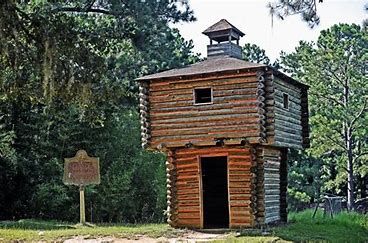
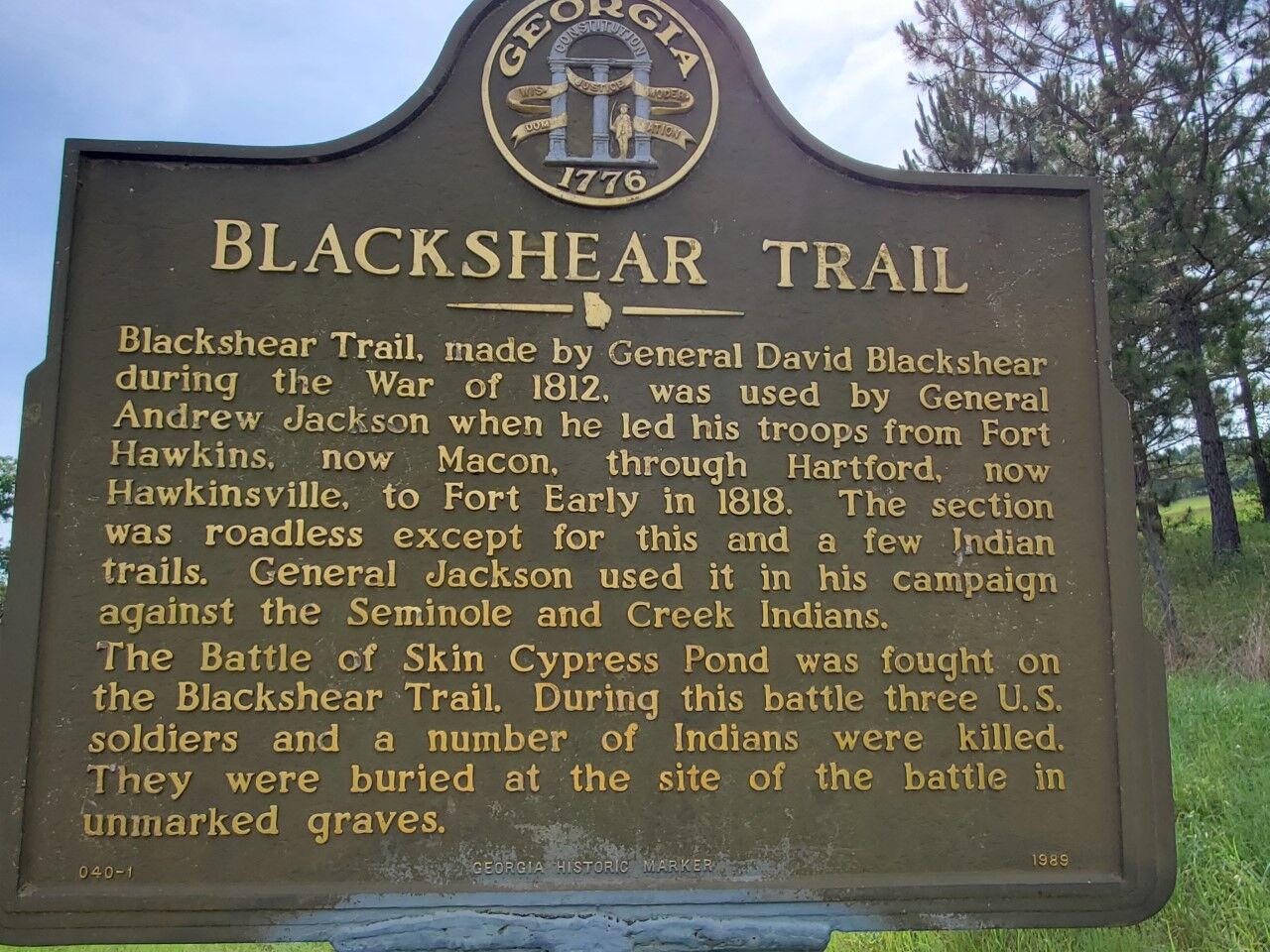
When war was declared on June 18, 1812, he returned to the service of his country and was authorized to build 11 forts along the southern and western borders of Georgia. The first clue to this effort can be found on a Georgia historical marker on Highway 300 in Crisp County. It reads, “Blackshear Trail, made by General David Blackshear during the War of 1812, was used by General Andrew Jackson when he led his troops from Fort Hawkins, now Macon, through Hartford, now Hawkinsville, to Fort Early in 1818. The section was roadless except for this and a few Indian trails. General Jackson used it in his campaign against the Seminole and Creek Indians. The Battle of Skin Cypress Pond was fought on the Blackshear Trail. During the battle, three U.S. soldiers and a number of Indians were killed. They were buried at the site of the battle in unmarked graves.”
The forts along the trail included Fort Telfair, Fort Twiggs, Fort Jackson, Fort Pike, Fort Mitchell, Fort Green, Fort Laurens, Fort Adams, Fort Clark and Fort McIntosh. Other forts in the region of significance include Fort Gaines, Fort Mitchell, Fort Morgan and Fort Scott.
By most accounts, military action in the region began on Aug. 30, 1813, when a war party of Creek Indians under Spanish and English influence attacked Fort Mims in what is now Alabama. During the action, 500 mostly white settlers were killed. In retaliation, General Andrew Jackson would lead his Tennessee Volunteers with the aid of Cherokee warriors, killing approximately800 Creeks at the Battle of Horseshoe Bend.
Another battle of note that highlights the alliances formed during the war would take place on the Apalachicola River at a fortification called British Port but more commonly known as Negro Fort. Indian laborers and “runaway” slaves enlisted by the British to harass the white settlers in the region.
The British placed two cannons, 2,000 muskets, and 1,000 swords there for use by the Native Americans and slaves. Though Spain complained about the fortification they were powerless to do anything about it.
The fort would become a refuge for Choctaw Indians, with the British promising them the return of their lands if they allied themselves with them against the Americans. In 1815, Col. Benjamin Hawkins wrote, “Col. Nichols has 200 troops, white and black, assembled with 500 warriors just below the forks. … The Indians are well-supplied with clothes and munitions for war.”
On July 24, 1816, a siege was planned against the fort. As the inhabitants of the fort began firing in defense, an American gun vessel (barge) fired a cannon ball heated on the galley range. It struck the fort’s main powder magazine. Witnesses reported, “The fort appeared to rise up and debris, human bodies and parts fanned out in all directions.” It was estimated that of the 100 men and 300 women in the fort at the time, fewer than 50 survived, although most of those were mortally wounded.
Marcus C. Buck, a participant in the battle, wrote his father, “You cannot conceive, nor I describe, the horrors of the scene. In an instant, the lifeless bodies were stretched upon the plain, buried in sand and rubbish, or suspended from the tops of surrounding pines. … The brave soldier was disarmed of his resentment, and checked his vicious career, to drop a tear on the distressing scene.”
Indians fighting in supporting of the American troops took the weapons, including 3,000 British muskets still packed in cases, 500 carbines, 500 swords and almost 1,000 pairs of pistols, along with 163 barrels and 500 kegs of powder.
A second historical marker in Crisp County marks the location of Fort Early and reads, “Fort Early, built by Gen. David Blackshear in 1812, was named for Peter Early, governor of Georgia at that time. It was used by Gen. Blackshear during the War of 1812. On Feb. 13, 1818, Gen. Andrew Jackson and his army arrived at the fort and used it in the campaign against the hostile Seminole Indians of Florida and Creek Indians of Georgia. Nothing remains of the fort. It is believed to have been a stockade like many used in Indian warfare.”
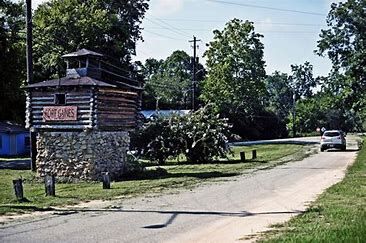
In Clay County, efforts are currently under way to better define the bounds of the Fort there, as well as mark previously unmarked gravesites dating back to the period. A marker there reads, “One of several forts on Georgia’s western frontier for the protection of white settlers, Fort Gaines was established in 1816 by order of Gen. Edmund P. Gaines, commander of a large district, who used this as his headquarters. Containing two blockhouses, the 100-foot-square fort was enclosed by a stockade 8 feet high. During 1817, when Indians were active in the area, settlers look refuge in the fort, garrisoned by federal troops under Gen. John Dill. Maintained for a number of years, the fort stood on the brow of the bluff just below the confluence of Town Branch with Chemochechobee Creek.”
In Decatur County, a marker recognizing Fort Scott reads, “In June 1816, Lt. Col. D.L. Clinch and a detachment of the 4th U.S. Infantry set up camp one mile west of here, calling it Camp Crawford. They began construction of a fort on the site in September 1816, naming it Fort Scott. Need for a fort was prompted by the presence of restless Indians who had emigrated to nearby areas — refugees largely composed of Seminoles and ‘Red Sticks’ (a hostile faction of the Creeks). Prematurely evacuated in December 1816 and almost immediately pillaged by hostile Indians, Capt. S. Donoho and his artillery company re-occupied Fort Scott in the Spring of 1817, reinforced later that year by additional troops of the 4th and 7th Regiments.
“March 9, 1818, Gen. Andrew Jackson arrived here with his staff and troops of the Georgia Militia. He was joined by Kentucky and Tennessee militiamen, who had marched through Alabama. At Fort Scott, Jackson concentrated troops for his march into Spanish Florida against Indians who had been raiding U.S. territory. He took with him the force at Fort Scott, excepting 60 men left as garrison. Following Jackson’s campaign, the garrison largely consisted of companies of the 7th Regiment. Frontier peace and increase of malaria probably account for the abandonment of Fort Scott in September 1821.”
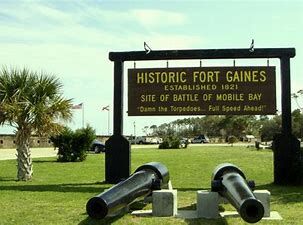
The War of 1812 resulted in a spirit of nationalism and an increase in global respect of other more established governments. It also showed the need for a more industrialized America. Most importantly, however, is that it was the catalyst for westward expansion and the removal of Native Americans from their ancestral homelands.
While the location and archeological evidence of many of the fortifications of the War of 1812 is plentiful for many sites, others are not as well-documented. Somewhere along the Flint River in Taylor County, the remains of Fort Lawrence are yet to be discovered.
Anyone interested in visiting the sites mentioned in this article can visit the Georgia Historical Marker website, www.georgiahistory.com and click on the Historical Marker site to get information and map out a route to visit these sites.
Author

Related Articles

Wild Game Dinner marks 34 years as South Georgia Scouting reaches for next generation
More than a century after organized Scouting first took root in Southwest Georgia, local leaders say the program is working to preserve its traditional mission while adapting to a new generation of young people.
Dawson’s $10.2 million sewer project leaves major financial questions unresolved
As Dawson’s finance director resigns and operating pressures mount, records show $10.2 million in sewer funding, frozen loans, missing audits and gaps in the public accounting of project money.

Foreclosures jump 52.9% across the region as buyers regain negotiating power
In Dougherty County, the number of residential properties advertised for foreclosure has nearly doubled this year. In neighboring Lee County, developers are preparing to add hundreds of new houses and apartments, including homes aimed at buyers who have struggled to find newer housing at an attainable price.
