
A family’s grief … and a statewide plea for reform
You know in your heart that your father would never take his own life.

Jake Embert
By Scott Ludwig & Rachel Embert
ALBANY — Imagine arriving at your father’s home and finding it surrounded by men in uniform and emergency vehicles with flashing blue lights – and you’re told you couldn’t go inside because there’s been “an accident.”
You find yourself overwhelmed with emotions, all the while being told you have to wait.
Imagine waiting … and waiting … and waiting … not knowing exactly what happened, and then finally being informed that your father committed suicide.
“Are you sure my dad did this?” you repeat over and over and over.
“Yes, I’m afraid so, ma’am,” you’re told.
But you know in your heart that your father would never take his own life.
Imagine finding out that the investigation of the crime scene was conducted in less than an hour. Certainly there’s more to it than just that, right? This is someone’s life you’re talking about. Wouldn’t that deserve more than just observations and hearsay to be sure the proper decision was made?
Imagine finding out later that the physical evidence at the scene indicated that what you knew in your heart all along was correct. Imagine finding out your father indeed did not commit suicide. He was murdered.
Now imagine you’re the daughter of the deceased. Your name is Rachel.
If you saw the recent episode of “Dateline” titled “Malice,” this scenario may sound familiar. Here’s the synopsis provided by NBC:
“Jake Embert and his second wife, Susan, had been married for just over a year when she made a frantic 911 call. She said her husband had shot himself. Jake’s health had been in decline for months before his death — heart attacks, seizures, stomach pain and nausea. Susan told police officers Jake had said he was “sick and tired of being sick and tired.”
After speaking with his new wife, responding officers believed Jake’s fatal wound was self-inflicted, and the coroner agreed. His body was cremated the very next day; a Sunday.
But Jake’s family was not convinced he killed himself. It just didn’t make sense to them.
So they hired a private investigator, who examined what little evidence was left behind and came to the same conclusion: This was a murder staged as a suicide.
This all took place in Albany. The murder occurred on June 28, 2014. It took three
trials and more than 11 years to bring Embert’s wife, Susan Marie Johnson Melton Majors
Thomas Fortune Embert, to justice. As her name suggests, she’d had more than one husband. In all likelihood, Jake Embert will be the last: Susan is currently serving a life sentence without parole for malice murder, felony murder, aggravated assault, and an additional five years in prison for a firearms charge.
Jake Embert met Susan online. They dated several months before becoming man and wife. Ten days after the wedding, Jake changed his will and life insurance policy, making Susan his sole beneficiary.
Flash forward 13 months. Jake is dead. Susan has his remains cremated, cashes in on his life insurance policy, cleans out his house – his coin collection, WWII memorabilia, antiques, a number of Hess model cars, and a family Bible – and takes off for Florida. Susan doesn’t say goodbye, leave a forwarding address, or bother to attend her own husband’s memorial service.
Now, about that crime scene …
Jake was found lying in bed on his back with a bullet in his head. There was a gun in his right hand, only Jake was left-handed. His hand was tucked under his right leg, his fingers firmly holding the gun – neither showing a trace of blood. The only visible blood outside of the head wound was a small pool of blood on the left side of Jake’s body. It is unknown if there was any gunpowder residue on Jake’s right hand; the coroner, Michael Fowler, didn’t bother to check.
And since the death was ruled a suicide, Dougherty County Police officials didn’t check Susan’s hands for any either.
Rachel said she suspected foul play from the very beginning, and she had a feeling there was more to follow. She discovered Susan began dating a man in Florida after her father’s death. His name was Jerry Lynn Dawson, and he died in 2019. Before he passed, he experienced the same symptoms as Jake: heart attacks, seizures, stomach pain and nausea.
Using hair samples from Jake’s brush, it was determined that the cause of her father’s
symptoms was Susan administering harmful fluids – antifreeze, arsenic, and insecticides – into his food and drinks. Rachel suspects Susan was doing it to Dawson as well in the days leading up to his death. (Rachel has tried contacting Dawson’s daughter to share what she knows, but she’s been unsuccessful.)
As for those three trials …
Susan was originally found guilty of murder in 2019, but 4 1/2 years later she was granted a new trial when it was discovered that one of the jurors was a convicted felon, thereby rendering him ineligible to serve on a jury. The courts ruled that, because of the ineligible juror, there had to be a retrial.
But Susan’s defense attorney filed a motion to dismiss the case entirely, which was
granted by Judge Willie Lockette. The district attorney, Greg Edwards, then filed an appeal to the Georgia Supreme Court asking to overturn Lockette’s ruling to dismiss the case entirely. On June 10, 2025, the Supreme Court remanded the case back to lower courts, stating the case ruling was an abuse of power and had misapplied the law.
The Supreme Court thoroughly reviewed the case and found that the delays weighed heavily on the requests by the defense for continuances. Lockette reprimanded the State.
Later in 2025, a second trial was dismissed because the coroner mentioned the word
“antifreeze” on the witness stand, after Judge Victoria Johnson had excluded that evidence from being admitted.
A retrial date was set for December of 2025. On Jan. 16, 2026, the jury rendered yet
another guilty verdict.
Flash forward to today for a glance at the lives of the people involved in the case:
— Lee Wilson, the private detective who worked tirelessly on behalf of the Embert family until the case was resolved, is still a huge part of their lives.
— Chad Kirkpatrick, the detective from the Dougherty County Police Department who
reminded the Embert family throughout the case that “suicide victims are the worst
because the families won’t accept it,” left the force. He now sells used cars.
— Rachel’s brother, Will, is married and living in Opelika, Ala.,where he is an officer with the local police department. In his position, Will wants to “get things done the right way,”
inspired by the aftermath of his father’s death.
— Rachel, who told Kirkpatrick “You ruined our lives” when she spotted him in a restaurant
during Susan’s third trial, along with her aunt, Yvonne Magnus, drafted “The William
“Jake” Embert Investigative Integrity & Victims’ Rights Act.” It was submitted to Georgia
State Legislators on Feb. 12, 2026. Also called “Embert’s Law,” Rachel says it is “a comprehensive, victim-centered legislative proposal created to strengthen the integrity, accountability, and reliability of Georgia’s criminal justice system in cases involving violent or suspicious deaths.”
Rachel’s cover letter introducing the proposed legislation describes the “human impact on our family” and how no family should have to experience what she and her family went through. “Embert’s Law comes from what we have lived through – from love, from loss, and from the belief that families deserve to be heard, protected, and supported from the very beginning,” she wrote.
To sum things up, Rachel Embert has done her part. Now it’s time for the politicians to do theirs.
“Truth in Its Clearest Form” by Rachel Embert:
“The systems entrusted to protect the truth must be held to the same standard they claim to uphold. When my father, William ‘Jake’ Embert, died in 2014, the investigation into his death lasted less than an hour. It was quickly ruled a suicide. No thorough forensic examination. No meaningful investigation. Just an assumption.
“However, the truth does not disappear simply because it is ignored. Over time, evidence surfaced that confirmed what our family knew in our hearts from the very beginning: my father was brutally murdered. For nearly 12 years, our family fought for the truth to be acknowledged. We questioned. We documented. We refused to accept silence where answers should have been.
“Today, the same system that once failed to uncover the truth speaks publicly about integrity, accountability, and oversight. Truth is not measured by statements. Truth is measured by actions. If integrity and accountability are truly the standard, then the failures that allowed a homicide to be dismissed as a suicide must be acknowledged — not ignored. Because the clearest form of truth is this: No family should have to spend over a decade fighting for the truth about the death of their loved one.
“Which is the exact purpose I submitted Embert’s Law to Georgia Legislators. Not out of anger. But out of responsibility. Responsibility to ensure that truth is never overlooked again.”
Truth. Accountability. Protection
“My family’s experience demonstrated how investigative gaps can delay justice and deepen the trauma experienced by victims’ families. Embert’s Law offers a path forward by strengthening investigative procedures and promoting accountability across Georgia.
This legislation represents an opportunity to ensure that future families receive the thorough investigations and transparency they deserve.
“There was a recent report that Dougherty County Coroner Michael Fowler has
been reappointed to the Georgia Coroner’s Training Council, a statewide body that helps
oversee training and certification for coroners across Georgia. Key points from the story:
• Gov. Brian Kemp recommended Fowler for reappointment.
The Georgia Coroner’s Training Council is responsible for:
• Setting training standards for coroners and deputy coroners.
• Approving curriculum and continuing education.
• Certifying coroners to ensure they meet state requirements.
• Having authority to suspend or revoke certification if laws are violated..
•The council includes five elected coroners, a physician, and a state law-enforcement
representative who work together to maintain “professionalism, accountability, and
consistency” in death investigations across Georgia.
“However, for my father’s case, including the “Dateline” investigation and the issues uncovered by our private investigator, it raises serious questions about why those standards were not followed locally in the first place.
I have repeatedly pointed out facts that are difficult to ignore:
• The initial investigation reportedly lasted less than an hour.
• Critical forensic steps were not performed early on.
• The death was initially ruled a suicide despite evidence later indicating homicide.
• My family had to push for years to get the truth acknowledged.
When you place those facts next to an article praising statewide oversight and accountability, it naturally creates a credibility gap.
“And yet my father’s case exposed what happens when those safeguards fail.
“The real question the public should ask is this: If the system is responsible for ensuring accountability, who holds the system accountable when it gets it wrong? That very question is at the heart of Embert’s Law. Now the same system that once ignored our repeated concerns is talking about integrity and accountability.”
Shortly after the “Dateline” episode aired, the Dougherty County Police Department released the following statement:
“The Dougherty County Police Department acknowledges renewed public interest
following recent national media coverage regarding the death of William “Jake” Embert.
In response to media inquiries, the department provided the following official statement:
“The Dougherty County Police Department is aware of questions that have been raised
regarding its investigation of the unfortunate death of William ‘Jake’ Embert. This case has been fully adjudicated through the court system, where all available evidence, investigative actions, and witness testimony were examined in detail. A jury rendered a verdict after considering the totality of the facts presented. Out of respect for the integrity of the judicial process, the Dougherty County Police Department declines to further comment on the matter. We remain committed to ensuring all of our investigations are conducted in good faith and in accordance with applicable policies and the law.
“The department recognizes the continued impact of this case on the Embert family
and the community and extends its respect to all those affected.”
Six days later, Rachel Embert posted her response to the DCPD’s statement on Facebook:
“Because this traumatic experience has deeply impacted our family and our community,
I respectfully encourage the Dougherty County Police Department to consider engaging
in an open and constructive dialogue about what lessons have been learned. A public discussion about investigative practices, accountability, and improvements moving forward would demonstrate a commitment to transparency and help restore confidence that every future investigation will receive the diligence and scrutiny it deserves.
“Our family believes that meaningful conversations about reform are essential so that
another family never has to endure the same prolonged search for truth that ours experienced.
“With national attention now focused on this case through “Dateline NBC,” this moment presents an opportunity for honest reflection and progress. In the spirit of accountability, our family respectfully asks the Dougherty County Police Department to address the following questions for our community:
1. Has the department conducted an internal review of the original investigation into my
father’s death to determine whether investigative procedures should be improved?
2. What policy changes, training measures, or safeguards – if any – will be implemented to ensure future death investigations receive the level of scrutiny and diligence that every family deserves?
3. Will the department commit to publicly sharing what lessons were learned from this case so that our community can have confidence and complete transparency that similar circumstances will never occur again?
“Our family respectfully asks the department to publicly address these questions so the community can understand what steps will be taken moving forward. Because what our family experienced should never happen again. A change is required.”
To date, Rachel Embert has not received an official reply. For now, her questions remain
unanswered. Following are her thoughts on the matter at this time:
“It left me with the exact same feeling the day my father was murdered. Zero response.
Not only disheartening for the future of cases like my father’s, but to remain silent yet again, after everything we’ve endured. This is highly concerning for the community.
I’ve mentioned this several times over the years: enduring a legal saga that spanned three
criminal trials and was an agonizing series of failures and mistakes at nearly every level of the justice system in Albany, Georgia, was a slow, grinding merciless erosion of our humanity.
“We can – and must – do better.”
Related Articles
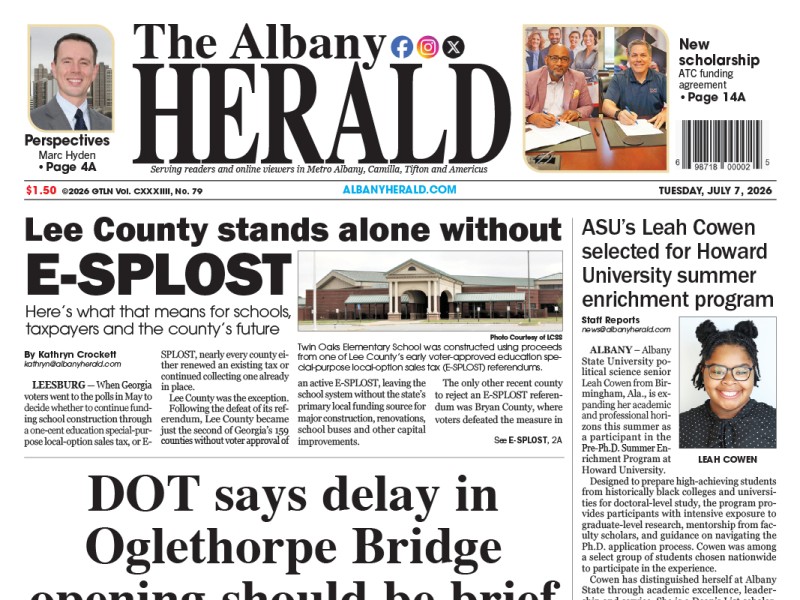
Albany Herald – July 7, 2026
Lee County stands alones without… DOT say delay in Oglethorpe Bridge… ASU’s Leah Cowen Selected for…

Classifieds – July 7, 2026
Albany Herald Classifieds: July 7, 2026
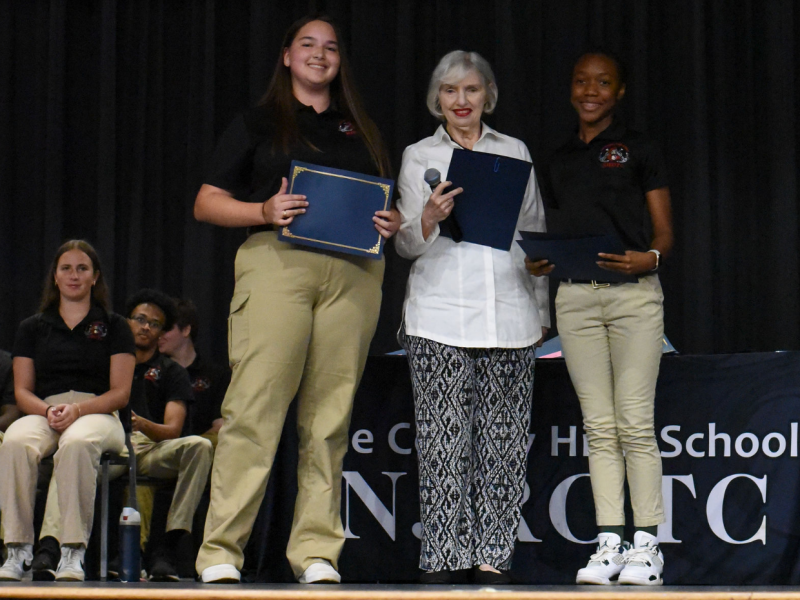
Lee County JROTC cadets honored by DAR for citizenship and leadership
Several Terrell County High School JROTC cadets were recognized for outstanding citizenship, leadership and service during the school’s recent JROTC Honors Night, receiving awards from the Old Herod Chapter of the National Society Daughters of the American Revolution.
