
Businesses see shortage of discontinued 1-cent coins
“It costs nearly three and three-quarter cents to make a penny. You have to add labor and materials. It’s very expensive. They spend a lot of money making pennies.
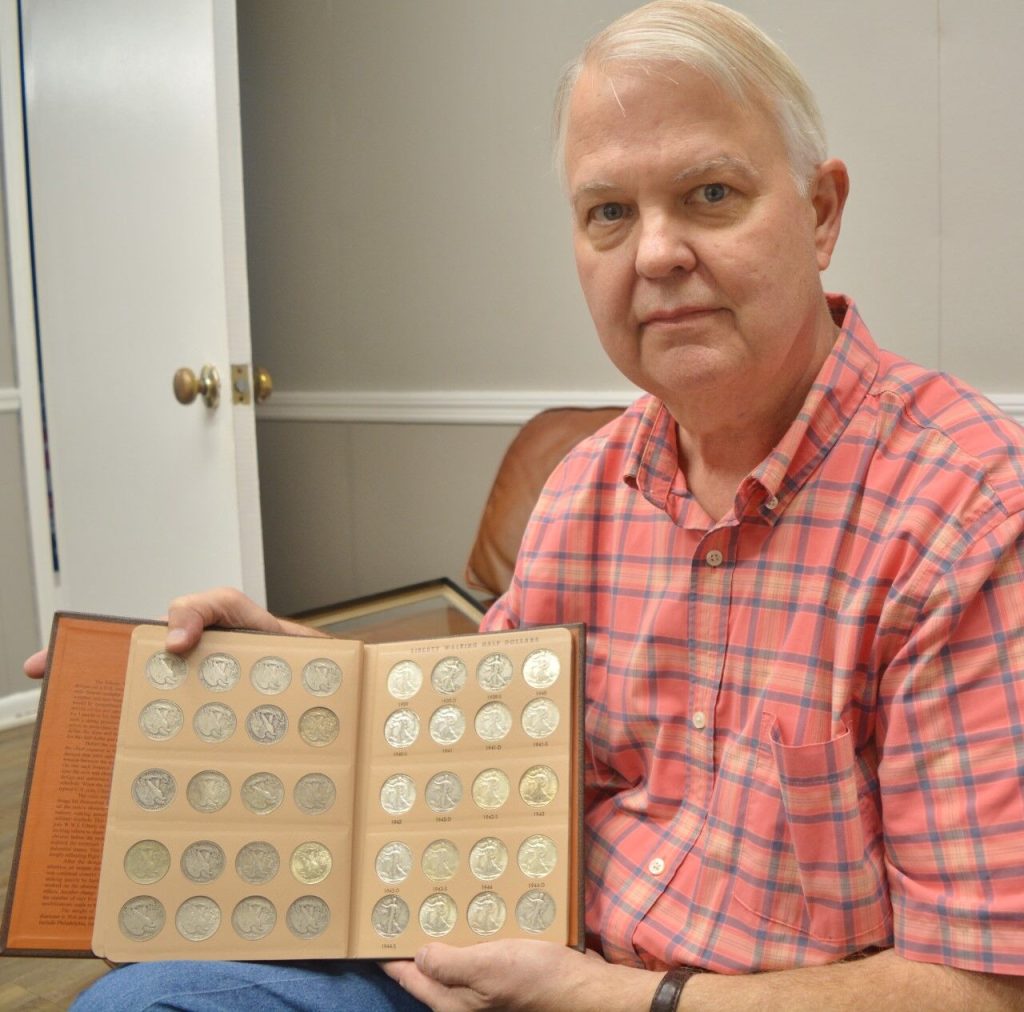
Jeff Neal shows off some of the coins from his collection. Members of the Southwest Georgia Coin Club, of which Neal is a member, gave their thoughts on the shortage of pennies resulting from the U.S. Mint halting production of one-cent coins in 2025.
By Alan Mauldin
ALBANY – A nickel for your thoughts? U.S. residents may have to get used to that change with the eventual demise of the coin that has been a part of American life for more than 200 years.
Although the number of pennies in circulation is estimated to be as many as 300 billion, many of those are sitting around houses in change containers or littering the sidewalk as no one thinks they’re worth picking up these days. The number in use is estimated at closer to 114 billion.
And with the U.S. Mint halting production in 2025, no more are being distributed to the Federal Reserve and banks it serves. That means that businesses no longer have a steady supply.
At the North Slappey Boulevard Zaxby’s this week, a sign on the door notified customers that it was no longer giving pennies as change but would be rounding to the next nickel.
Other retailers around the country have made similar announcements or are planning for a world without a steady supply of pennies from banks.
Despite the large number of pennies that have been produced over the years, that doesn’t necessarily mean that businesses can depend on a sufficient supply on hand at any given time to provide change down to the penny, Southwest Georgia Coin Club President Gary Deliberto said.
Deliberto, who started collecting pennies, as a youngster, is not particularly nostalgic for the change.
“It costs nearly three and three-quarter cents to make a penny,” he said. “You have to add labor and materials. It’s very expensive. They spend a lot of money making pennies. I have a friend who tosses them in the garage (because) to him they are a nuisance.
“I think businesses are having problems getting the pennies. They can’t give you exact change if they don’t have it. If they don’t have the pennies, they’re going to charge you 20 bucks instead of $19.99.”
Customers can also use a credit or debit card to avoid the rounding up to the nickel issue, he said.
That doesn’t mean Deliberto has given up his affinity for a coin that was first minted in the United States in 1878 and had the first official version leave the U.S. Mint in 1793.
“I’ve always been a penny guy,” he said. “They’ve always been my favorite coin, probably because that was what I could afford.”
For a 2025 story in The Albany Herald about the club’s annual coin show, Deliberto recounted how he would go to the bank for rolls of pennies, which he would comb to find unusual or valuable specimens.
“They come in boxes of $25, 50 rolls, from the mint,” he said. “I got four boxes when I heard they were going to stop making them. For Christmas a friend sent me Philadelphia and Denver rolls.”
Some companies are playing on the nostalgia by offering rolls of pennies for $10 as the “last pennies ever minted,” Deliberto said.
“That roll of pennies, even though they’re the last ones, they’ll never be worth $10,” he said.
The penny will continue on for some time due to the sheer volume of the coins in circulation and as special editions from the U.S. Mint, coin club member Jeff Neal said.
“What I think is going to eventually happen is they will make pennies for the collecting community,” he said. “Instead of making a billion pennies, they may make a million pennies a year.”
The end of penny production was not the first time a U.S. coin has been tossed.
“There was a time in our country when we had a half-penny,” Neal said. “That was phased out in the 1850s. The penny was a lot larger, but they made it the size of a half-cent.”
The size of that coin was between that of a quarter and a half-dollar piece, Deliberto said.
“I’m not sad,” he said. “Things have to change. We have to be fiscally responsible. Making a penny for 3 1/2 cents is not (sustainable).”
Still, the collector said he plans to continue to pick up any pennies he runs across as he runs errands.
“When my wife and I go to the gas station I walk all around looking for pennies,” Deliberto said.
Author

Related Articles
Albany Herald – July 7, 2026
Lee County stands alones without… DOT say delay in Oglethorpe Bridge… ASU’s Leah Cowen Selected for…

Classifieds – July 7, 2026
Albany Herald Classifieds: July 7, 2026

Lee County JROTC cadets honored by DAR for citizenship and leadership
Several Terrell County High School JROTC cadets were recognized for outstanding citizenship, leadership and service during the school’s recent JROTC Honors Night, receiving awards from the Old Herod Chapter of the National Society Daughters of the American Revolution.
