
A (rail) line on history
Jim Hendricks
ALBANY — Passenger train service in Albany is a thing of the past, but what it was like — and finding out how critical freight and passenger train service was to the development of Albany — is something residents and visitors will be able to experience in the near future.
Thronateeska Heritage Center at 100 W. Roosevelt Ave. temporarily closed its train exhibit — a collection consisting of a locomotive and train cars that once served America’s railroads — earlier this month while it works on the exhibit at its Union Station. Some motorists in the downtown area on Tuesday and Wednesday got an early peek at one of its latest projects — a restored combine car that once carried passengers and baggage on smaller rail lines.
Georgia Northern Railway Combine 38, which had been in Thronateeska’s possession since 2002, returned last week from the Roundhouse Railroad Museum in Savannah, where it was restored. The 40-ton car, sitting atop a semi trailer, was maneuvered through downtown Albany and then backed down a street on Wednesday to the rail line, where it was picked up by cranes and placed on a side track of Norfolk Southern Railroad north of Thronateeska.
When the train exhibit reopens — no date has been set, but Thronateeska officials are hoping for this fall — the combine car will be part of the museum’s static train exhibit.
“I think it will be in the fall,” Tommy Gregors said during a tour of the restored combine car Thursday. “A good date to have it done would be in October. That’s the month when the depot opened.”
But there’s a lot of work yet to be done before the exhibit can reopen. Electricity will have to be restored to the train, and the cars will have to be air conditioned. Plus, the train needs to be repositioned so that the locomotive and cars are in the right sequence.
“We’ve got to pull it out, put it (the train) in the right order and put it back in,” he said.
Walking through the combine car last week under the hot Georgia sun, Gregors pointed to the small vents at the top of the car where sunlight leaked in. “Imagine that being your air conditioning,” he said.
The combine car, according to a rail-car information fact sheet from Thronateeska, was built around 1914 for the Charleston & Western Carolina Railway before it was purchased in the 1930s by Georgia Northern, which operated it until 1948. Thronateeska officials say the car, which was used on smaller rail lines that had had fewer passengers, is one of the few of its type remaining.
Photos of the car from before the restoration show how much work had to be done to rescue it. Inside, half of the concrete floor had to be replaced with plywood. The passenger half has seat frames lining the east side of the car. Gregors said the seats lined both sides, but Thronateeska likely will leave one side vacant of the seats to make walking through it easier.
“I think people were a lot smaller back then,” he said as he pointed out the restroom facilities, which appear cramped by today’s standards.
The combine car was restored through $140,000 in funding from Special-Purpose Local-Option Sales Tax VI, which generated a total of $640,000. Of that, $500,000 was used to stabilize Albany’s original train station, the Tift depot, which is located just north of Thronateeska’s Science Museum.
Restoration work on Thronateeska’s Georgia Northern Railway Steam Locomotive 107 was paid for through $500,000 in funding from SPLOST IV, which also paid for removing asbestos and restoration work on the museum’s two boxcars.
“The county’s been very committed behind Thronateeska over the years,” Gregors said, adding the city of Albany also has been supportive through SPLOST, such as funding for the center’s archives center. “We’re actually getting toward the end of the funding now.”
Fortunately for Thronateeska, local officials, including County Administrator Richard Crowdis, have been supportive of its efforts to tell Albany and Dougherty County’s history.
“Richard Crowdis is interested in telling that story about the trains and how they relate to the history of Albany,” Gregors said.
And trains certainly played a pivotal role. Before train service, Albany, which city founder Nelson Tift envisioned as the trade center for the region, was served by steamships that traveled the Flint River. But river conditions could interrupt the transportation of goods and people by ship. As with today, reliable transportation was key to progress in the 1850s.
When the Tift depot opened in 1857, it opened a new era in Albany’s development.
“Nelson Tift had it built as a way of enticing the railroad to come south from Americus,” Gregors said. “Nelson Tift said, ‘I’ll build the depot if you’ll bring the railroad.’ That’s what really spurred the development of Albany, when the railroad started coming.
“Moving people and goods became more reliable with the railroad. That really changed Albany’s position as far as being able to move its goods out reliably and with bringing goods in here.”
Albany soon outgrew the depot, with the Victorian-style Union Station opening to the south in 1870. The Union was razed to make way for the 1912 brick station, Throanteeska’s history museum, that now sits at that location.
Utilizing the sales tax funds, Thronateeska has been able to keep the Tift depot from crumbling. The problem, Gregors said, is that it was originally built to sit above surrounding track. That area was later filled in, bringing up the ground level. Some of the original track has been found several feet below the current ground level.
Moisture became a problem as water seeped its way into the brick, causing it to weaken to the point that in 2013 the depot was placed on the places in peril list. The new, non-weathered brickwork is noticeable in that the coloration is slightly different from the remaining aged brick.
“We had to replace all of that,” Gregors said, pointing to the north wall of the depot. “You can tell where the new brick is. But the new bricks were laid in in the same pattern as the original ones.”
The result is the building has been stabilized, but it’s a long way from being usable as part of an exhibit. Funding would be needed, perhaps from a future SPLOST.
Meanwhile, a piece of history that’s important not only to Albany, but to the state, has been preserved.
“The Tift depot is one of five antebellum brick depots still in existence in the state. It’s also the southernmost one,” Gregors said, adding there also are five wooden antebellum depots still around.
Gregors said getting the Tift depot out of danger has always been a high priority. “It was the No. 1 thing I wanted to do when I got here,” he said.
Down the track, so to speak, Gregors would like to see the Tift depot, its replacement Union Station that houses the history museum, the train exhibit and grounds all tied together for visitors to enjoy. The Science Museum sits on the site of the old railroad roundhouse, its curved north wall facing the area where the turntable was located.
In addition to its locomotive, which was moved to Thronateeska from its home at Tift Park when the zoo there moved to Chehaw, and the restored combine car, Thronateeska’s rail-car collection, according to a museum fact sheet, includes:
— Southern Railway Baggage Car 518: Built in 1939, this was the first car donated to Thronateeska and has been restored. It houses the museum’s model railroad collection, including an HO scale exhibit operated and maintained by the Flint River Model Railroad club;
— Georgia Northern Railway Caboose X153: Built as Southern Railway X401 in 1969, it was rebuilt as a stand-in for the 1940 Georgia Northern X153. Restored;
— Atlantic Coast Line Railroad Railway Post Office RPO 13: Built in 1913 as Atlantic Coast Line 700, last used as maintenance car and postal fixtures were removed. Donated to Thronateeska in 1979 and is 50 percent restored;
— Atlantic Coast boxcars: Built in the 1950s and in service until the ’70s, restorations complete;
— GATX Tank Car 69995: Built in 1963, this 10,200-gallon tank car was donated to Thronateeska in 2002. Restoration is yet to be funded.
Related Articles
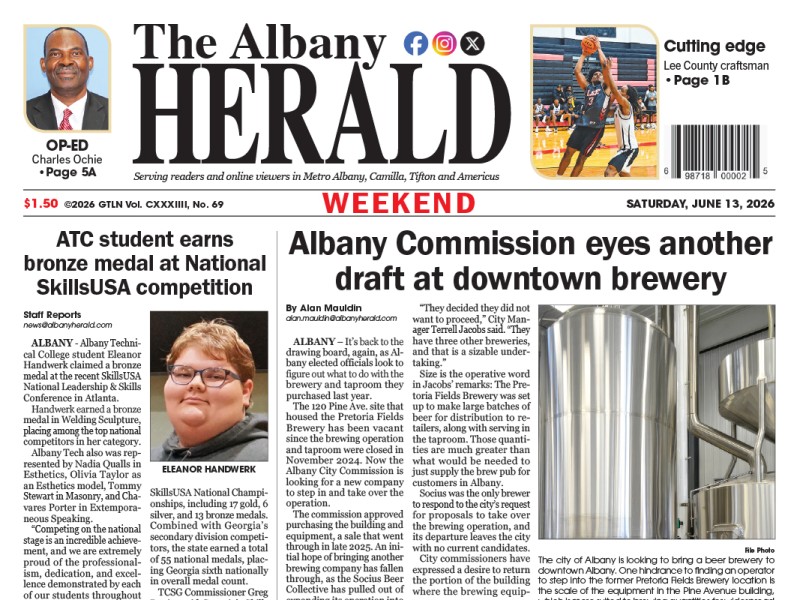
Albany Herald – June 13, 2026
ATC student earns bronze medal at National SkillsUSA competition… Albany Commission eyes another draft at downtown brewery… PUBLIC OPPOSITION SINKS PROPOSED LEE COUNTY SOLAR FARM…

Classifieds – June 13, 2026
Moving Sale: Sat June 13th, 8am-12pm. 265 Brenda Lane, Albany. Large Variety of Items.
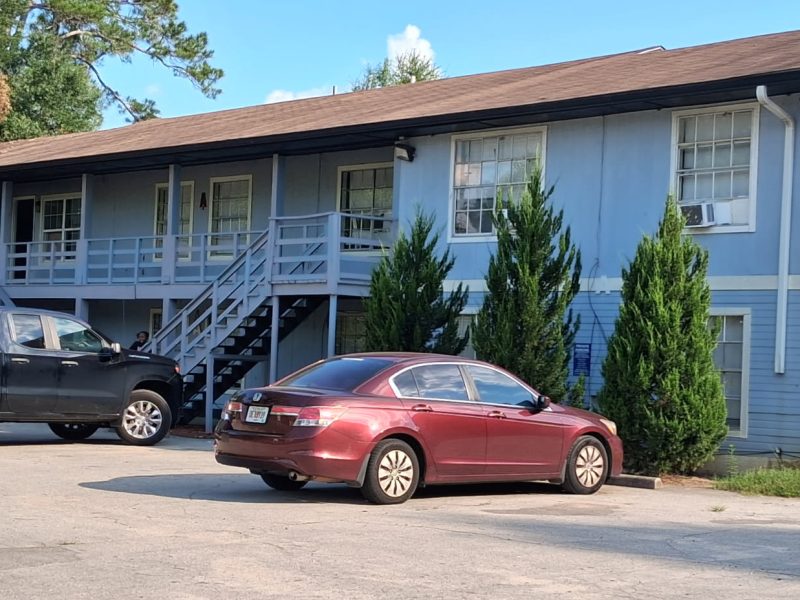
Tenants in Albany apartments face eviction
Residents at Cornerstone apartments, located at 608 Moultrie Road, said that eviction notices were placed on the doors of all of the units this week, giving them three days to pay two months’ rent or face being removed in three days. Tenants said they were confused to whom rent should be paid and are frustrated by the living conditions at the complex that is more than 50 years old.

