
Agencies respond to pilot whale stranding at St. Catherines Island
Short-finned pilot whales are a deep-water species usually found off the continental shelf and slope
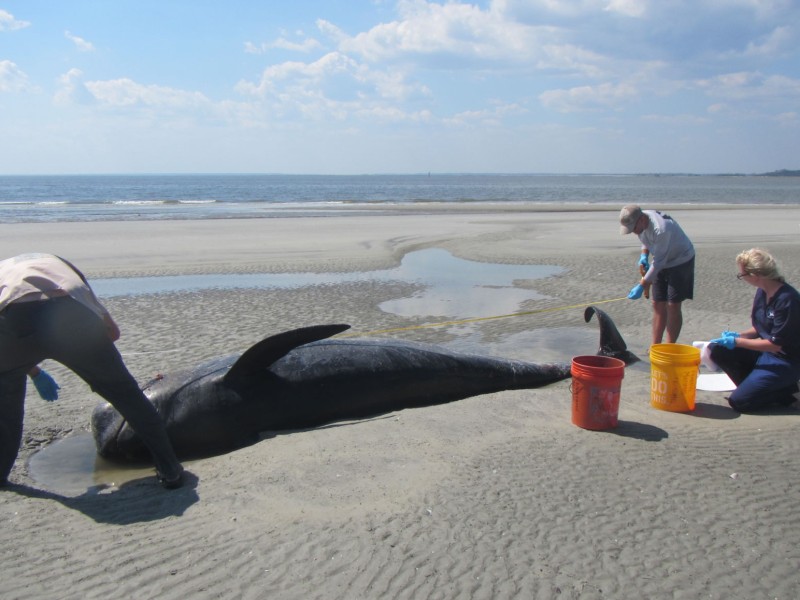
Special Photo: Georgia DNR
From staff reports
BRUNSWICK — Approximately 26 short-finned pilot whales were stranded on or near St. Catherines Island Wednesday, leaving 15 dead in Georgia’s second mass stranding of these large marine mammals this year.
St. Catherines officials, the Georgia Department of Natural Resources and the National Oceanic Atmospheric Administration responded. Staff from the Georgia Sea Turtle Center and the Florida Fish and Wildlife Conservation Commission also helped.
Why the whales beached themselves is not known. Necropsies, or animal autopsies, are being done to assess what the animals’ health condition had been and to search for possible clues to the stranding.
Short-finned pilot whales are a deep-water species usually found off the continental shelf and slope, as far as 100 miles offshore. These social animals, which travel in pods sometimes numbering in the hundreds, are also the most common species to mass-strand in the southeastern U.S.
On July 16, at least 47 pilot whales were involved in a mass stranding on St. Simons Island — leading to the death of three whales. No cause for that mass stranding has been determined, and it is not known if any survivors were part of the St. Catherines mass stranding.
St. Catherines is privately owned and not open to the public. The St. Catherines Island and Edward J. Noble foundations support conservation of island resources, plus extensive research and education.
St. Catherines staff found 11-13 whales stranded on the remote island Wednesday morning, Mike Halderson, operations director for the island, said. Five were alive.
Using tarps, tow ropes and vehicles, staff carefully returned four of the whales to the water. The fifth died before it could be moved.
“It was an all-hands-on-deck situation,” Halderson said.
Short-finned pilot whales live in social groups of tens to hundreds of whales. They are found worldwide in tropical and warm temperate waters and inhabit deep water along the continental shelf and slope. They feed primarily on squid but may also feed on octopus and fish, typically at depths of 1,000 feet or more, and may live 50-70 years.
They are protected under the Marine Mammal Protection Act. For more on the species, visit fisheries.noaa.gov/species/short-finned-pilot-whale.
Since 1991, there have been 26 pilot whale mass strandings in the southeastern U.S. The St. Catherines mass stranding is the third in the Southeast this year. Incidents in the Southeast have ranged from two to 51 whales, with most occurring in Florida.
There also have been two mass strandings in North Carolina, one in South Carolina and one in Puerto Rico. Of those in Florida, 25 percent were on the state’s northeast coast with the remainder in the Florida Keys or on the Gulf Coast — primarily from southwest Florida through the Keys.
Related Articles

Residents’ safety concerns defeat request to privatize Plantation Road
The Terrell County Board of Commissioners rejected a request July 7 to remove Plantation Road from the county road system after nearby residents warned that closing the roadway could leave them without emergency access when adjoining roads flood.

Classifieds – July 21, 2026
Albany Classifieds and Legal Notices:

Albany Herald – July 21, 2026
From cotton to cloud… Dougherty Jail graduates first class of… Worldwide United
Way leader speaks…
