
Albany City Commission says yes to Rails to Trails purchase
Carlton Fletcher
ALBANY — The Albany City Commission gave nonbinding approval Tuesday to the purchase of 13.6 miles of land owned by South Georgia Rails to Trails in a measure that could have far-reaching financial and recreational impacts on the region.
If approved at the commission’s night meeting next Tuesday, the $150,000 purchase would give the city’s Utility Board access to a swath of land from downtown Albany to the city of Sasser in Terrell County that would offer prime opportunities to expand utilities services in Dougherty, Lee and Terrell counties.
The purchase would also provide a key piece to a proposed continuous greenspace trail along the Flint River that would stretch from the Radium Springs area in south Albany, north to Chehaw Park and west from downtown to Sasser.
The agreement’s one caveat that led to extended discussion Tuesday was that the city must, in keeping with the terms of the agreement, construct a multi-use trail along the 13-plus miles of the property. Assistant City Manager Phil Roberson told commissioners that maintenance of the trail would be handled by Rails to Trails and that potential utilities agreements should cover cost of the trail construction, which he estimated would run between $1 million and $1.5 million.
Dougherty County Attorney Spencer Lee, who is one of the principals involved in the greenspace project, said the city’s OK of the proposal would provide a cohesiveness to ongoing efforts to create a marketable series of trails in the community.
“The county has allocated $81,000 in funding for a master plan that would bring all of these elements together: the city, county, Chehaw, Rails to Trails, Sasser, Lee County, Albany State (University),” Lee said. “Details of the proposal would come with the completion of the master plan.”
Roberson said Oxford Construction Co. of Albany has agreed to “do some of the really heavy lifting” by contracting to clear a roughly 60-foot swath along the 13.6 miles of the Rails to Trails property in exchange for the right to harvest the ballast along the railroad bed that’s on the pathway.
“That takes care of a lot of the heavy lifting,” the assistant city attorney said. “The big issue was going to be removal of the trees along the trail. They haven’t been thinned in (15) years, so there are 6- and 7-foot diameter trees that have to be removed. The estimated cost for that work is a little less than $200,000.
“Oxford will do that work at no cost to the city. In exchange, they’ll harvest the ballast that’s very valuable to them.”
The commission also tentatively approved changes to the city’s sign ordinance that would, among other things, increase the number of multimessage signs allowed in the city from 75 to 100 and allow changes on those electronic signs every 20 seconds rather than the 30-second intervals recommended by a Sign Ordinance Task Force and the Albany-Dougherty Planning Commission.
Ward IV Commissioner Roger Marietta pushed for the smaller intervals between messages to thwart “competitive advantages” of businesses in the unincorporated portion of the county and in neighboring Lee and Mitchell counties.
“I’m concerned with the competitiveness of our businesses,” Marietta said. “Small businesses in the city are heavily invested in these signs. I would like for us to embrace a compromise of 20 seconds on this issue.”
Ward V Commissioner Bob Langstaff and Ward I’s Jon Howard said the 30-second interval recommended by the task force was “reasonable,” and Ward VI Commissioner Tommie Postell challenged Marietta when Marietta said the sign changes at 20-second intervals did not distract drivers.
“You say this is not a safety issue … based on what?” Postell asked. When Marietta started his response, “In the county and in other …” Postell cut him off saying, “This is not Lee County, this is not Dougherty County, this is not Camilla. This is Albany, Georgia.”
Postell eventually, though, offered a motion to cut the intervals to 20 seconds, and the motion carried 4-3. Howard, Langstaff and Mayor Dorothy Hubbard voted against the change.
The commission also heard from Patricia Ward, who said she headed a Crime Watch organization at Lincoln, Gordon and Mercer avenues. Ward said that while police had curtailed rampant prostitution in the neighborhood, other criminal activity was occurring “literally yards from my house.”
“I’ve been reporting, reporting, reporting, but it continues,” Ward said. “I just want it to stop.”
William Wright also came before the commission to ask that it help honor the “foot soldiers” of the civil rights movement as part of the 50th anniversary recognition of the Civil Rights Act of 1964 and the Voting Rights Act of 1965. Wright said he was chairman of a group that wanted to give a commemorative medal to 50 or more “foot soldiers” from this area. Wright said the medals would cost approximately $1,000 per person.
“You’re coming before this board asking for money, so we need more information than what you’ve given us,” Postell said. “Where does Albany fit in in subsidizing funding for something we know nothing about? You say you’re the chairman of this group seeking our participation. Is this group a branch of the NAACP?”
Wright had previously served as president of the local NAACP branch.
“Well …” Wright said and hesitated.
“OK, that’s enough for me,” Postell said. The Ward VI commissioner then asked that the matter be tabled until Wright brings additional information to the board.
Related Articles
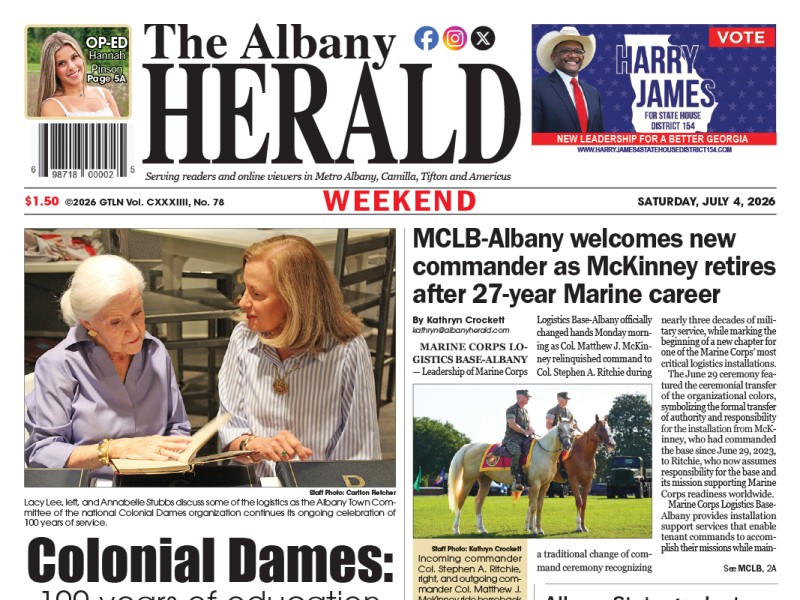
Albany Herald – July 4, 2026
MCLB-Albany welcomes new commander as… Colonial Dames: 100 years of… Albany State graduate Justin Clements earns…

HAPPY 250TH ANNIVERSARY AMERICA
America Celebrates 250 Years???

Classifieds – July 4, 2026
Albany Classifieds: Real Estate for Sale: 1835 Arlington Park Circle… Jobs: Irrigation Tech needed…
