
Albany Commission approves $358.2 million budget for Fiscal Year 2026-2027
The Albany City Commission approved a $358.2 million spending plan during its final meeting of the budget year that ends on June 30.

ALBANY – The Albany City Commission has settled its Fiscal Year 2027 budget, approving a spending package that will not require a tax increase, but the current 2025-2026 budget also has cast a shadow over the city’s finances.
The commission approved the $358.2 million spending plan during its final meeting of the budget year that ends on June 30. That amount represents an increase over the $342.8 million budget for 2025-2026.
During the same meeting, commissioners approved an amendment to the 2025-2026 budget totaling $7.76 million. The spending includes $300,000 in additional funds for demolition of dilapidated buildings in the city, which exceeded the budgeted amount of $400,000; $3.11 million for police school zone cameras, and $2 million for police salaries and fire department expenditures of $1.34 million for school zone cameras and additional fire department salaries totaling $1 million.
The funds for the school zone cameras will be paid from fines collected, not through taxes, officials said.
“I think we’re all kind of taken aback by the amount,” Mayor Bo Dorough said.
The news wasn’t all negative. The increase in money budgeted for salaries means that the police and fire departments have moved closer to being fully staffed. After years of running at about 70% of full staffing, the police department is now closer to 90%.
As for the 2026-2027 budget, some commissioners complained about the process, including not having sufficient time to review and make changes to the final document.
“There’s a lot of cutting in here, a lot of cutting of infrastructure,” Commissioner Diana Brown said. “We need more time to go through this budget. You can’t give us 282 pages when we already had another 282–page budget.
The budget is “top heavy” for higher-paid employees, Commissioner Jon Howard said.
“From tonight, I will be like the hawk watching the rabbit, watching what we do for those at the very bottom,” he said.
City Manager Terrell Jacobs warned the commission throughout the process that the city has some long-term obligations that will cost money in coming years. Chief among those are the city’s underground water mains. About 25 miles of those underground pipes, some of which are 75 to 100 years old, will need to be replaced over the next five years.
The city has been burned in the past by putting off needed repairs. The city spent more than $100 million to separate the stormwater and sewage drainage systems after the state Environmental Protection Division gave an ultimatum on that work.
“I’ve been doing this for 34 years,” the city manager said of the budget for the fiscal year that begins on July 1. “This was a collaborative effort, getting input from you all … from staff and the public. It was a challenging budget to put together.”
On the topic of the budget amendment leading to the $7.7 million increase, Jacobs said that having the police and fire departments better staffed is a mixed blessing.
“In essence, there has been a kind of trend (where) the approach we’ve taken is budgeting for 70 or 80% (of full staffing),” he said. “Now we’re seeing numbers of closer to 90% to 100%, which is a good thing but a bad thing because you’ve got to pay for it.”
Author

Related Articles
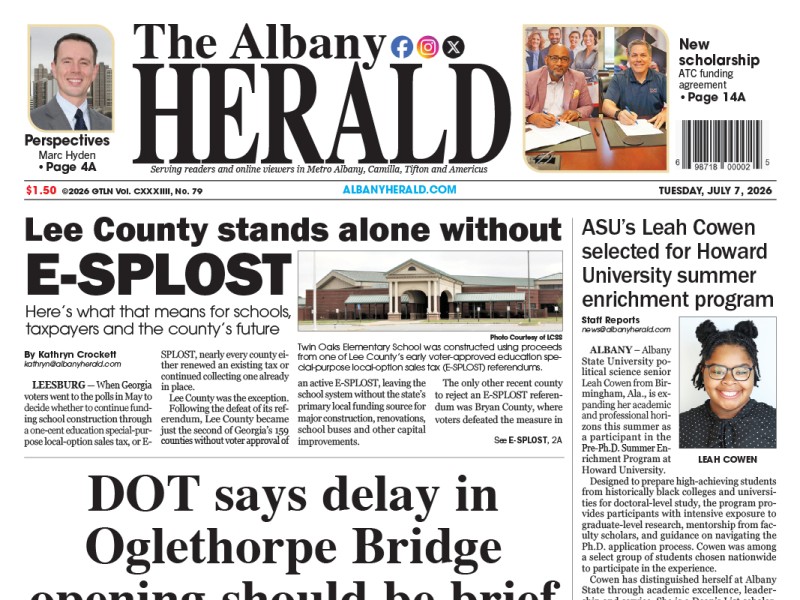
Albany Herald – July 7, 2026
Lee County stands alones without… DOT say delay in Oglethorpe Bridge… ASU’s Leah Cowen Selected for…

Classifieds – July 7, 2026
Albany Herald Classifieds: July 7, 2026

Lee County JROTC cadets honored by DAR for citizenship and leadership
Several Terrell County High School JROTC cadets were recognized for outstanding citizenship, leadership and service during the school’s recent JROTC Honors Night, receiving awards from the Old Herod Chapter of the National Society Daughters of the American Revolution.
