
Albany, Dougherty County mediation session on splitting sales tax proceeds a bust
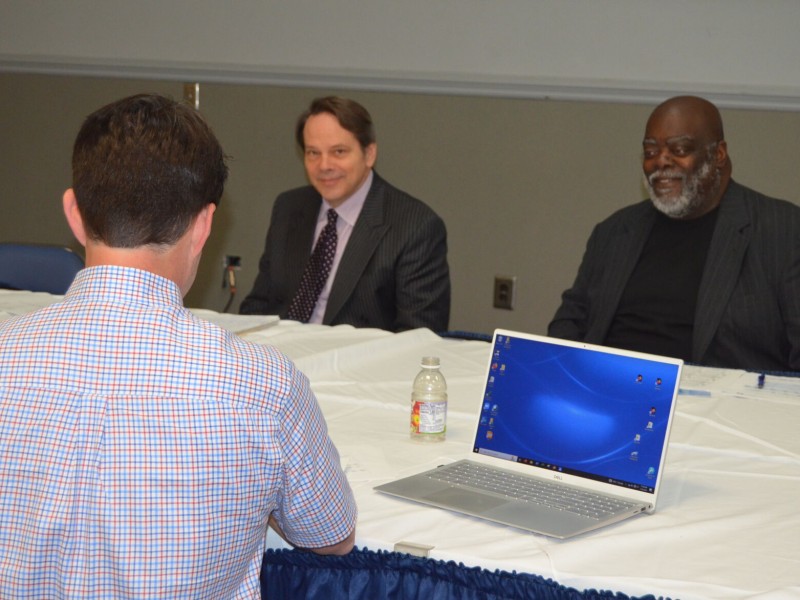
Staff Photo: Alan Mauldin
By Alan Mauldin
[email protected]
ALBANY — Whether it was in “impasse for today,” as described by one official or an “abrupt walkout,” in the words of another, a four-hour mediation session between the city of Albany and Dougherty County on the division of a penny sales tax ended without resolution on Thursday.
The two sides made a presentation stating their reasons for either keeping the same split of local-option sales tax dollars the same, as is the county’s position, or for a larger share going to the sole municipality located within its borders.
The clock is ticking, and the penalty for not reaching an agreement by Dec. 30 is the elimination of the 1% tax that can be used to fund government operations. If that occurs, the shortfall of the approximately $17 million per year would fall to city/county taxpayers who own property.
The formula has been 60% for Albany and 40% for Dougherty County since its inception. The role of the mediator, agreed to by both sides prior to the Thursday session at the Albany Civic Center, is to help them reach an agreement.
Albany Mayor Bo Dorough said that due to its larger population and larger work force, as well as the need to find additional funds to complete a federally mandated sewage/stormwater separation project, the city is due a larger share.
For other Georgia cities, the process is driven to a larger degree by population, the mayor said.
“Eighty-two percent of the population lives in the city,” he told The Albany Herald during a break in the mediation session. “The city provides the lion’s share of services.
“In 2018 the city got notice about getting completed 85% of (sewage system) separation. Originally the estimate was $105 million. That $105 million has now been recalculated, and now it’s $135 million (due to price increases).”
During an interview later Thursday afternoon, upon the completion of the session, Dorough said the county had walked out before an agreement was reached.
“I was surprised; they just got up and walked out,” he said. “That’s unfortunate. Those other counties we identified, the share that goes to the municipality roughly compares to the population of the city.
“The law directs cities and counties to sit down every 10 years and reassess the formula. Apparently the county is not interested in the stated financial requests.”
The city has aggressively sought grant funding for the combined sewer overflow project, as well as earmarked $20 million from a separate special-purpose local-option sales tax. The Albany City Commission also voted to use $10 million in federal COVID-relief funds for the project, and the county agreed to provide an additional $3.5 million of the SPLOST collections toward it.
“We still have a shortfall of about $60 million,” Dorough said.
The mayor’s counterpart with the county, Commission Chairman Chris Cohilas, likened the city’s position to “taxpayer piracy” of funds needed to provide constitutionally-required services, including the jail and courts, as well as Emergency Medical Services.
“This whole exercise is an embarrassment to the entire community,” he said during a telephone interview following the session. “It’s incredible the amount of time, money and effort that has been expended over how to divvy up some tax dollars. … It’s just quite literally offensive to me.”
As a commissioner whose time in office is coming to an end in January, Cohilas said he views the issue from a taxpayer’s perspective at this point rather than as a politician.
“This should have been handled a year ago,” he said of reaching an agreement. “You’ve got some city commissioners who want to jab their fingers into the pocket to bankrupt one of the governments.
“We don’t need the theater. We don’t need the mediator. None of this helps a single citizen.”
Asked what’s next, he replied: “We’ve reached an impasse for the day. The county is going to continue to be open to reasonable negotiations. That’s not what we saw (today). It was not productive. We’re going to try to see how to provide some calm to this process and taxpayer piracy.”
During the lunch break, County Commissioner Clinton Johnson said he did see some reason for optimism. Discussions with City Commissioners Jon Howard and Chad Warbington gave reason to believe the two sides could come to an agreement that does not put an extreme burden on the county, which formulated its 2022-2023 budget that extends through July 30 based on the traditional split.
Unlike the city’s money-making Utilities Department, “We only have property taxes, and our only job here today is to protect the citizens of Dougherty County,” Johnson said.
Another County Commissioner, Anthony Jones, also expressed optimism, because the alternative is losing the $17 million per year, no matter the division that is decided on between the two governments.
“We just want the thing the same as it’s always been,” he said. “We’re serving the same people. It’s been that way; it’s been working that way. We want the citizens to know it’s not the county that’s looking for the change.”
Author

Related Articles
From Ledo to Coston, Lee County’s summer road projects are underway
Updates provided during recent meetings of the Lee County Board of Commissioners show projects are underway or scheduled to begin on several county roads, while additional transportation improvements funded through the Local Maintenance and Improvement Grant (LMIG) program and Transportation Special Purpose Local Option Sales Tax (T-SPLOST) are expected to begin shortly after the July Fourth holiday.
PSC candidate Peter Hubbard makes case for election to full term
The reason why voters should pick me is I’m a rare breed in that I read everything that comes across my desk. I’m asking hard questions at the meetings. I want to get to the bottom of are data centers paying their fair share, are residential customers getting their fair share.
Dougherty Schools prepare for bell-to-bell student cell phone ban
As Georgia prepares to expand its statewide ban on personal electronic devices in public schools, Dougherty County School System leaders say they are working to balance compliance with the new law while giving individual schools flexibility in how they implement the policy.
