
Albany Museum of Art opens fall 2023 exhibitions
Staff Photo: Lucille Lannigan
By Lucille Lannigan
[email protected]
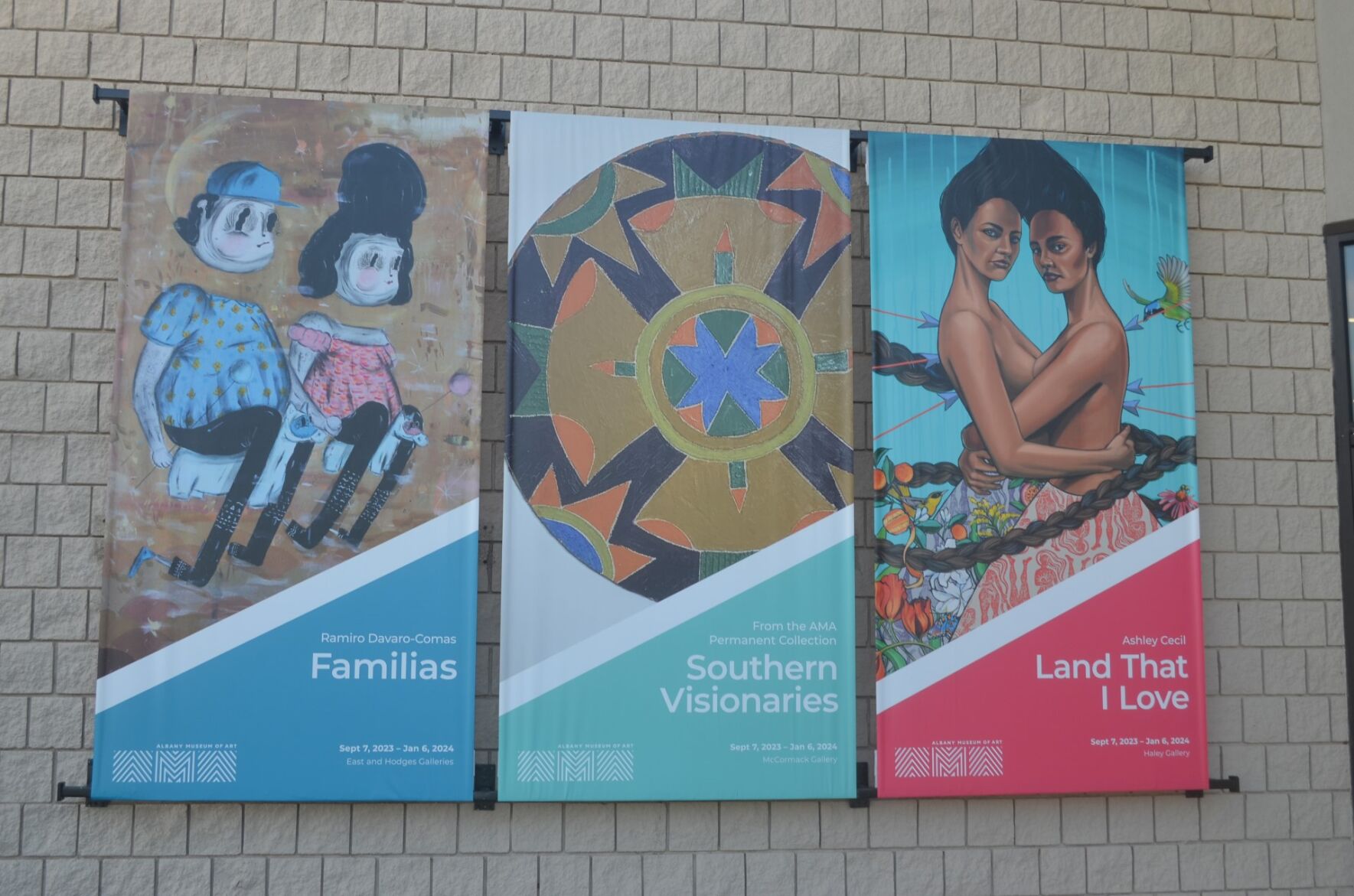
ALBANY — A mixture of water color, acrylic, spray paint and sculpture from three new exhibitions will greet visitors to the Albany Museum of Art this fall and winter.
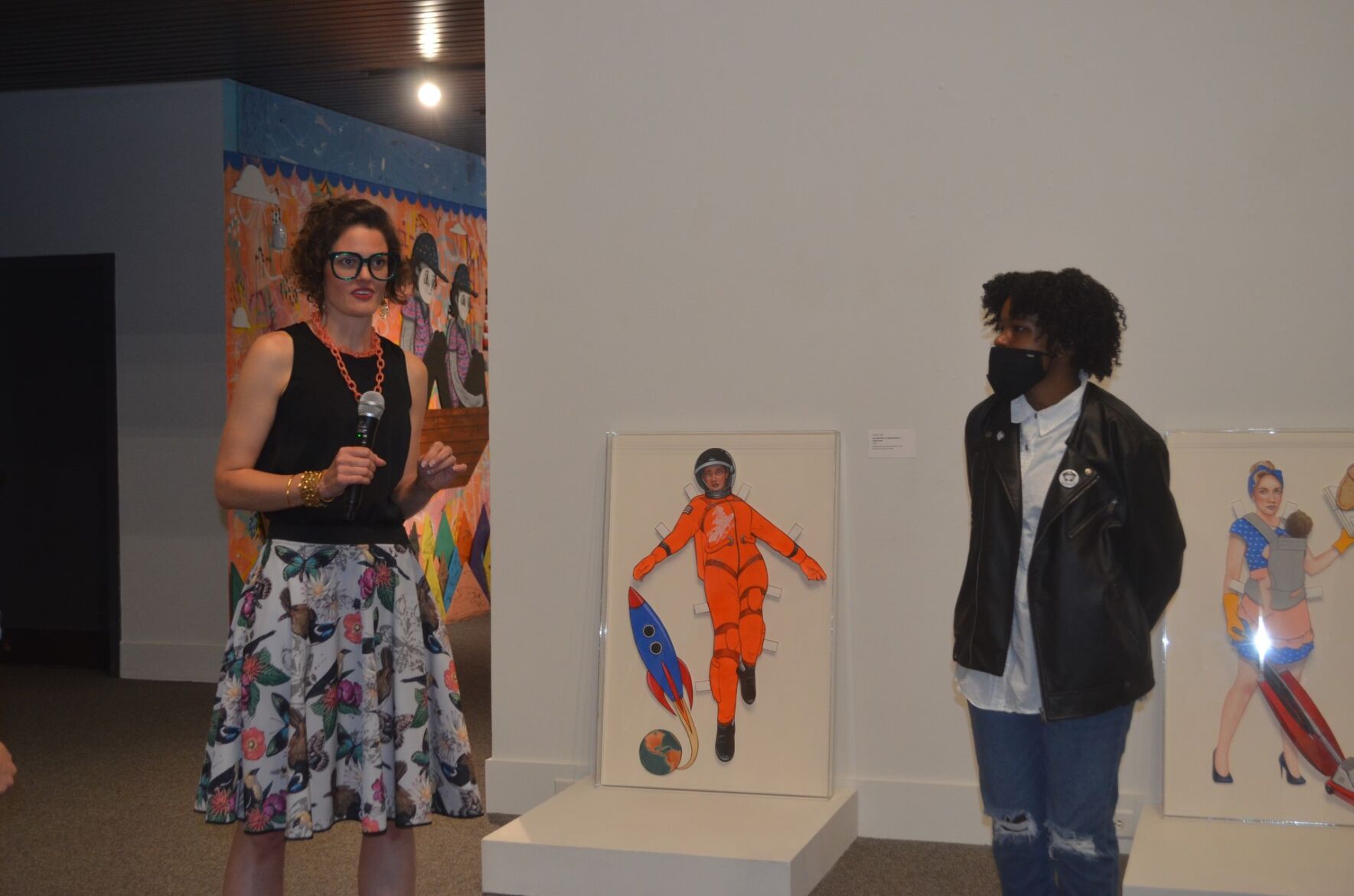
The museum celebrated a trio of art exhibitions Thursday at its opening reception. Artists Ashley Cecil and Ramiro Davaro-Comas presented their artwork to about 50 guests during the evening event
AMA’s mission is to bring the art of the South to the world and the art of the world to the South, and each new exhibit plays a part in this mission.
Visitors can travel upstairs to the McCormick Gallery to see “Southern Visionaries” from the AMA permanent collection. Sculptures made out of wood, paint, glitter glue and glass as well as large canvases depicting plantation and sharecropping scenes using acrylics are on display.
The three featured artists — O.L. Samuels, Woodrow Wilson Long and Eddie Owens Martin — were all born and raised in the Southeast. They all left home but later returned and began creating art that was both reflective of their histories and used as a tool for healing.
All artists are storytellers, Katie Dillard, the AMA director of curatorial affairs, said. Samuels and Marton are both from Georgia, making their stories impactful for many Georgians.
“We believe in sharing those stories because there’s a perception of the South that other areas of the U.S. have,” she said. “So we’re trying to elevate some of the stories with a sense of clarity and just giving artists here a chance.”
Art from the other two new exhibits, while not local to the South, presented ideas and stories that many could relate to.
Attendees marveled at Cecil’s emotional works displaying the relationship between feminism and environmentalism as well as Davaro-Comas’ unique depictions of familial love and ties even through immense change.
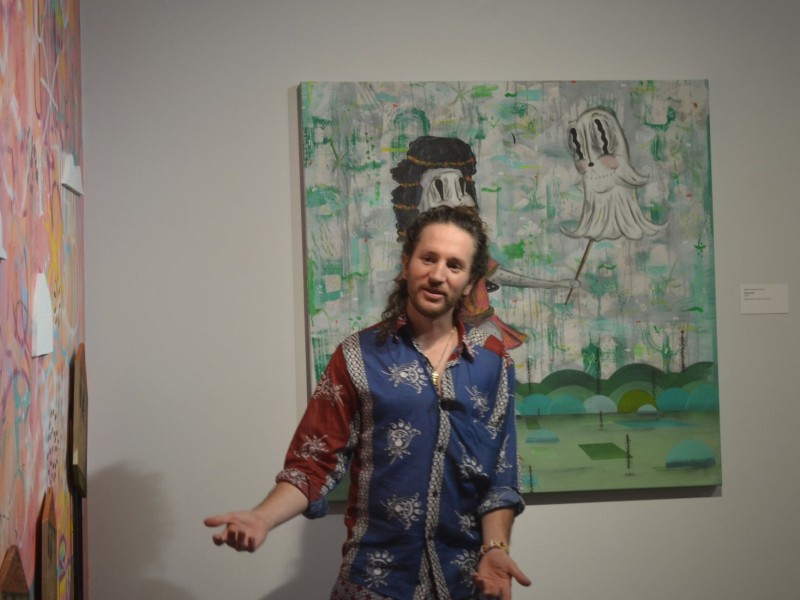
Davaro-Comas’ collection, “Familias,” depicts immigrant families traversing through surreal, new lands while maintaining a strong closeness. He immigrated from Argentina and now lives in New York.
The figures are gray, like stereotypical aliens, which Davaro-Comas pointed out is an often-used name for immigrants. They wear masks, representing the effort to fit in. In one painting, a mother carries her baby on her back while pushing her other child forward through a mountainous landscape. In another, a father barbecues with his family.
“My story is very relatable to many people, whether they’re immigrants or not,” he said.
This is the American story, Davaro-Comas said. Many people often forget where they come from or what their background is.
“It’s illustrative, colorful, and inviting, and it doesn’t hit you over the head with the word ‘immigrant,’” he said. “I think that that kind of imagery is accessible to people and allows people to enter the conversation in an easier way.”
Cecil’s works bring up the nuances of the oppression of women and destruction of the environment. “Land That I love” consists of colorful acrylic and watercolor depictions of mothers, women, nature and how they are interconnected.
In her acrylic and oil piece “Broken Waters,” a mother carries her infant on her shoulders through a body of water. Storm clouds fill the sky as the woman’s mouth is barely able to grab air at the surface. Collaborative sculpture pieces showcase pinatas shaped as fruits and flowers symbolic of the female body. Below them, is a pile of broken Barbies, empty birth control packets and remnants of in vitro fertilization.
The series was inspired by the birth of her first child and a series of artist residencies that were rooted in learning about climate change, Cecil said Thursday at the opening reception.
“There are so many parallels between the ways we mistreat women and the ways we mistreat the environment,” she said.
Nature and a woman’s ability to create life are powerful forces that should be cherished, Cecil said. But instead, they are often abused.
“Both are religiously sanctioned as property, legislated against, denigrated into submission, their beauty monetized, and their fertility systematically policed,” she said.
In partnership with the Flint Riverkeeper, Cecil taught an art workshop Friday morning to further illustrate this tie between humans and their environment.
Southwest Georgia is made up of streams and waterways connected to the Flint River. Its agricultural roots and love for recreation on the river make the health of these streams a necessity, which the mixed-media workshop at the AMA showcased.
Seventeen participants attended the workshop and learned how to use water on water painting techniques as well as collage. They heard from R.J. Gipaya, the Flint Riverkeeper’s watershed specialist, and Jessica Rutledge, the group’s operations coordinator. The two showed a demonstration of how runoff pollution from different sources can end up in a river.
Amy Stevens and her daughters, Audrey and Anna Claire, traveled from Vienna to attend the workshop. The 11-year-old and 8-year-old are homeschooled and learning about watersheds.
Stevens said they feel a connection to the Flint and the Floridan aquifer that flows into it and wanted to educate themselves further through the creative experience.
Braxton Newkirk, a 21-year-old Albany State University student, attended the workshop with several other students.
“I’m just here to learn,” he said.
The group spent two hours mixing watercolors into different shapes and images. Some went for abstract swirls and others created butterflies or the sky.
Cecil said she hopes the workshop allowed participants to see their connection to the river that flows through their city.
“The whole exhibition is about the parallels in the way we treat human bodies and the way we treat the environment,” she said. “I’m excited to share these fun techniques that I use in my own work that allow me to capture the motion of water — pigments that dry to look like both waterways and the human vascular system”
Author
Related Articles

Crime in Albany is flat. Residents’ fear of it isn’t
Albany police recorded 1,200 crimes against persons from January through July. In the same seven months of 2025, they recorded 1,202 — a difference of two incidents.
Albany recycling center enacts material separation rule
Mixed items will no longer be accepted at the Albany recycling center at its 2521 Meredyth Drive facility. Individuals will now be required to separate items befor they will be accepted.

Wild Game Dinner marks 34 years as South Georgia Scouting reaches for next generation
More than a century after organized Scouting first took root in Southwest Georgia, local leaders say the program is working to preserve its traditional mission while adapting to a new generation of young people.
