
Albany officials dispute Harper’s Magazine account of city’s lack of economic progress
Terry Lewis
ALBANY — It’s not often citizens of a community get to see their city painted by a national magazine as the poster child for poverty and cited for its struggles to recover from the Great Recession.
Albanians will see it next week when Harper’s Magazine publishes New York-based Kai Wright’s “What Recovery? Two years in a town where the Great Recession never ended.”
On Tuesday, Harper’s publicists issued a cover sheet with an advance copy of Wright’s story. It read:
“The poverty rate in Albany, Georgia, is 39.9 percent. Among the town’s African-American residents — who account for two-thirds of its 76,000 inhabitants — that rate is almost 42 percent. Kai Wright spent two years visiting Albany, and the portrait he’s drawn — of white flight, shuttered businesses, underfunded schools and overstretched food banks — is more than poignant; it’s painful. Though Wright finds a population unbowed in the face of economic devastation, even the most optimistic residents know better than to expect a dramatic improvement any time soon.
“As Major Jones, a longtime resident who lost his job when a local business closed, says, “Sometimes, it’s gotta get worse before it gets better.”
The story focuses on the closing of Bobs Candies and Cooper Tire, coupled with the nation’s Great Recession of 2007, as the driving forces which, Wright wrote, dealt the city an “economic deathblow.”
Wright writes, “Between 2007 and 2010, Albany’s poverty rate jumped 12 points, to a record high of 39.9 percent. More than two-thirds of Albany’s 76,000 residents are black, and since 2010, their poverty rate has climbed even higher, to nearly 42 percent.”
Wright notes that Albany is an extreme example of what is happening across the nation, yet the negative portrayal was more than enough to catch the attention of city and county officials who called the story “narrow in its focus.”
“My initial response is that it is very difficult for a person from outside to capture the heart of and soul of a community, especially by making assumptions based on the closing of two different manufacturing plants” Dougherty County Commission Chairman Chris Cohilas said. “It’s also interesting that he focused on those two companies instead of the other viable industries in our community. It’s a meandering story designed to sell magazines, and since he’s not from here he won’t be held accountable for what he has written.”
Albany Economic Development Commission President Justin Strickland acknowledged the piece contains some truths about the city, but he said it fails to recognize the progress made over the past several years.
“This article shows we still have challenges facing us as a community,” Strickland said. “But we have a lot of positives to accentuate over the past three years. Our school system is turning the corner, businesses have expanded and existing manufacturers are extending their global reach.”
Strickland pointed to an article in “Global Atlanta,” which highlighted the recent international export capabilities of MillerCoors Brewery, M&M Mars, Procter & Gamble, Thrush Aircraft, SASCO Chemicals and Equinox Chemicals.
In the midst of the Great Recession, unemployment in the Albany Metro Area reached 12.9 percent. By June of this year, that percentage had dropped to 7.3 percent, in line with state and national numbers.
“Albany has talent, but we can’t pretend that the city doesn’t have multifaceted positives and negatives,” Albany Area Chamber of Commerce interim President Barbara Rivera Holmes said. “There has been a lot of change since Cooper and Bobs closed, and I think the article is narrow in its focus. We understand the challenges we face to achieve economic growth, but the story I just read does not represent the Albany that I love.”
Strickland agreed.
“The tone in Albany has really changed over the past three years. Some of it was spurred by the ‘One Albany’ campaign which we were a part of,” Strickland said. “Plus we have two colleges, a tech school and a rising public school system that are collaborating to benefit the region. What other community our size would not love to have those assets?”
Cohilas said many people don’t know it, but the city and county are making progress.
“We are the economic hub of Southwest Georgia; that counts for something,” he said. “We must address the core issue of poverty. We still have too many students who are not graduating from high school, and the ones who graduate from college leave town. But our community has demonstrated over the past two years that we are capable of moving things forward.”
Related Articles
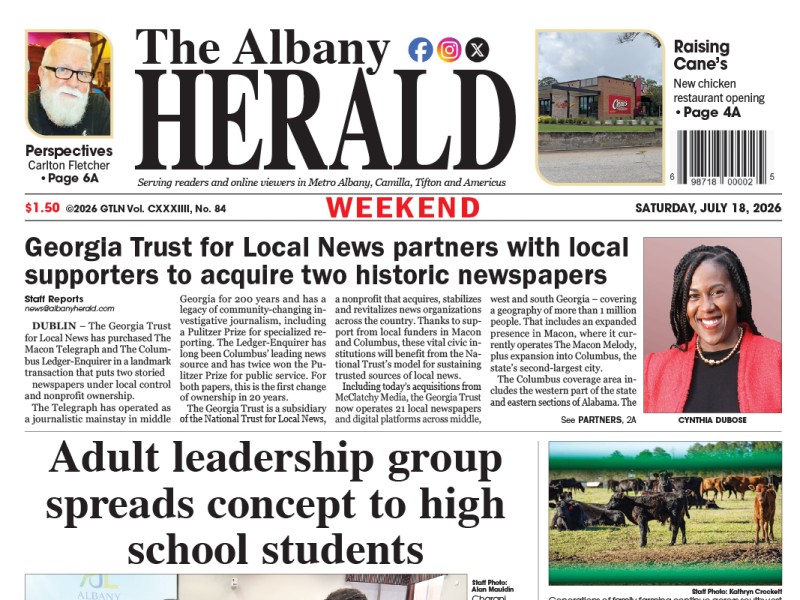
Albany Herald – July 18, 2026
Georgia Trust for Local News partners with… Adult leadership group spreads concept to… Lee County homeowners have until Aug. 1 to claim…

Classifieds – July 18, 2026
Classifieds; Legals;

Albany police make arrests in murder, robbery cases
Officials with the Albany Police Department have announced a number of arrests in cases that involved a homicide and a pair of thefts.
