
Albany officials ponder future needs, mull tax hike
“Utilities have to sustain themselves. They can’t be fleeced. They can’t be (starved) to the point they can’t provide the services.”
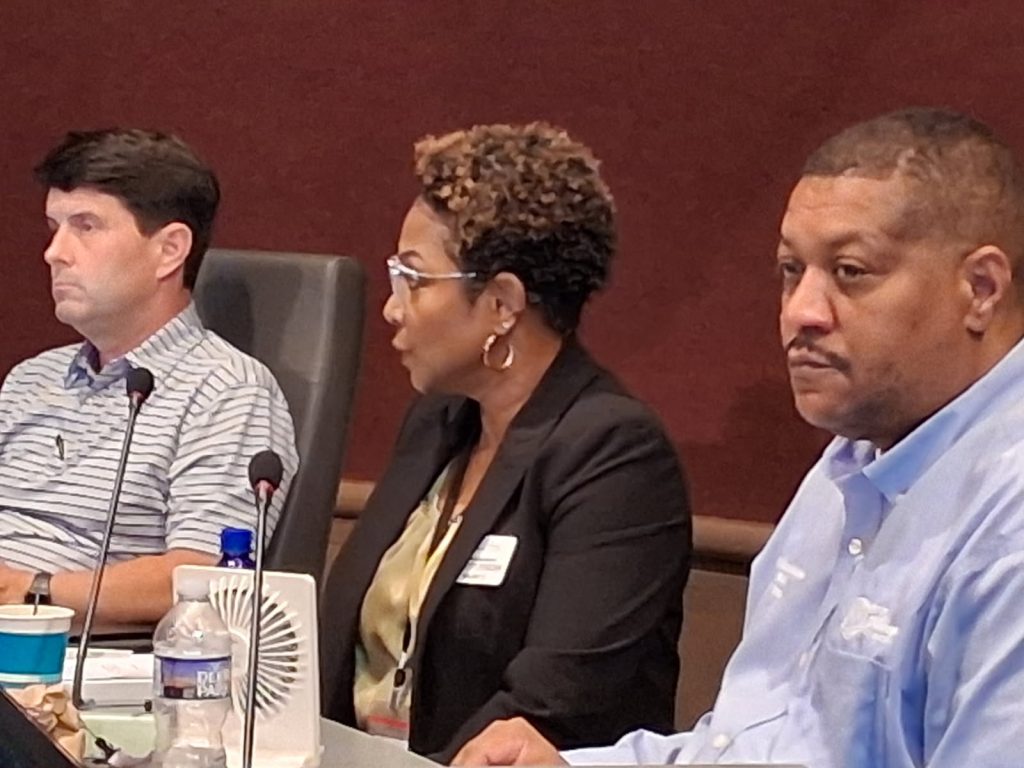
ALBANY – The days of kicking the can down the road should be a thing of the past, according to Albany City Manager Terrell Jacobs, and as an example he used the city’s aging water system.
The city manager made his remarks during a Tuesday Albany City Commission work session in relation to the city’s budget, which could require a tax increase for the budget year starting on July 1, although there are other options that could avoid a tax hike but could also prove unpopular.
Last year, the city completed a mandated upgrade of its stormwater and sewage drainage systems, a mandate that required achieving 80% separation of the two in order to reduce sewage discharges into the Flint River. That effort came at great expense and was boosted by federal grant funding. It also required an extension of a state Environmental Protection Division deadline.
“I think from my analysis of what has transpired over many administrations is the can has been kicked down the road,” Jacobs said. “Downtown, the water main is probably over a hundred years old, or a couple of our lines, that have never been touched.”
In previous years the city was able to utilize trust funds and profits from the city’s utility operations in order to cover expenses. The city also made use of federal grants from the Infrastructure Investment and Jobs Act and American Rescue Plan Act, both passed during the administration of President Joe Biden.
The city also was able to cover expenses because a large number of staffing positions went unfilled, particularly in public safety, whose ranks are now filling, removing that cushion that the city enjoyed in the past.
“Those trust funds are gone,” Jacobs told commissioners. “In essence, we’ve got to pay the full cost of running the government. I know it’s hard. The days of for whatever reason people thinking there’s free money out there from the federal government (are gone). I know it’s tough to hear. That’s why people put you in these positions – to make tough decisions.”
To modernize aging utility infrastructure, the amount of money the city depends on for general operations will need to be reduced, the city manager said.
“Utilities have to sustain themselves,” he said. “They can’t be fleeced. They can’t be (starved) to the point they can’t provide the services.
“There’s nothing wrong with transfers. But you can’t fleece it to the point where it can’t sustain itself.”
One option to balance the budget for the 2026-2027 budget year is to increase the property tax millage rate by 1%. Other options are to forego a cost of living adjustment for employees or to reduce services, city CFO Michael Eaton told commissioners.
Staff will provide options to the commission ahead of making final decisions, Jacobs said.
Commissioner Willie Weaver suggested that staff should engage in long-term planning to ensure that the can doesn’t get kicked around any longer.
Currently, the staff prepares for contingencies looking five years into the future, something that could be extended to look at a decade in advance, Eaton said in response.
Author

Related Articles

New commander takes helm as Marine Corps logistics adapts to evolving battlefield
Brig. Gen. Kevin G. Collins assumed command of Marine Corps Logistics Command during a change of command ceremony at Marine Corps Logistics Base Albany, succeeding Maj. Gen. Keith D. Reventlow after four years leading the organization responsible for sustaining Marine forces around the globe.
Classifieds – July 2, 2026
Cemetery lots for sale: 5 burial plots in Riverside Cemetary… Health: Private Caregiver…Full-Time Job: Irrigation Tech needed…
Albany Herald – July 2, 2026
Dougherty schools prepare for bell-to-bell… From Ledo to Coston, Lee County’s summer road… Lee County moves another step closer to issuing…
