
Albany session offers rare look at how appeals courts shape Georgia law
The First Panel of the Georgia Court of Appeals convened at 10:30 a.m. in Billy C. Black Auditorium on ASU’s East Campus, hearing oral arguments in three cases involving family law, premises liability and criminal sentencing before students, attorneys and members of the public.
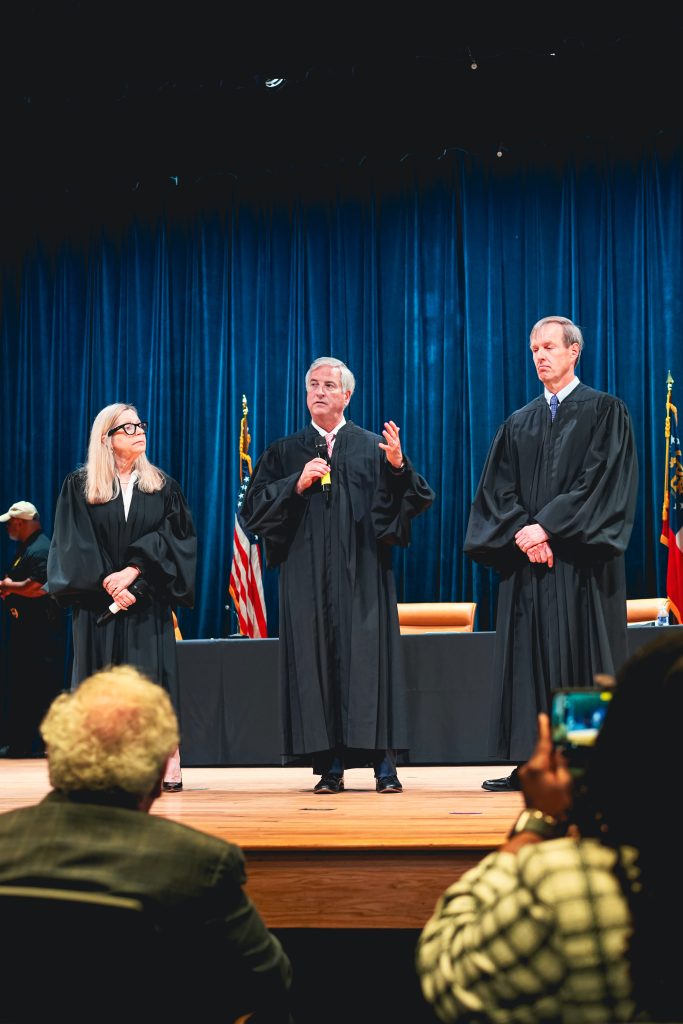
ALBANY — In a packed auditorium at Albany State University on Thursday morning, judges on Georgia’s intermediate appellate court wrestled with questions that reached beyond legal procedure and into the center of family autonomy, criminal punishment and personal responsibility.
The First Panel of the Georgia Court of Appeals convened at 10:30 a.m. in the Billy C. Black Auditorium on ASU’s East Campus, hearing oral arguments in three cases involving family law, premises liability and criminal sentencing before students, attorneys and members of the public.
The panel — Judge Ann Elizabeth Barnes, Judge Todd Markle and Judge Kenneth B. Hodges III — directed pointed questions toward attorneys that revealed the legal tensions beneath each case.
Before arguments began, ASU Associate Dean Jason Armstrong explained that appellate courts differ sharply from courtroom dramas commonly portrayed on television.
“There will be no surprise witnesses, no surprise evidence, no last-minute confessions,” Armstrong told the audience. “They’re focused on legal arguments, careful review of the record and interpretation of Georgia law.”
The hearing was part of the court’s continuing statewide outreach effort designed to give communities direct access to appellate proceedings and a clearer understanding of how higher courts shape everyday life.
Unlike trial courts, appeals courts do not retry cases or hear new evidence. Instead, appellate judges review whether lower courts properly interpreted and applied the law. Their rulings often establish precedent that lower courts across Georgia must follow, meaning decisions in a single appeal can ultimately affect everything from child custody disputes and criminal sentencing practices to liability standards and constitutional protections statewide.
The first case, Bishop v. Arroyo, centered on whether a grandmother and aunt should receive court-ordered visitation with a child after the child’s biological father was killed in a 2021 shooting involving the mother’s husband.
Attorneys for the child’s mother, Chelsea Bishop, argued the lower court improperly expanded Georgia’s grandparent visitation statute by granting visitation to relatives who allegedly had no meaningful pre-existing relationship with the child.
The appeal stems from a 2021 shooting in which the child’s biological father, Eduardo Figueroa, was killed by Bishop’s husband, Nicholas Mimms. Attorneys for the paternal relatives argued the child now lives in the same household as his father’s killer while also being isolated from his paternal family.
Appellees argued the child faces potential emotional harm if denied access to paternal relatives and cited allegations involving untreated mental health concerns, instability in the home and the lingering trauma surrounding the father’s death.
Bishop’s attorneys countered that the statute was never intended to authorize courts to intervene merely because relatives desire a relationship with a child or disagree with a parent’s decisions.
“The plain language of O.C.G.A. § 19-7-3(c)(1) conditions the right to visitation on a pre-existing relationship between the petitioning relative and the child,” the mother’s appellate brief argued.
During oral arguments, the judges repeatedly pressed both sides on how broadly courts may interpret the phrase “emotional or physical harm” under Georgia law.
The panel focused heavily on whether the alleged harm was tied to the loss of an existing family bond or instead based on speculation about future emotional consequences — a distinction that could affect how much authority Georgia courts have to override parental decisions in custody and visitation disputes statewide.
At several points, the judges questioned how far courts can intrude into parental decision-making absent clear evidence of harm, underscoring the constitutional tensions that increasingly define modern family law disputes.
The second case, Campbell v. Taylor, examined whether a woman injured while attempting to rescue her blind mother from an alleged domestic assault assumed the risk of danger by entering the property where the attack occurred.
Attorney Michael Burke argued Doris Campbell acted instinctively after receiving a frantic phone call from her mother, who reported she was being attacked.
“My mom was in danger,” Campbell testified in deposition excerpts discussed during the hearing. “My first instinct was to try and get her out of danger.”
Campbell’s attorneys argued she never consented to a violent confrontation herself and had no reason to expect she would become the target of an attack.
Defense attorneys for the estate of homeowner Susan Taylor argued Campbell knowingly entered an obviously dangerous situation after learning her mother’s boyfriend had allegedly committed previous acts of violence.
“Appellant knew Mr. Taylor was a threat before she arrived,” the appellee’s brief argued.
The judges repeatedly challenged attorneys on whether Campbell’s emergency response excused what the defense characterized as a voluntary decision to confront a known danger.
“With the previous incident, wasn’t the danger known?” Barnes asked during one exchange.
The case highlighted broader questions increasingly facing courts as judges balance traditional liability doctrines against the realities of domestic violence emergencies and split-second rescue decisions.
The final case, Merrell v. State, addressed whether defendants placed under strict electronic home confinement before trial should receive sentencing credit for that time.
Attorney David Wolfe argued his client, Deveon Tyree Merrell, spent a year under conditions so restrictive they effectively amounted to incarceration. According to court filings, Merrell could leave home only for court appearances, attorney visits or medical emergencies while under GPS monitoring.
“Confinement is confinement,” Wolfe argued during oral arguments.
Merrell’s attorneys argued Georgia law requires credit for any lawful confinement and contended electronic lockdown conditions fit within the statutory definition of a penal institution.
State attorneys countered that home confinement fundamentally differs from incarceration and warned that equating the two could dramatically alter criminal sentencing across Georgia.
The state’s brief argued electronic monitoring lacks the defining characteristics of jail confinement and pointed to the fact that Merrell was later permitted to attend a family reunion and church services while on bond.
Judges questioned both sides about how Georgia statutes define confinement and whether lawmakers intended increasingly common GPS-monitoring programs to function as punishment, supervision or something in between, an issue likely to grow as counties rely more heavily on alternatives to overcrowded jails.
One notable moment came when Mercer University law student Grace Lucas argued on behalf of the state under Georgia’s student practice rules allowing supervised third-year law students to appear in court. Judges publicly welcomed her before arguments began.
After the hearings concluded, the judges remained for a public question-and-answer session discussing how appellate courts function and why only a fraction of appeals receive oral argument.
“We grant oral argument because it will help us make a decision,” Barnes told attendees.
Markle noted that appellate judges are not deciding who “wins” emotionally, but whether the law itself was interpreted correctly — a process that can quietly shape how courts across Georgia handle similar disputes for years to come.
For many in attendance, the hearings offered a rare public glimpse into a part of the judicial system most citizens never see, despite its broad influence over daily life.
The panel took all three cases under advisement Thursday. Written opinions are expected at a later date and could help define how Georgia courts balance parental rights against third-party visitation claims, how far legal protections extend during emergency interventions, and whether electronic confinement should increasingly be treated like jail time in an era of expanding digital supervision.
Related Articles

Terrell County school board calls special meeting to consider CFO consulting services
The Terrell County Board of Education will hold a special called meeting Tuesday to consider hiring outside financial consulting services as the school district continues work on its finance operations.
The meeting is scheduled for 5 p.m. Tuesday, Aug. 25, in Room 107 of the Terrell County Board of Education office, 761 First Ave. SE in Dawson.

Dawson’s proposed fire tax district: What residents need to know
Dawson residents could soon see a new $8 charge on their monthly city utility bills to help pay for fire protection. That is the simplest way to describe what the Dawson City Council is considering. But the proposed ordinance would do considerably more than add another line item to a water bill.

Judges denies residency challenge; Edward Brown to claim Senate District 12 seat
An email ruling issue this week paves the way for Albany businessman Edward Brown to enter the Georgia Senate next year. A Superior Court judge denied candidate Corey B. Morgan’s challenge to Brown’s residency in the District 12 race.
